A tour of Montmartre Cemetery

Montmartre Cemetery is one of the largest within the city limits of Paris. It is the final resting place of a vast number of prominent figures, particularly from the worlds of theatre and cinema, music and literature. This route winds its way through the cemetery to visit the graves of 82 of them – the largest number in this series on Parisian cemeteries.

This walk is part of a multi-day hike: A stroll through Paris’s cemeteries

Details

n°97685930
Creation:
Last update:
Last review:
–
  • Walking
    Activity: Walking
  • ↔
    Distance: 2.01 mi
  • ◔
    Average duration: 1h 00 
  • ▲
    Difficulty: Easy

  • ⚐
    Back to start: Yes
  • ↗
    Ascent: + 46 ft
  • ↘
    Descent: - 46 ft

  • ▲
    Highest point: 249 ft
  • ▼
    Lowest point: 184 ft
  • ⚐ Country: France
  • ⚐ City: Paris (75000)
  • ⚑
    Start/End: N 48.884274° / E 2.329053°
  • ❏
    IGN map(s): Ref. 2314OT
  • Hour-by-hour weather

Description of the walk

Start from Place de Clichy metro station (lines 2 and 13). Take exit 2 onto Rue Caulaincourt.

(S/E) Upon exiting the metro station, walk along the open space situated between the two branches of Boulevard de Clichy. Turn immediately right at the traffic lights to cross the right-hand branch of the boulevard. Then turn left to cross the boulevard in two stages. On the other side, follow Boulevard de Clichy to the right. Take the first left, Avenue Rachel, and continue straight on until you reach the entrance to the cemetery.

The route within the cemetery is a guide only and can be adapted in various ways. In the description below, the names appearing on the graves may be highlighted for three different reasons:
1) Graves of notable figures, in which case one or two lower-case letters in brackets refer to a short entry in the ‘Places to see’ section, where the names are listed in the order in which they appear on the route.
2) Particularly original monuments.
3) Useful landmarks within the cemetery.

(1) Enter the cemetery and you will immediately notice, on the right, the grave of Sacha Guitry (a) and his father Lucien (b), whose headstone is a sort of white menhir. Turn right straight away at the foot of a wall (featuring a sculpture of two clasped hands) and climb a flight of steps. Follow Avenue des Polonais and note, on the left-hand side, several imposing graves bearing names of Polish origin and the eagle, the emblem of Poland.

Turn left onto Avenue des Gardes. On the right is the gravestone of Pierre-Léonard Laurécisque (c), which features two upright coffins with heads and feet protruding from them. On the left is the grave of Charles Baudin (d).

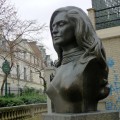
Cross Rampe Colaincourt on the left-hand side and continue straight ahead. On the right, Guy Pitchal (e) is depicted smoking a pipe. As you approach the end of the path, you will find Dalida’s grave (f) on the left. Continue on to the gate and note, on the right, the grave of Théodore Champion (g), adorned with a statue of a mourner.

As the path ends in a cul-de-sac, retrace your steps. Turn right onto Rampe Colaincourt and, when it bends to the right, carry on straight ahead and go down a flight of steps. At the bottom, ignore Chemin Aniot on the right and take a path immediately after it. On the left, a stele adorned with a portrait bearing the inscription “To our dear mother” and, behind it, the tomb of Jules Duprato (h), adorned with a medallion.

Carry on straight ahead, passing under the bridge on Rue Colaincourt and between the graves – seen from the rear – of Henri Rochefort (i), surmounted by his bust, and Eugène Labiche (j). You’ll emerge at a rotunda; note the recumbent statue of Godefroi Cavaignac (k) on the left.

(2) Go round the rotunda on the right and take the first right onto Avenue Dubuisson. Note on the left, adorned with a statue of a young woman (a young fisherwoman from Cancale throwing some flowers), the grave of two brothers, Eugène Feyen (l) and Augustin Feyen-Perrin (m). At the T-junction, opposite the grave of Pierre Waldeck-Rousseau (n), turn left.

(3) At the crossroads, turn left onto Chemin Artot and immediately turn left again to climb a flight of steps. At the top, go straight on, then turn right, passing the Châteauneuf family’s grave on your left and a grave decorated with a basin on your right. Note, on the left, the grave of Désiré-Alexandre Batton (o), adorned with a medallion bearing his effigy.

Shortly afterwards, go down three steps on the left. Then turn right onto a cobbled path and turn right again towards a small obelisk. You will then find, on the right, the imposing tomb of Émile Zola (p), adorned with a bust of him and his wife Alexandrine (q). Then go down the steps leading back to the rotunda seen earlier.

(2) Walk round the rotunda on the right and take the first right, the Avenue de la Croix. Note, on the right, a statue of a naked man evoking Greco-Roman mythology. Cross, on the right-hand side, the Chemin Artot and then the Chemin Troyon. Just after the latter, take the first path on the right. The seventh grave on the left is that of Marshal Koening (r).

With your back to this grave, squeeze through between two graves opposite. You’ll soon come to Chemin Troyon, at the corner of a chapel, and follow it to the left. When the path turns left, at the foot of the Rousset Chapel, carry on straight ahead along a footpath. Further on, opposite a dilapidated chapel, you’ll find the grave of Claire Bretécher (s) and Guy Carcassonne (t) on the left.

You will then emerge onto Avenue Hector Berlioz; follow it to the left. On the left-hand side, just past a chapel, you will find the grave of Jean-Baptiste Greuze (u) and his daughter Anna (v). Shortly afterwards, still on the left, you’ll find the grave of Heinrich Heine (w), whose bust is adorned with a red scarf. On the other side, in the second row, you’ll find the grave of François Truffaut (x) and, nearby, that of Jacques Rivette (y), both very simple.

Retrace your steps and walk past the path you took earlier. You will then immediately find, on the right, the grave of Hector Berlioz (z), before reaching a junction you passed earlier.

(3) Turn left onto Avenue Cordier, at the corner marked by a statue of a weeping woman, and immediately turn right onto Chemin des Israélites. On the left-hand side, a grave is topped by a huge statue of Moses carrying the Tablets of the Law; this is the grave of Daniel Iffla Osiris (aa).

Then turn left and, between two parallel paths, take the one on the left. You will soon come across the tomb of Émile Deutsch de la Meurthe (ab) and, just behind it, that of Camille Sée (ac).

Retrace your steps, return to Avenue Cordier and follow it to the right. On the left, just past a small obelisk, is the grave of Jeanne Moreau (ad). Next, still on the left, is the grave of Gustave Guillaumet (ae), adorned with a sculpture depicting a young woman seated, scattering flower petals onto the artist’s medallion.

Continue along Avenue Cordier and, on the right, you will find the grave of Théophile Gautier (af), recognisable (despite the name being somewhat illegible) by the statue atop it, depicting Calliope, the muse of poetry, holding a palm frond and a lyre.

Shortly afterwards, turn right and climb a flight of steps. Then turn left and climb another flight of steps. At the top, follow Avenue Montebello to the right. Note, on the left, the statue of a wounded soldier on the grave of Mieczysław Kamieński (ag). On the right, a short distance apart, are the chapels where Marshal Lannes (ah) and Édouard Degas (ai) are laid to rest. A few rows further back is the grave of Michael Lonsdale (aj).

Continue along the avenue and head slightly downhill. On the left-hand side, note the graves of Adolphe Adam (ak), Antoine Jars (al) and, further down, Adolphe Sax (am). Turn left along the avenue and note, on the right-hand side, the grave of Léon Foucault (an), adorned with his bust. You will immediately come to a junction. Turn left here onto Avenue Cordier. Note, on the left-hand side, the grave of Mimi Barthélémy (ao), adorned with wrought-ironwork.

(4) Turn right at the corner by the Ronot grave. Climb a flight of steps, then turn left to climb another flight of steps. At the top, go straight ahead and walk round a mausoleum on the left. Continue along a balustrade until you reach the grave of Francis Thomé (ap), whose bust is flanked by two female statues.

Turn right and you will immediately see the grave of Jacqueline Didsbury (aq), adorned with a sculpture of her own design, entitled “Douleur” (Sorrow), in tribute to her son who died at the age of 20. Then turn right and then left at the foot of the mausoleum you saw a short while ago.

Follow a path that curves slightly to the left and, as you continue, note on the right-hand side the graves of the Colaco-Osorio family (medallion), Alexandre Dumas fils (ar), with his recumbent statue, and the Laver-Frantz family, adorned with sphinxes (feminine sphinxes).

You will come to a junction; follow Avenue Sanson to the right and go down a flight of steps. At the bottom, note a slab shaped like a book on the right, followed by the tomb of Joseph Samson (as). Next, still on the right, you will see the tomb of Vaslav Nijinsky (at) in his Petrushka costume, seated on a drum.

At the junction, note the grave of Jacques-Joseph Grancher (au) on the right-hand corner and continue straight ahead. On the left-hand side, you will find the grave of Isabelle Mergault (av). Just behind it are the graves of Paul Puget (aw), on the left, andAnnie Fratellini (ax), on the right.

At the next junction, turn right onto Avenue des Anglais and immediately ignore a path on the left. Note, on the left-hand side, a memorial stone featuring a coloured stained-glass panel. At the end of the avenue, still on the left-hand side, is the grave of Jacques Offenbach (ay) (incorrectly positioned on OSM). The grave of Francisque Poulbot (az) is situated behind it.

Then turn left twice to join Chemin Saint-Nicolas. On the right-hand side, note the grave of Jules Noriac (ba) with its medallion. Cross a cobbled path and continue straight ahead. Still on the right-hand side, and also featuring a medallion, is the grave of Joseph Garnier (bb). Then take the second left onto Chemin Jomini. At the end, you’ll find yourself facing the sculpture of a seated guitarist, which adorns the grave of Fernando Sor (bc).

Then follow a wide avenue to the right, Avenue Travot, and you’ll immediately find the grave of Dick Rivers (bd) on your right. At the junction, carry straight on along Avenue Travot and head slightly uphill. On the right is the grave of Frédéric Chichin (be) and Catherine Ringer (bf).

(5) At the next junction, turn left onto Avenue de Montmorency. Walk past, on the right-hand side, the large statue of a seated naked man, then a huge obelisk above the grave of the Duchess of Montmorency (bg) and, finally, a large mausoleum.

At the corner of the mausoleum, turn right onto Chemin Troyon. Note, on the left-hand side, the statue of Léon Rostan (bh), then, on the right-hand side, the tombs of Gustave Chaudey (bi), followed by those of Jean-Martin (bj) and Jean-Baptiste (bk) Charcot.

At the junction, carry on a little further to find the tomb of Joseph Méry (bl), adorned with a statue of the muse Erato, and the recumbent statue of Alphonse Baudin (bm).

Retrace your steps and turn left onto Chemin Baudin. You will emerge onto Avenue Lacroix, where you will find, opposite, the grave of Paul Codos (bn) and, behind it, those of André-Marie (bo) and Jean-Jacques (bp) Ampère.

Follow the avenue to the right and you will immediately find, on the right, the grave of Jacques Charon (bq). Shortly afterwards, on the left-hand side, is the grave of Stendhal (br). Continue further and note, on the right, the glass-covered grave of Michel Berger (bs) and France Gall (bt). You will soon reach a junction you passed earlier.

(5) Then turn left onto Avenue de Montmorency. Shortly afterwards, on the left, you will find the grave of Henri-Georges (bu) and Véra (bv) Clouzot. Next, on the right, you will find the grave of Edmond (bw) and Jules (bx) de Goncourt.

Cross Chemin Guersant on the left-hand side and you will immediately find, also on the left, the grave of Michel Galabru (by). Then turn left onto Chemin Saint-Charles. Take the first right onto Chemin Muron and you will immediately notice, on the right-hand side in the second row, the grave of Alfred de Vigny (bz).

Cross Chemin de Saint-Éloy on the left, then turn left at the corner by the Scanberti grave. Further on, after two graves hidden beneath the vegetation, you’ll find the very simple grave of Louis Jouvet (ca).

Continue along the path, passing a sculpture depicting a very young child praying at the foot of a bust of a woman. Immediately afterwards, turn left and head slightly downhill. Join Chemin de Saint-Éloy again and follow it to the right. Then go down a flight of steps on the left. Cross a path (Avenue Saint-Charles) and go up the steps opposite.

On the right, set slightly back, you’ll find the graves of Ernest (cb), Nadia (cc) and Lili Boulanger (cd). At the junction immediately ahead, turn right onto Chemin Guersant. At the end, go down a flight of steps and you’ll reach Avenue Principale under the bridge on Rue Colaincourt. Follow the avenue to the left to quickly reach the cemetery exit.

(1) Continue straight on along Avenue Rachel until you reach Boulevard de Clichy. Follow it to the right and, at the traffic lights, turn left to cross the boulevard in two stages. On the other side, turn right and cross a side street off the boulevard. Turn left and you’ll soon reach the Place de Clichy metro station (S/E).

Waypoints

  1. S/E : mi 0 - alt. 203 ft - Place de Clichy
  2. 1 : mi 0.16 - alt. 207 ft - Entrance to Montmartre Cemetery
  3. 2 : mi 0.39 - alt. 213 ft - Rotunda
  4. 3 : mi 0.46 - alt. 213 ft - Crossroads
  5. 4 : mi 1.01 - alt. 197 ft - Staircase
  6. 5 : mi 1.44 - alt. 217 ft - Junction with the Montmorency circular loop
  7. S/E : mi 2.01 - alt. 203 ft - Place de Clichy

Notes

A good pair of trainers is sufficient for this short urban walk.

Inside the cemetery, there are drinking fountains marked on the map and toilets on the left just after the entrance. There are bars and restaurants in the surrounding neighbourhood.

It is recommended that you obtain the map provided by Paris City Hall, which indicates the locations of the graves of several notable figures. Allow around three to four hours for a visit to the cemetery.

Montmartre Cemetery opening hours:
- Opening: weekdays, 8.00 am; Saturdays, 8.30 am; Sundays and public holidays, 9.00 am.
- Closing: from 6 November to 15 March, 5.30 pm; from 16 March to 5 November, 6.00 pm.

Please note that a cemetery is a place of contemplation and that discreet and respectful behaviour is required.

Walk undertaken by the author on 1 October 2026.

Worth a visit

Some facts about the history of Montmartre Cemetery:
The cemetery was established in 1825 on the site of a former burial ground dating from 1798. The bridge over Rue Caulaincourt has spanned it since 1888. Covering an area of 10.5 hectares, it is the third-largest cemetery within the city limits of Paris.

Graves of notable figures (non-exhaustive list):
a – Sacha Guitry (1885–1957) Theatre and film actor, playwright and director, screenwriter and film director.
b – Lucien Guitry (1860–1925) Actor.
c – Pierre-Léonard Laurécisque (1797–1860) Architect, who designed the decoration of his own grave.
d - Charles Baudin (1784–1854) Admiral, who served under the reigns of Napoleon I, Louis-Philippe and Napoleon III but who, being opposed to the Restoration, left the army during the reigns of Louis XVIII and Charles X.
e - Guy Pitchal (1922–1989) Psychoanalyst and endocrinologist.
f – Dalida (1933–1987) Born Iolanda Cristina Gigliotti, pop singer and actress.
g – Théodore Champion (1873–1954) Swiss stamp dealer and cyclist. He was, notably, Swiss champion in 1894. In 1899, he moved to Paris, where he quickly became one of the leading stamp dealers.
h - Jules Duprato (1827–1892) Composer.
i - Henri Rochefort (1931–1913) Journalist, writer, playwright and politician. A Republican and anti-clericalist, he took part in the Paris Commune, for which he was sentenced to nine months’ imprisonment at Fort Boyard, followed by hard labour in Nouméa, from which he managed to escape in March 1874. Towards the end of the 19th century, he became a supporter of Boulangism and joined the ranks of the anti-Dreyfusards.
j – Eugène Labiche (1815–1888) Playwright, elected to the Académie Française in 1880. An iconic figure of the vaudeville genre, he wrote 176 plays, some of which became very famous and were frequently performed, such as *Le voyage de Monsieur Périchon* and *Un chapeau de paille d’Italie*.
k - Godefroi Cavaignac (1800–1845) Journalist and short-story writer. A staunch republican, he took part in the Three Glorious Days of July 1830 and was a fierce opponent of the July Monarchy, which led to his exile in England from 1835 to 1840.
l – Eugène Feyen (1815–1908) Photographer and painter.
m – Augustin Feyen-Perrin (1826–1888) Painter, engraver and illustrator.
n – Pierre Waldeck-Rousseau (1846–1904) Politician and statesman. A staunch Republican, he contributed to legislation on trade unions (the 1884 Act) and on associations (the 1901 Act). Having served as a minister on several occasions, he was Prime Minister from June 1899 to June 1902; his government was thus the longest-serving under the Third Republic. In this capacity, from the very start of his term of office, he initiated the retrial of Alfred Dreyfus.
o – Désiré-Alexandre Batton (1798–1855) Composer.
p - Émile Zola (1840–1902) Writer and journalist. Best known for *Les Rougon-Macquart*, a 20-volume naturalist epic depicting the not always rosy reality of French society under the Second Empire, he is one of the most popular and widely translated novelists in the world. He is also known for his involvement in the Dreyfus Affair and for publishing, in January 1898, the article ‘J’accuse’ in the daily newspaper *L’Aurore*, edited at the time by Georges Clemenceau, which led to him being tried for libel and exiled to London. His ashes were transferred to the Panthéon in 1908.
q – Alexandrine Zola (1839–1925) Wife of Émile Zola. Coming from a very humble background and having been orphaned at a relatively young age, it is likely that she inspired Émile Zola to create certain characters from the working-class people of Paris. She supported all her husband’s political stances and accompanied him during his exile in London. Her ashes were transferred to the Panthéon on 4 June 1908.
r - Pierre Koening (1898–1970) Soldier and politician. Having risen to the rank of general during the Second World War, he was posthumously promoted to Marshal of France. He joined the army in 1917 and is best known for his involvement in the Free French Forces from June 1940 onwards. He was in command during the Battle of Bir Hakeim in May–June 1942, the first victory of the Free French forces. He was appointed military governor of Paris on 21 August 1944. He served as a Member of Parliament for the Bas-Rhin constituency during the 1950s and as a minister for a few months in 1954.
s – Claire Bretécher (1940–2020) Comic book author and illustrator. She contributed to numerous magazines, including *Tintin*, *Spirou*, *Pilote*, *L’Écho des savanes * and *Le Nouvel Observateur*. She created series focusing on social criticism, including *Les Frustrés* and *Aggripine*, which were hugely successful.
t - Guy Carcassonne (1951–2013) A lawyer specialising in constitutional law. He held teaching posts at the Universities of Reims, Paris-Nanterre and Paris-Sorbonne.
u - Jean-Baptiste Greuze (1725–1805) Painter and draughtsman.
v - Anna Greuze (1762–1842) Painter.
w - Heinrich Heine (1797–1856) German writer, poet and journalist, who settled in Paris from 1931 onwards. Opposed to German nationalism, he was close to Marx and Engels.
x - François Truffaut (1932–1984) Filmmaker, a leading figure of the French New Wave. He had a difficult childhood and adolescence and, at the age of 16, was sent to a reformatory for juvenile offenders. He directed 26 films, almost all of which were highly successful, including *The 400 Blows* (1959), *Jules and Jim* (1962), *Day for Night* (1973) and *The Last Metro* (1980). He also wrote an essay on the cinema of Alfred Hitchcock in 1966.
y – Jacques Rivette (1928–2016) Filmmaker, a leading figure of the French New Wave, and film critic, particularly for *Cahiers du Cinéma*, which he edited in the 1960s.
z - Hector Berlioz (1803–1869) Composer and conductor. Although better appreciated during his lifetime for his skills as a conductor, the value and significance of his work were not recognised until around a century later. He composed 124 works, including four symphonies – the most famous being the Symphonie fantastique – and seven operas.
aa – Daniel Iffla Osiris (1825–1907) Financierand patron of the arts. He assisted refugees, widows and orphans during the Franco-Prussian War of 1870 and the Siege of Paris. In 1896, he purchased the Château de la Malmaison (the former country house of Joséphine de Beauharnais) and had it restored and furnished before donating it to the State in 1903. On his death, his fortune was bequeathed to the Pasteur Institute.
ab – Émile Deutsch de la Meurthe. Financier; founder, in 1921, of the Cité Internationale Universitaire de Paris.
ac – Camille Sée (1847–1919) Lawyer and politician. A staunch Republican, he served as a Member of Parliament and later as a member of the Council of State; he was particularly noted for his work in promoting secondary education for girls.
ad - Jeanne Moreau (1928–2017) Actress, singer and film director. Having started out in the theatre, she appeared in around 130 films between 1949 and 2015. She was a key figure of the French New Wave, but her long and prolific career cannot be reduced to that alone.
ae – Gustave Guillaumet (1840–1887) Painter of the so-called Orientalist school.
af – Théophile Gautier (1811–1872) Poet, writer and art critic. A follower of Victor Hugo, he published eight novels, including *Le Capitaine Fracasse*, a large number of short stories and several collections of poetry.
ag - Mieczysław Kamieński (1833–1859) Of Polish origin, he served in the French army during the Crimean War. Seriously wounded at the Battle of Magenta on 4 June 1859, he died of gangrene three months later.
ah – Jean Lannes (1769–1809) A general during the Revolution and the First Empire, he was promoted to the rank of marshal in 1804. He took part in both Italian campaigns, in 1892 and in 1899–1800. In June 1800, he won the battles of Montebello and then Marengo. He took part in the battles of Austerlitz, Jena and Friedland. He was mortally wounded at the Battle of Essling.
ai – Edgar Degas (1834–1917) Painter, engraver and sculptor. Having been part of the Impressionist movement, he is remembered for his depictions of dancers and, in a completely different genre, horse races.
aj – Michael Lonsdale (1931–2020) A theatre and film actor, in which he played a vast number of roles across a wide variety of genres, and a director of Franco-British origin. A committed Catholic, he sponsored several organisations of this faith and recorded a large number of readings on religious themes.
ak - Adolphe Adam (1803–1856) Composer
al – Antoine Jars (1774–1857) Politician. Deputy Mayor of Lyon during the Hundred Days, it was he who presented Napoleon, on his return fromElba, with the keys to the city. He was subsequently elected Mayor of Lyon but was forced to resign during the Restoration and the return of Louis XVIII. He was elected Member of Parliament for the Rhône from the late 1820s to the early 1840s.
am – Adolphe Sax (1814–1894) A Belgian-born maker of musical instruments. Having settled in Paris with his family from 1842 onwards, he is remembered for inventing the saxophone.
an – Léon Foucault (1819–1868) Physicist and astronomer. Best known for his 1851 experiment demonstrating the Earth’s rotation on its axis, using the ‘Foucault pendulum’, he was one of the first, in 1862, to reliably estimate the speed of light.
Aug – Mimi Barthélémy (1939–2013) Haitian writer and storyteller.
ap – Francis Thomé (1850–1909) Pianist and composer.
aq – Jacqueline Didsbury (1910–1995) Sculptor.
ar - Alexandre Dumas fils (1824–1895) Novelist and playwright. He was the illegitimate son of Alexandre Dumas and his neighbour across the landing; he was not recognised by his illustrious father until the age of seven. He is best known for his novel *La Dame aux Camélias*.
as – Joseph Samson (1793–1871) Actor and playwright, a member of the Comédie Française from 1827.
at – Vaslav Nijinsky (1889–1950) Russian ballet dancer and choreographer of Polish origin.
au – Jacques-Joseph Grancher (1843–1907) Paediatrician, director of the Hôpital des Enfants Malades in Paris from 1885 until his death. He was a pioneer in the prevention of childhood tuberculosis. In 1885, he worked alongside Louis Pasteur on the first vaccination against rabies. He subsequently helped to establish the Pasteur Institute.
av - Isabelle Mergault (1958–2026) Comedian, actress, screenwriter, director and playwright.
aw – Paul Puget (1848–1917) Composer.
ax – Annie Fratellini (1932–1997) Clown, actress and player of a wide range of musical instruments. In 1974, together with her husband Pierre Étaix, she founded the École Nationale du Cirque.
ay - Jacques Offenbach (1819–1880) Composer and violinist of Prussian origin who became a naturalised French citizen. He composed several operas, comic operas and operettas, including *La Vie Parisienne*, undoubtedly his best-known and most frequently performed work.
az – Francisque Poulbot (1879–1946) Artist, illustrator and poster designer. He was called up in 1914 but was quickly discharged; during the Great War, he produced numerous patriotic posters and postcards. A prominent figure in Montmartre life, he produced countless portraits of ‘titis parisiens’, his surname having become a common term for these street children.
ba – Jules Noriac (1826–1882) Journalist, playwright and writer. He notably wrote an account of the 1870 siege of Paris.
bb - Joseph Garnier (1813–1881) Economist and politician, a founding member of the Société d’économie politique.
bc - Fernando Sor (1778–1839) Spanish guitarist and composer. In 1813, he left Spain for good to settle in France, having taken France’s side in the war between the two countries.
bd - Dick Rivers (1945–2019) (born Hervé Forneri), rock singer and founder of the band Les Chats Sauvages. He was one of the singers who, in the 1950s and 1960s, introduced and popularised rock ’n’ roll in France.
be - Frédéric Chichin (1954–2007) Guitarist, known as Fred Chichin, co-founder, in 1979, of the band Les Rita Mitsuko.
bf - Catherine Ringer (1957–2026) Singer, songwriter, co-founder of the band Les Rita Mitsuko. Blessed with a wide vocal range, she was also known for her energetic and choreographed stage presence.
bg - Charlotte de Montmorency-Luxembourg (1752–1829) She was a lady-in-waiting to Queen Marie-Antoinette from 1774 to 1792.
bh - Léon Rostan (1790–1866) Doctor and professor at the Paris Faculty of Medicine. In 1848, he took up the cause of the Republic.
bi - Gustave Chaudey (1817–1871) Lawyer, journalist and politician. During the Paris Commune in 1871, he was suspected of being responsible for the shooting on 22 January – a charge that earned him the nickname ‘executioner of the people’ – and was executed by firing squad on 23 May.
bj – Jean-Martin Charcot (1825–1893) Neurologist and professor at the Paris Faculty of Medicine. Discoverer of amyotrophic lateral sclerosis (ALS), which was named after him. He is regarded as a founder of modern neurology and psychopathology.
bk – Jean-Baptiste Charcot (1867–1936) Doctor and polar explorer. An accomplished sportsman, he was French rugby champion in 1886 with the Club Olympique de Paris and won two silver medals in sailing at the 1900 Paris Olympic Games. In the 1900s and 1910s, he undertook numerous expeditions, including the first overwinters in the Arctic. During the 1914–1918 war, he was called up into the navy and commanded a submarine hunter. He resumed his polar expeditions in the 1920s. He was a member of the Academy of Sciences and the Naval Academy. He perished at sea off the coast of Iceland, but his body was recovered and he was given a state funeral.
bl – Joseph Méry (1797–1866) Journalist, novelist, poet and playwright.
bm - Alphonse Baudin (1811–1851) Politician, elected as a Member of Parliament in 1849, killed on a barricade whilst opposing the coup d’état of 2 December 1851 led by Louis-Napoléon Bonaparte, the future Napoleon III.
bn - Paul Codos (1896–1960) Aviator, holder of numerous records, including, in 1929, the record for the longest distance on a closed route (8,027 km covered in 52 hours with two pilots) and, in 1933, the record for the longest distance in a straight-line flight (9,104 km covered in 55 hours with two pilots).
bo - André-Marie Ampère (1775–1836) Mathematician, physicist, chemist and philosopher, member of the Academy of Sciences. He is regarded as one of the pioneers of the mathematisation of physics. His most significant discoveries were in the field of electricity; he was the first to establish the link between electricity and magnetism, and the unit of electric current is named after him. He also made contributions to thermodynamics (Avogadro–Ampère’s law).
bp – Jean-Jacques Ampère (1800–1864) Historian and writer, professor at the Collège de France, who undertook numerous journeys across Europe and the Far East.
bq - Jacques Charon (1920–1975) Actor, member of the Comédie Française, and theatre director.
br - Stendhal (1783–1842) Born Henry Beyle, a writer best known for his novels *The Red and the Black* and *The Charterhouse of Parma*.
bs - Michel Berger (1947–1992) Born Michel Hamburger, singer, pianist, songwriter and musical arranger, who had a major influence on French chanson in the second half of the 20th century.
bt - France Gall (1947–2018) (born Isabelle), a hugely popular singer who won the Eurovision Song Contest in 1965 as Luxembourg’s representative.
bu - Henri-Georges Clouzot (1907–1977) Film director, screenwriter and dialogue writer, particularly renowned for his talent in film noir.
bv - Véra Clouzot (1913–1960) Born Vera Gibson Amado, of Brazilian origin, a theatre and later film actress.
bw - Édmond de Goncourt (1822–1896) Writer and co-founder of the Académie Goncourt, which awards the prize of the same name annually.
bx - Jules de Goncourt (1830–1870) Writer and co-founder of the Académie Goncourt, which awards the prize of the same name annually.
by - Michel Galabru (1922–2016) Film and theatre actor, director and theatre manager. Although often typecast in comic roles, he also successfully took on a number of dramatic roles.
bz – Alfred de Vigny (1797–1863) Writer, poet and playwright, a leading figure of the Romantic movement in France.
ca - Louis Jouvet (1887–1951) Theatre and film actor, director and theatre manager. Regarded as one of the leading actors of the 20th century in France, he helped train many young actors. During the Great War, he enlisted as a volunteer and served as a paramedic and pharmacist until his demobilisation in 1917. During the Second World War, he and his troupe from the Théâtre de l’Athénée left France to avoid having to perform the plays the occupying forces sought to impose on them, and went on tour in Switzerland and America. He appeared in 32 films and a vast number of plays.
cb – Ernest Boulanger (1815–1900) Composer.
cb – Nadia Boulanger (1887–1979) Pianist, organist, choir director, composer, music teacher.
cd - Lili Boulanger (1893–1918) Composer.

Sources: Paris City Hall and Wikipedia.

Other walks in the area

For more walks, use our search engine .

The GPS track and description are the property of this route's author. Please do not copy them without permission.