Green spaces in the east of Paris’s 17th arrondissement

The 17th arrondissement of Paris is distinguished by its great urban and social diversity. The eastern part of the arrondissement combines working-class neighbourhoods with areas undergoing regeneration. Formerly a railway and industrial area, it has undergone significant recent transformation, notably with the Clichy-Batignolles eco-neighbourhood. Martin Luther King Park exemplifies this urban regeneration, designed according to ecological principles. But visitors also appreciate the charm of the Square des Batignolles or the Square des Épinettes, with their typical 19th-century landscape, or the tranquillity of the Square de la Villa Sainte-Croix.

Details

91308189
Creation:
Last update:
Last review:
  • Walking
    Activity: Walking
  • ↔
    Distance: 4.79 mi
  • ◔
    Average duration: 2h 15 
  • ▲
    Difficulty: Easy

  • ⚐
    Back to start: No
  • ↗
    Ascent: + 23 ft
  • ↘
    Descent: - 89 ft

  • ▲
    Highest point: 207 ft
  • ▼
    Lowest point: 112 ft
  • ⚐ Country: France
  • ⚐ City: Paris (75000)
  • ⚑
    Start: N 48.887599° / E 2.32542°
  • ⚑
    End: N 48.888157° / E 2.315192°
  • ❏
    IGN map(s): Ref. 2314OT
  • Hour-by-hour weather

Photos

Description of the walk

Start from La Fourche Metro station – Line 13, Exit 1, “Avenue de Clichy”.

(S) On leaving the metro, cross Avenue de Clichy, head left, and enter Square Ernest Chausson immediately on the right. Walk around it , then return to Avenue de Clichy on the right. Turn right onto Rue Hélène, and enter Square de la Rue Hélène on the right.

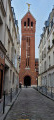
(1) Walk around the square, then continue along Rue Hélène to the right. Turn right onto Rue Lemercier, then right again onto Rue la Condamine. At the end, cross Avenue de Clichy at the pedestrian crossing opposite – there are no traffic lights, so please take care. Head left, then turn right onto Rue Saint Jean. Follow it, passing the bell tower of the Église Saint-Michel des Batignolles on your left, then turn right onto Rue Saint-Michel.

When you reach Avenue de Saint-Ouen, turn left, pass a school complex on your left, turn left, and enter Square du Passage Moncey on your right.

(2) Cross the square, exit onto Rue Dautancourt and turn right. Then turn left onto Rue Davy, right onto Rue Legendre, and left onto Rue du Capitaine Lagache, a pedestrian street whose central reservation features a community garden.

(3) Cross Rue Guy Moquet at the pedestrian crossing and continue straight ahead onto Rue Lacaille, which is also pedestrianised. Cross Rue de la Jonquière, continue straight ahead onto Rue Jean Leclaire, and turn right at the junction with Rue Colette into Square des Épinettes.

(4) Walk all the way round the square and exit where you entered, at the corner of Rue Jean Leclaire and Rue Colette.

(4) Cross Rue Jean Leclaire to the right and continue to the left. Turn right onto Rue de la Jonquière, then right again onto Villa Sainte Croix, passing under a building, and turn right into Square de la Villa Sainte-Croix.

(5) Walk around the square.

(5) On your return, take Villa Sainte Croix on the left, Rue de la Jonquière on the right, and Rue Lantiez on the right. Cross Rue Navier at the pedestrian crossing on the right and arrive at the entrance to Square Jean Leclaire.

(6) Enter the square and exit at the far end of the garden. Cross Rue Jacques Kellner to the left at the pedestrian crossing and continue left. Cut across Rue Lantiez and continue straight ahead along Rue Jacques Kellner. At No. 5, on the long façade of a primary school, you’ll find a beautiful, cheerful and colourful mural.

Cross Boulevard Bessières and the tram tracks to enter Rue de Pont à Mousson opposite, slightly to the left. Cross Rue Fernand Pelloutier on the right and, when the street begins to curve to the left, turn right onto Rue André Brechet. Opposite a mural on the right, turn left into Square Jacques Manavian.

(7) Walk around the square, exiting at the far end, leaving Rue André Bréchet on your left. Continue straight ahead onto Place Arnault Tzanck, which slopes gently downwards, taking the path lined with a row of trees and street furniture on the right and a wide strip of trees and flowers on the left. Keep to the right to continue along Boulevard du Bois le Prêtre. Pass Rue Émile Borel on your right, then Rue Hélène et François Missoffe, and enter the Hans and Sophie Scholl Garden.

(8) Go down a few steps and take the path on the right, running parallel to Rue Hélène et François Missoffe. Pass a small playground and a giant slide on your left. At the end, turn left, following the ring road which runs above the ball courts, then take the first turn left then right to go round a small building, and join Boulevard du Bois le Prêtre. Head left, slightly uphill, until you reach the traffic lights.

(8) Cross the boulevard at the pedestrian crossing and continue straight ahead onto Rue André Putman, signposted further on. Turn right onto the street (Rue Pierre Rebière, unsignposted) to find Passage Rose Valland on the left.

(9) Take this and enter the Jardin Clémence-Annick Burgard.
Cross this tiny garden, exit at the far end on the right, and continue left along Passage Rose Valland. At the end of the passage, cross Boulevard Bessières and the tram tracks to take Rue du Docteur Paul Brousse opposite. Then turn left uphill onto Rue Ernest Roche, which runs alongside a community garden on the right.

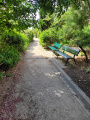
At the end of the street, turn right to cross over the railway tracks of the old Petite Ceinture, and go down the metal staircase on the right to enter the Paul Didier Garden. Follow this narrow, shaded path for about 300 metres, running alongside the disused railway tracks on the right. Pass a first exit on the left, then a kiosk and some table tennis tables. Pass another playground and another exit on the left, and exit at the very end of the garden. Cross Rue de la Jonquière, continue straight ahead along Rue Boulay, and turn left into Square Ernest Gouin.

(10) Take the path immediately on the right, then turn left to go round the playground below. At the end, turn left, then take the exit on the right. Head straight ahead onto Rue Paul Bodin, which features a wide green strip on the right-hand pavement. Cross Avenue de Clichy, continue straight ahead onto Rue Bernard Buffet, and at the junction with Rue René Blum on the left, enter Martin Luther King Park.

(11) Continue straight ahead, keeping to the right (Allée André-François Bron de Bailly). At thefirst junction, go straight on, then take the next small, uphill path on the right. Keep to the left and, at the end of the path, go down the small flight of steps on the right. Turn sharply right, then, at the end of the path, take a wooden footbridge to cross a pond. Then take the stairs, or the lift, to enjoy the view of the park and the distinctive buildings surrounding it.

(12) Go down the other side of the railway tracks and continue towards the New Ministry of Justice, which is clearly visible. At the first junction, ignore an exit on the right and, on the left, a long path that ends in a wide staircase. Continue straight ahead, then turn left into the next path and follow it to the end, taking a few detours along the small woodland paths on the right if you wish.

At the very end of the path, cross a wide path and, with your back to a pétanque court, ignore a small flight of steps leading up to the right and take the narrow, uphill path. Reach the end, climb a flight of steps on the right, and turn left. Cross the railway tracks, leaving a building with a dark façade on your right. After walking a few steps along a wide gravel path with a glimpse of the Sacré-Cœur in the distance to your left, go down a wide flight of steps on the left and follow the small path immediately to the right. At the end of this, cross a pond and turn right onto a wide paved path, then continue straight on to leave the park onto Rue Cardinet.

Cross Rue Cardinet and follow it to the right. Walk past a boules court on the left, and a little further on, turn left into Square de Batignolles. Take the path on the left, walk past a playground, then an exit, and carry straight on. Pass another playground and another exit on the left, then turn right in front of a fountain onto the small Allée Barbara. Cross a waterfall and walk past the bust of the poet Léon Dierx.

At the junction, continue straight ahead, between a book box on the left and a small bridge on the right. Exit the square opposite and take Rue Cardinet to reach the metro on the right, or, on the left, Pont-Cardinet station (E).

SNCF Line L, Metro Line 14, Buses 28, 31, 66, 94, 163

Waypoints

  1. S : mi 0 - alt. 200 ft - La Fourche metro station
  2. 1 : mi 0.2 - alt. 200 ft - Square de la Rue Hélène
  3. 2 : mi 0.68 - alt. 171 ft - Square du Passage Moncey
  4. 3 : mi 0.98 - alt. 138 ft - Rue Lacaille
  5. 4 : mi 1.09 - alt. 138 ft - Square des Épinettes
  6. 5 : mi 1.45 - alt. 135 ft - Square de la Villa Sainte-Croix
  7. 6 : mi 1.84 - alt. 151 ft - Square Jean Leclaire
  8. 7 : mi 2.22 - alt. 148 ft - Jacques Manavian Square
  9. 8 : mi 2.49 - alt. 128 ft - Hans and Sophie Scholl Garden
  10. 9 : mi 2.89 - alt. 115 ft - Clémence-Annick Burgard Garden
  11. 10 : mi 3.41 - alt. 115 ft - Ernest Gouin Square
  12. 11 : mi 3.63 - alt. 121 ft - Martin Luther King Park
  13. 12 : mi 3.91 - alt. 118 ft - Railway lines
  14. E : mi 4.79 - alt. 135 ft - Pont Cardinet Station

Worth a visit

Square Ernest Chausson - 55 avenue de Clichy - Created in 1999 (967 m²) Play area, drinking fountains, book box.
At the entrance, a small gazebo offers a view of the entire garden. To the right, a long central path frames two green spaces, leading to a playground. The square is named in memory of the French composer Ernest Chausson (1855–1899).

(1) Square de la Rue Hélène - 12 Rue Hélène - Created in 1992, modified in 2017 (940 m²). Playground, multi-sports ground, drinking water point, table tennis table.
A square enclosed by high walls, mainly dedicated to play. Its name comes from the owner of the land on which the street was opened in 1837, Mr Hélène.

(2) Square du Passage Moncey – Avenue de Saint-Ouen – 30 Rue Dautancourt – Created in 1996 (880 m²). Small play areas, drinking fountains.
The square connects Rue Dautancourt to Avenue de Saint-Ouen; it consists of a long central path lined with evergreen shrubs. The garden and passage are named after Jeannot de Moncey, Marshal of France (1754–1842).

(4) Square des Épinettes - Rue Colette, Rue Jean Leclaire, Rue Maria Deraismes, Rue Félix Pécault - Created in 1893 (10,420 m²). Play equipment, playground, sandpit, multi-sports pitch, drinking fountains, bandstand, chess set, book box.
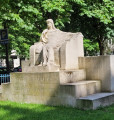
A large square comprising a rectangular area occupied by a multi-sports court, followed by a bandstand and a long, concave lawn. Les Épinettes was a former hamlet whose name may derive from the white spruce from which beer was brewed, or from the Pinot Blanc grapes that once grew on these lands. It features a statue of Jean Leclaire (1801–1872), an entrepreneur, and Maria Deraismes (1828–1894), a feminist writer.

(5) Square de la Villa Sainte Croix - Impasse Villa Sainte Croix – Rue de la Jonquière - Created in 1995 (3,370 m²). Playground, drinking fountains, book box.
Stretching out in a long, narrow shape, this is a peaceful square, set apart from the hustle and bustle of the street, with an original layout. It features two separate play areas, one of which faces a waterfall and a pond. At the far end of the garden, a grassy terrace invites visitors to relax. It is named after the street that runs alongside it, a reminder of the former Red Cross dispensary that once stood on this site.

(6) Square Jean Leclaire -44ter Rue Lantiez – 22 bis Rue Jean Leclaire, Rue Navier, Rue Jacques Kellner - Created in 1940 (3,750 m²). Playground, multi-sports ground, table tennis table, drinking fountain, book box.
This long, narrow garden was laid out on a slab covering the Petite Ceinture railway line. It pays tribute to Jean Leclaire (1801–1872), a statue of whom stands in the nearby Square des Épinettes. This building painter and contractor was one of the first French employers to involve his workers in the profits of his business.

(7) Square Jacques Manavian - 22 Rue André Brechet, 38 Rue Pouchet - Created in 2009 (2,200 m²). Play areas, drinking fountains.
Created during the redevelopment of Porte Pouchet, this long, narrow square is situated between Rue Bréchet and a football pitch. It has a playground at each end and benches made from beams. The square is named after a boxing champion, Jacques Manavian (1928–2020), who was notably president of the Club Sportif Épinettes-Batignolles.

(8) Hans and Sophie Scholl Garden – Porte Pouchet, 12 Boulevard du Bois Leprêtre – Created in 2019 (10,000 m²). Playground, drinking fountains.
Created as part of the redevelopment of Porte Pouchet, this garden is a vast green corridor between Paris, Clichy and Saint-Ouen. An open space, it features large lawns and original play areas. Ball game pitches have been laid out beneath the ring road. It is named after Hans Scholl and Sophie Scholl, brother and sister, members of the White Rose network of the German Resistance against Nazism, who were executed in 1943.

(9) Clémence-Annick Burgard Garden - 49 Rue Pierre Rebiere - Created in 2015 (800 m²). Drinking water point.
The garden stretches along both sides of the Rose Valland walkway, with a small play area on the left and a green strip on the right. It pays tribute to the French resistance fighter Clémence-Annick Burgard (1923–2019).

Paul Didier Garden - 12 Rue Du Colonel Manhes - Created in 2005, extended in 2011 (2,400 m²). Play area, drinking fountains, table tennis tables, chess boards, community garden, compost bins, toilets.
Stretching out in a long, narrow strip, it consists of a long, narrow path running alongside the old railway line from the former Goüin factories (a railway equipment company founded in 1846 by Émile Goüin) to the Petite Ceinture. Named in memory of Paul Didier (1889–1961), a magistrate and member of the Resistance.

(10) Square Ernest Goüin - 19 Rue Émile Level - Created in 1935 (4,355 m²). Playground, climbing frames, multi-sports ground.
This shaded garden, refurbished in 1984, adjoins the sunbathing area of the Bernard-Lafay swimming pool. It comprises two levels: a wide, quiet path lined with benches overlooks a large playground. In 1846, the site of the square was home to a railway equipment manufacturing company. It pays tribute to the industrialist Ernest-Alexandre Goüin (1815–1885), a builder of locomotives and railway infrastructure.

Clichy-Batignolles Park – Martin Luther King – 147 Rue Cardinet – Created between 2007 and 2021 (10 ha). Fitness equipment, multi-sports pitches, skate park, play areas, boules courts, drinking fountains.
The park was developed on the former site of Batignolles station, which was used to transport goods to Les Halles in Paris. The tracks and clock tower bear witness to the site’s railway activity, which ceased with the creation of Rungis market. Each path leads us to a different space and atmosphere. A place for leisure and relaxation, it was designed according to ecological principles promoting biodiversity and sustainable water management, featuring gardens, lawns, ponds, playgrounds and sports fields. A viewing platform offers a vista over the entire park and the modern buildings of the surrounding eco-neighbourhood. In the distance, the new Palais de Justice dominates the scene. The park pays tribute to the American pastor Martin Luther King (1929–1968), winner of the 1964 Nobel Peace Prize, who fought his entire life against racial prejudice in the United States.

Square Des Batignolles - 144 Bis Rue Cardinet - Created in 1862 (16,615 m²). Playground, drinking fountains, boules court, table tennis tables, chess tables, book box.
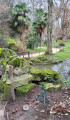
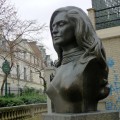
The square was designed by Adolphe Alphand when the village of Batignolles was incorporated into Paris in 1860. He created a landscaped area around a small stream, imitating a natural landscape: a grotto, a waterfall, undulating and steep terrain – all of it artificial. The vegetation comes from all over the world, including a giant sequoia, situated at the highest point of the site. Here you can see the strange sculpture "Les Vautours" (1930) and a bust of the poet Léon Dierx (1838–1912). The central path, named Allée Barbara, pays tribute to the artist Barbara (1930–1997), who mentions the square in one of her songs.

Other walks in the area

For more walks, use our search engine .

The GPS track and description are the property of this route's author. Please do not copy them without permission.