This walk is based on an outing organised by the ‘Les Cafés Géographiques’ association – as such, I would like to express my heartfelt thanks to Sylvie Gazannois, a tour guide, who did such a wonderful job of bringing these places and their history to life.
Walkers can access all the sources used by clicking on the web links (shown in blue on the website and the “Visorando” app): I would like to thank the organisations and their contributors, who are the sources of the content for this “discovery trail”
Haussmann’s Paris
Baron Haussmann transformed Paris between 1852 and 1870. The 9th arrondissement of Paris is at the heart of this transformation.
This wave of change lasted for a century, shaping Paris and other European cities.
In terms of urban planning, this is reflected in wide avenues, boulevards, large squares and crossroads… (History and Geography website of the Bordeaux Academy).
The Place de l’Europe, which dates from 1823, is a fine example of a star-shaped square.
The buildings from the Haussmann era were constructed between 1868 and 1872.
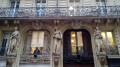
Their façades are clad in cut stone. The flats and apartments are spread over seven storeys, including the ground floor and the attic. A social hierarchy is established within the same building. The ground floor and mezzanine (storeys 1 and 2) are modest in both social and architectural terms. The first floor (level 3) is the main floor, the most elaborately finished, with large flats. The second and third floors (levels 4 and 5) are more conventional. The fourth floor is more modest. The top floor serves as attic space or staff accommodation.
The balconies on the first and fourth floors are one of the most striking features of Haussmann-style buildings. They are generally ‘continuous’, meaning they run from one end of the building to the other. All these specifications mean that, in some cases, these balconies form a continuous line along the street.
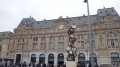
Saint-Lazare station
Saint-Lazare and the stations that preceded it.
The interior, with its glass roofs and stained-glass windows dating from 1930.
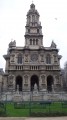
The Church of the Holy Trinity
Situated on the edge of two rapidly developing neighbourhoods – Saint-Lazare and the ‘New Athens’ – the parish had, as early as 1860, been in need of a place of worship suited to the changing demographics. It was in 1867 that Hausmann solemnly handed over this church to Monsignor Darboy.
Pictured: the south façade facing Square Étienne d’Orves. The somewhat eclectic style of the Church of the Holy Trinity is typical of the Second Empire. Some railway station façades built during this period have a similar appearance… The three statues in the foreground depict the Trinity.
Mogador district
Mogador: a reminder of the Franco-Moroccan War.
At 25 Rue de Mogador, the Théâtre
At number 20: a superb investment property
Boulevard Haussmann: the department stores
The dome of Galeries Lafayette
Spring
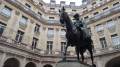
The Square de l’Opéra Louis Jouvet, then Place Edouard VII and Rue Edouard VII
Pegasus and the poet
Place Édouard VII is at the heart of a city block.
Its current appearance is the result of a major urban planning and property development programme initiated in 1911 by a property company and carried out by the architect Nénot.
This block is designed and perceived as a single entity, with its shops, offices, grand hotel and small theatre. It was opened up to the rest of the neighbourhood through the creation of Rue, Place and Passage Edouard VII.
Note: the fluted pillars are topped with Corinthian capitals; they extend over two storeys, thereby lending the façade a colossal grandeur. Beneath the windows, which feature balustrades, bas-reliefs depict the arts.
Boulevard des Capucines
At 1 Rue Scribe: the Hôtel Scribe, featuring a memento of the Lumière brothers.
Opposite, at No. 35 Boulevard des Capucines, a building with a beautiful red glass roof, a remnant of the studio built by Nadar (the famous photographer).
On the corner of Rue Scribe and Boulevard des Capucines: the former ‘Old England’ shop, which closed in 2012.
At No. 27 Boulevard des Capucines, a green building with glass canopies: La Samaritaine de Luxe is a fine example of Art Nouveau architecture
At 12 Boulevard des Capucines: Le Grand Hôtel
Opera district
The Opéra Garnier
Description of the façade
Another source
At No. 8 Boulevard des Capucines: two plaques on either side of the wooden door mark the former Paris headquarters of Gresham Life Assurance Limited. Later, Offenbach lived there from 1876, composed *The Tales of Hoffmann* there, and died there in 1880.
At No. 2, Boulevard des Capucines, the Gaumont Opéra
Boulevard des Italiens area
No. 5–7 Rue des Italiens is a post-Haussmannian-style building. It was built in 1911 by the architect Jean-Jacques Fernier. Its façade features a monumental clock. It was formerly the headquarters of the newspaper *Le Temps* between 1861 and 1942, and then that of the newspaper *Le Monde* from 1944 to 1989.
Since 1999, it has been occupied by the financial division of the Paris Regional Court.
No. 17–23, Boulevard des Italiens: Crédit Lyonnais
Opposite No. 15 Boulevard des Italiens: a visual vista towards the Basilica of the Sacré-Cœur in Montmartre and Notre-Dame de Lorette (see photo)
These visual corridors breathe life into the built environment; they allow the eye to connect neighbourhoods with the city’s symbolic landmarks. They reinforce residents’ sense of identity in outlying neighbourhoods, linked to their sense of belonging to the city.
For this reason, they are incorporated into development plans and subject to town planning restrictions.
Whilst this visual axis is almost hidden away, Hausmann’s street openings have created numerous such views towards Paris’s iconic monuments.
At 1 Place Boieldieu, the Opéra-Comique.
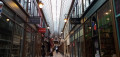
At No. 5 Boulevard des Italiens lies the Passage des Princes,
Covered passages predate the Haussmann era.
The Passage des Princes, dating from 1860, is one of the last passages to have been built. As such, it is rather plain compared to older passages.
This passage connects the Boulevard des Italiens to Rue Richelieu at a right angle.



 Country:
 City:
City:




 !
!
 Visorando Member