A visit to Saint-Vincent Cemetery

A very short walk offering the chance to visit the small cemetery of Saint-Vincent, which is perched on the hill of Montmartre, near its vineyard, and which is the final resting place of several famous figures from Montmartre’s history.

Details

97664129
Creation:
Last update:
Last review:
  • Walking
    Activity: Walking
  • ↔
    Distance: 0.40 mi
  • ◔
    Average duration: 0h 15 
  • ▲
    Difficulty: Easy

  • ⚐
    Back to start: Yes
  • ↗
    Ascent: + 69 ft
  • ↘
    Descent: - 69 ft

  • ▲
    Highest point: 338 ft
  • ▼
    Lowest point: 269 ft
  • ⚐ Country: France
  • ⚐ City: Paris (75000)
  • ⚑
    Start/End: N 48.889867° / E 2.338691°
  • ❏
    IGN map(s): Ref. 2314OT
  • Hour-by-hour weather

Photos

Description of the walk

Start from Lamarck-Caulincourt metro station (line 12). Take the only exit onto Rue Lamarck.

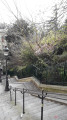
(S/E) Upon exiting the metro station, turn round and climb the stairs. At the top, cross Rue Colaincourt at the traffic lights, then turn left into Rue Lucien Gaulard. This will take you to the cemetery entrance.

The route within the cemetery is a guide only and there are various alternative routes. In the description below, the names appearing on the graves may be highlighted for three different reasons:
1) Graves of notable figures, in which case a lower-case letter in brackets refers to a short entry in the ‘Places to see’ section, where the names are listed in the order in which they appear on the route.
2) Particularly original monuments.
3) Useful landmarks within the cemetery.

(1) Enter the cemetery and turn immediately right, at the corner of the Heinz grave. Then turn left then right. Then turn left down a path running alongside the wall and note Marcel Legay’s grave (a) on the right. Shortly afterwards, climb a flight of steps on the left and reach a junction where a small column stands. Turn right here and note Annouck Aimé’s grave (b) on the right-hand side.

(2) At the T-junction, where Jacqueline Cazalières’s grave (c) is located, turn right to see Adolphe Chatelier’s grave, topped with decorative stones and a cross. Retrace your steps.

(2) Continue straight ahead and note, on the right-hand side, the grave of Paul Aumonier (d), covered in ivy, followed by that of Maman Perdon (e).

(3) At the next T-junction, turn right. Note, on the left, the grave of Paul Fichter, known as Stello (f), followed by that of Alexandre Dumez (g). Then turn right and you’ll reach a shaded grave with a headstone shaped like a menhir. Retrace your steps.

(3) Walk a little further and turn right at the foot of a fountain. Pass the grave of Jacques Edme Bazin (h) on your left.

(4) At the next junction, climb a small flight of steps on the right. At the top, turn right then left. Take the second path on the left and walk past the grave of Xavier Schoellkopf (i). At the end, turn right twice to see the Bizières grave, adorned with a bronze sculpture depicting two busts, one male and one female, and the Prat grave, adorned with a medallion.

Retrace your steps and, at the previous junction, go straight on and down a flight of steps. At the bottom is the grave of Maurice Utrillo (j) and his wife, Lucie Valore (k). Then turn left, noting the grave of Claude Pinoteau (l) on the left, and return to a junction you passed earlier, at the foot of the small flight of steps.

(4) Then turn right and walk down a shaded path. On the right-hand side, note the graves of Roland Dorgelès (m) and then the Debray family (n).

(5) At the junction, turn right. Note, on the right-hand side, the graves of Claude Charpentier (o) and his son Jean-Marie Charpentier (p). At the end, turn left and head downhill. At the bottom, note the grave of Georges Guignard (q) and turn left onto a tarmac path. Pass the graves of Marcel Carné (r) and Paul Sédir (s) on your right.

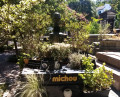
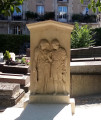
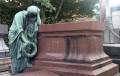
At the junction, note the grave of Pierre Joseph Bussoz (t), topped by an angel. Then turn left and head back up the slope. On the left, you’ll find the Defradas grave, adorned with a bas-relief, followed by the grave of Marcel Aymé (u). At the junction shortly afterwards, turn right and follow a shaded path. At the next junction, look out for Michou’s grave (v) on the left, which is a touch extravagant.

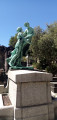
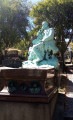
Then turn right and head back down. At the bottom, look out for Harry Baur’s grave (w) on the right. Turn left and follow the tarmac path to the cemetery exit. As you pass, look out for, on the left-hand side, the grave of René Dumesnil (x), adorned with a sculpture depicting a couple; the much simpler grave of Arthur Honneger (y); and finally that of Cândido de Faria (z), also adorned with a sculpture.

(1) On leaving the cemetery, walk back down Rue Lucien Gaulard, cross Rue Caulincourt at the traffic lights, and go down the steps to quickly reach the Lamarck-Caulincourt metro station (S/E).

Waypoints

  1. S/E : mi 0 - alt. 269 ft - Lamarck-Caulincourt metro station
  2. 1 : mi 0.05 - alt. 299 ft - Entrance to Saint-Vincent Cemetery
  3. 2 : mi 0.11 - alt. 328 ft - T-junction
  4. 3 : mi 0.13 - alt. 331 ft - T-junction
  5. 4 : mi 0.17 - alt. 328 ft - Crossroads
  6. 5 : mi 0.25 - alt. 315 ft - Crossroads
  7. S/E : mi 0.4 - alt. 269 ft - Lamarck-Caulincourt metro station

Notes

A good pair of trainers is sufficient for this short urban walk.

Inside the cemetery, there are drinking fountains marked on the map and toilets straight ahead shortly after the entrance, on the left. There are numerous bars and restaurants in the surrounding neighbourhood.

A detailed map is useful (at the very least, the one accompanying this description). It is recommended that you obtain the map provided by Paris City Hall, which indicates the locations of the graves of several notable figures.

Opening hours for Saint-Vincent Cemetery:
- Opening: weekdays, 8.00 am; Saturdays, 8.30 am; Sundays and public holidays, 9.00 am.
- Closing: from 6 November to 15 March, 5.30 pm; from 16 March to 5 November, 6.00 pm.

Please note that a cemetery is a place of contemplation and that discreet and respectful behaviour is required.

Walk undertaken by the author on 4 July 2026.

Worth a visit

Some facts about the history of Saint-Vincent Cemetery:
The cemetery was opened in 1831. It is the final resting place of several prominent figures from Montmartre.

Graves of notable figures (non-exhaustive list):
a – Marcel Legay (1851–1915) Chansonnier.
b – Annouck Aimé (1932–2024) Actress, one of the icons of the New Wave in the 1950s.
c – Jacqueline Cazalières (1913–1988) Painter.
d – Paul Aumonier (1872–1944) Opera singer.
e - Maman Perdon (1872–1954) Senior nurse, serving on the front line during the wars of 1914–1918 and 1939–1940 (born Jeanne Lepailleur).
f - Stello (1882–1945) Singer at the Lapin Agile.
g - Alexandre Dumez (1864–1932) Engineer specialising in reinforced concrete, founder of the company that bears his name.
h - Jacques Edme Bazin (1762–1833) Former mayor of Montmartre, founder of the Saint-Vincent cemetery.
i - Xavier Schoellkopf (1869–1911) An iconic Art Nouveau architect.
j - Maurice Utrillo (1883–1955) Painter born in Montmartre, son of the painter Suzanne Valadon.
k - Lucie Valore (1878–1965) Painter and writer.
l - Claude Pinoteau (1925–2012) Film director and screenwriter.
m - Roland Dorgelès (1885–1973) Journalist and writer. He served in the First World War (1914–1918) and is best known as the author of the biographical work *Les croix de bois*.
n – The Debray family, a family of millers at the Moulin de la Galette.
o - Claude Charpentier (1909–1995) Architect and town planner. In the aftermath of the Second World War, he contributed to the reconstruction of several towns, including Metz, Belfort and various towns in the Ardennes.
p – Jean-Marie Charpentier (1939–2010) He was responsible for numerous major buildings in France and China, notably in Shanghai.
q - Georges Guignard (1861–1935) Painter.
r - Marcel Carné (1906–1996) Film director and screenwriter, who collaborated extensively with the poet Jacques Prévert.
s - Paul Sédir (1871–1926) Philosopher and esotericist.
t - Pierre Joseph Bussoz (1872–1958) Inventor of a device similar to a jukebox.
u - Marcel Aymé (1902–1967) Writer and playwright.
v - Michou (1931–2020) Cabaret manager.
w - Harry Baur (1880–1943) A very famous actor during the interwar period. He was arrested in Paris in May 1942 and tortured on several occasions by the Gestapo. Released in September, he died in April as a result of the trauma.
x - René Dumesnil (1879–1967) Literary and music critic, musicographer.
y - Arthur Honegger (1892–1955) A Swiss composer who lived mainly in France.
z - Cândido de Faria (1849–1911) Brazilian caricaturist, poster artist and painter who settled in France from 1882 onwards.

Sources: Paris City Hall and Wikipedia.

Other walks in the area

For more walks, use our search engine .

The GPS track and description are the property of this route's author. Please do not copy them without permission.