On the Ardents trails

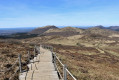
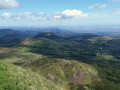
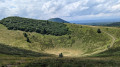
For hot summer days, this route is almost exclusively in the forest, at the foot of the volcanoes, following in the footsteps of the heroes of the Auvergne Resistance. A few crossings of meadows will offer you beautiful views of the Puy de Dôme.

Details

1245004
Creation:
Last update:
Last review:
  • Walking
    Activity: Walking
  • ↔
    Distance: 15.05 km
  • ◔
    Average duration: 5h 05 
  • ▲
    Difficulty: Moderate

  • ⚐
    Back to start: Yes
  • ↗
    Ascent: + 272 m
  • ↘
    Descent: - 269 m

  • ▲
    Highest point: 1,087 m
  • ▼
    Lowest point: 923 m

Description of the walk

Park at Col de Ceyssat, in the car park or on the side of the D68 road.

(S/E) Take the road eastwards for a few metres and, in front of the Gros Manaux inn, climb the steps on the right. At the top, note the stele to the Glory of the Ardents of Auvergne on the right. A few metres further on, you will see the yellow "Col de Cessat" signpost. Follow the signs for Vulcania, keeping to the left and following the yellow markings, as well as the red and white markings ofthe GR®®4/441. At a fork in the road shortly afterwards, continue in the direction of Vulcania.

(1) Further on, at the yellow signs indicating the directions to Vulcania and Col de Cessat, turn left, ignoring these directions and leaving the GR®® markings. Shortly afterwards, at the pink dots on a tree, ignore a cluttered pseudo-path and, a hundred metres further on, ignore a path on the right and then another pseudo-path on the right at an old rusty, leaning sign (not visible on the map).

(2) At an intersection with more pink dots on a tree a few metres ahead, take a clear path on the right. Further on, you will reach the edge of a meadow and, just after that, you will arrive at the Bac de Montmeyre site, with a fountain and a series of stone drinking troughs, at the "Bac de Montmeyre" signpost.

(3) Following the direction of Bac de Cessat, ignore the path on the left, note the information panel on Les Ardents and continue towards the memorial to the three resistance fighters murdered at this spot. Continue straight ahead to arrive shortly afterwards at a crossroads with an information panel on the left about "Les deux Puys de Dôme" (The two Puys de Dôme), which explains the formation of the volcano. Continue straight ahead. Further on, cross a poorly maintained path (only the right-hand side of which is shown on the map). At a smallPR®® sign on the right, ignore the two paths on the left and turn right to reach the Bac de Ceyssat, a series of stone drinking troughs with a small, simple memorial topped with an iron cross.

(4) Just after the drinking troughs, ignore the path that continues straight ahead and turn left, then immediately turn right, ignoring the path that continues straight ahead. Further on, ignore a cluttered path on the right, then a path on the left. Then cross a path, only the right-hand side of which is shown on the map.

(5) At the intersection with a path on the right, follow it for a few metres, then turn left at a green and white cross on a tree. Further on, ignore a path that branches off to the right and continue until you reach a road.

(6) Continue straight ahead. Cross a path and then, just after, at the four paths, turn left and, at the next crossroads of four paths, turn right (none of these paths are shown on the map). You will arrive at a road at the "Puy de Côme" signpost and find an information panel about the solidified lava flow of the Puy de Côme. Follow the road to the right, then when it starts to curve to the right, take a path to the left.

(7) Further on, you will come to a wide path. Follow it to the right along the Prés de Côme, which are summer pastures. At the next intersection, leave the path and take the path on the right, between the meadows. Enter the forest again and you will come to an area covered with horsetails (a type of small, dark green bamboo). Ignore the path on the right.

(8) At the "Chabanne Vieille" signpost, you will find theGR®® markings, which you will now follow until the end. Follow them straight ahead, in the direction of the Col de Ceyssat. At the next intersection, find the "Pied du Puy de Côme" signpost and continue on theGR®® to the right, still towards the Col de Ceyssat. Further on, you will see a sign inviting you to leave the path and take a trail that runs along a fence on the right. As this trail was very overgrown when we passed, we continued a few metres further along the path.

(9) However, shortly afterwards, at the end of the "detour", ignore a path on the right and leave the path that continues straight ahead into the meadow, turning onto a path on the left at the "1026m" signpost, still following theGR®®. Further on, you will come to a sign for mountain bikes saying "Attention clôture" (Beware of fence) and come out onto a clearing. Follow the path on the left and you will soon come to some yellow signs.

(10) Continue to the left, towards the Col de Ceyssat. Further on, at another set of yellow signs, continue straight ahead, still towards the Col de Ceyssat. You will come to a yellow marker covered withGR®® and other markings, at the junction between theGR®®4and 441.

(11) Follow theGR®®4to the right, still heading towards Col de Ceyssat. Cross this meadow, which offers a superb view of the Puy de Dôme. At the next intersection, at the yellow signs, continue straight ahead, still towards Col de Ceyssat. Further on, you will come to a crossroads that you already passed on the way there (yellow signs).

(1) Continue straight ahead along the same path as on the way there to return to Col de Ceyssat (S/E).

Waypoints

  1. S/E : km 0 - alt. 1,064 m - Le col de Ceyssat
  2. 1 : km 1.56 - alt. 1,055 m - Start of the circular loop
  3. 2 : km 2.38 - alt. 1,015 m - Path on the right
  4. 3 : km 3.47 - alt. 945 m - Right towards Bac de Cessat - Bac de Montmeyre
  5. 4 : km 5.08 - alt. 928 m - Turn left then right. - Bacs de Ceyssat
  6. 5 : km 6.21 - alt. 957 m - Right then left - Puy de Côme
  7. 6 : km 7.25 - alt. 954 m - Path opposite
  8. 7 : km 8.16 - alt. 929 m - Path on the right
  9. 8 : km 9.36 - alt. 1,007 m - GR, straight ahead
  10. 9 : km 10.29 - alt. 1,029 m - Path on the left - Le Grand Suchet
  11. 10 : km 11.08 - alt. 1,037 m - Path on the left
  12. 11 : km 12.05 - alt. 1,072 m - Path on the right
  13. S/E : km 15.05 - alt. 1,065 m - Le col de Ceyssat

Notes

This is a moderately difficult hike, requiring standard hiking equipment.

A map and some basic navigation skills, or possibly the Visorando app, will be useful between (1) and (3) and between (4) and (6) as there are no markings and some of the trails, which are more or less indistinct, do not appear on the map.

You will see a lot of people at the start of this hike, but most hikers climb the Puy de Dôme, some go around it, and from (1) onwards, you will have much more peace and quiet!

Worth a visit

Discover more hikes in this area with a description or the Visorando app in Puy-de-Dôme here

The Ardents National Resistance Movement was created in Clermont-Ferrand in 1940 by Roger Lazard, alias General François, under the patronage of General Gabriel Cochet, who launched the first call to the metropolitan Resistance on 6 September 1940.

Immediately after the defeat of 1940, Gabriel Cochet reacted vigorously and formed his own network: the "Cochet" network, with other military personnel such as Dufrénois, Robert Gaujour and even his brother Léopold and his sisters Marianne and Christiane. It was under these circumstances that he met General Lazard, and together they laid the foundations for the "Les Ardents" resistance movement. After two arrests in France, Gabriel Cochet moved to London and became Chief of Staff of the Free French Forces in London (1943), then head of the secret service in Algiers.
Appointed military delegate of the Provisional Government for the Southern theatre of operations and commander of the French Forces in the Southern zone (1944), he ensured, in cooperation with General Alexander Patch's headquarters, the landing on the French Riviera. Gabriel Cochet was one of the very first French resistance fighters, one of the great leaders of the "army of revenge" and one of the pioneers of post-resistance action.

The Ardents adopted the stake of Joan of Arc as their symbol, an inverted T that stigmatised resistance to oppression.

Returning to Auvergne, the regional leader was Charles Rauzier, a lawyer whose office housed the regional headquarters. In hiding, he was known by the pseudonym Commandant Tranchet. He was assisted by Jean-Baptiste Michel, alias Lamaire. The Ardents had no political allegiance. They carried out various actions, organising strike teams for intelligence gathering, forging documents, sabotage, sheltering wanted persons, etc. They came from all walks of life and were active in the administration, the police, the gendarmerie, the army, the tramways, the university, the post office, the railways, the fire brigade, the judiciary, public works, etc. The Auvergne group mourns the loss of some forty fighters who died for France.

The Ardents maquis at Bacs de Montmeyre. This maquis was initially intended to serve as a place of retreat but also for the military training of members of the Corps-franc. However, with the introduction of compulsory labour in February 1943, it was also necessary to find a refuge for those who refused to comply, many of whom joined the active resistance. So, it was at this time that the group bought a woodcutter's plot with financial contributions from everyone. Under the guise of forestry operations, paths were opened up, including those you are hiking on today, and barracks were built with the help of the local population to house around forty men.

After several incidents, 2 September 1943 marked the end of this maquis. The Nazis had discovered the role played by these "lumberjacks" and stormed the camp without warning, opening fire on the unarmed men at lunchtime. While a few men managed to escape, Marcel, the Parisian and Bob were killed. They were in their twenties and are commemorated on the Bacs de Montmeyre memorial. There were wounded and prisoners. Some were deported and two of them survived the death camps. Another memorial was erected in honour of the Ardents at the Col de Ceyssat, the starting point of this hike, in October 1948.

Gentian flowers in June, lots of raspberry bushes.

Always be cautious and plan ahead when you're outdoors. Visorando and the author of this route cannot be held responsible for any accidents occurring on this route.

The GR® and PR® markings are the intellectual property of the Fédération Française de Randonnée Pédestre.

Reviews and comments

4.6 / 5
Based on 5 reviews

Reliability of the description
4.8 / 5
Ease of following the route
4.6 / 5
Route interest
4.4 / 5
User 12387534
• Edited:

Overall rating : 4.3 / 5

Date of your route : Jun 28, 2025
Reliability of the description : ★★★★★ Very good
Ease of following the route : ★★★★☆ Good
Route interest : ★★★★☆ Good
Very busy route : Yes

On this very hot day (35°C in Clermont-Ferrand), this largely shaded hike was very welcome. Despite being in the woods, you can occasionally see the surrounding peaks.
At this time of year, you can also see martagon lilies, purple foxgloves, bellflowers, yellow gentians and hear a multitude of birdsong.

Machine-translated

User 10513366

Overall rating : 4.3 / 5

Date of your route : Jun 29, 2025
Reliability of the description : ★★★★☆ Good
Ease of following the route : ★★★★☆ Good
Route interest : ★★★★★ Very good
Very busy route : No

A very beautiful hike on a very hot day. The route is very shaded, but still offers views of the surrounding volcanoes (Les Goules, Le Knoll, Le Cliersou and finally Le Puy de Dôme).
The map is very useful.
At the end of June, there are lots of martagon lilies.
Don't overlook the historical aspect.
Probably worth doing again in autumn.
Thank you.

Machine-translated

annieben
annieben

Overall rating : 4.7 / 5

Date of your route : Jun 17, 2023
Reliability of the description : ★★★★★ Very good
Ease of following the route : ★★★★★ Very good
Route interest : ★★★★☆ Good
Very busy route : No

A very good route with little elevation gain.
It is mostly under trees and recommended in summer. Some beautiful "charbonnières" (charcoal kilns) have been restored.
The start at the memorial is interesting, serving as a reminder of the sacrifice made by young people for our freedom.
Easy and enjoyable.

Machine-translated

Jacqueline B
Jacqueline B

Overall rating : 5 / 5

Date of your route : Apr 24, 2023
Reliability of the description : ★★★★★ Very good
Ease of following the route : ★★★★★ Very good
Route interest : ★★★★★ Very good
Very busy route : No

Lovely walk to do again in summer, lots of undergrowth

Machine-translated

Dalla Zanna Maryse
Dalla Zanna Maryse

Overall rating : 4.7 / 5

Date of your route : Oct 21, 2019
Reliability of the description : ★★★★★ Very good
Ease of following the route : ★★★★★ Very good
Route interest : ★★★★☆ Good

A pleasant hike to do again in hot weather as most of it is in the woods. In 9, after marker 1026, there is a sign warning of fences for mountain bikes, which is quite far away as there are other signs before it that should be ignored.

Machine-translated

Other walks in the area

For more walks, use our search engine .

The GPS track and description are the property of this route's author. Please do not copy them without permission.