Country:

 City:
City:


Start: Berglusthaus, 79283 Bollschweil – St. Ulrich
Access route: Freiburg – Merzhausen – Au – Sölden – St. Ulrich
Signposting for the St. Ulrich Circular Trail:
The sign features the coat of arms of St. Ulrich: it depicts St. Ulrich in a black monk’s robe on a green background, with his right hand raised in blessing and a silver (white) cross in his left. In addition, the yellow diamond of the Black Forest Association is positioned towards the signpost.
(S/E) The circular route first runs from the ‘Berglusthaus’ signpost (831 m) along the tarmac road towards the ‘Eckewitti’ (860 m) and ‘Parkplatz Gerstenhalm’ (850 m) signposts.
The first property on the left (house no. 25) is known as ‘s ́Große’ and belongs to the Roland Steiert family. In a deed of transfer from 1871, it is first described as a single-storey dwelling with a stable and a timber-beamed cellar, as well as a small farm. In 1995, following the sale of the last cows, farming operations ceased. The dwelling now houses a holiday flat. The floral displays and the cottage garden at the fork in the path are particularly lovely.
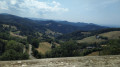
The St. Ulrich Circular Trail continues along the tarmac road, offering magnificent views to the west over the Black Forest ridge and the Vosges.
The old name ‘Äckerleweg’ on the sign by the fence refers to the field ‘Vogtsäckerle’, but also suggests that there used to be arable land here instead of the current grassland.
(1) Behind the signpost “Am Geißenfelsen” (855 m), from which the lower panoramic trail branches off at Hohbühl, we come to the next property.
This is the “Fridlihof” in Vogtsäckerle (house no. 26), which was built around 1780 on the Geiersnester Weid. In 1994, farming operations ceased and the farm section of the house was converted for residential use and later extended to the south.
Behind the property, the tarmac road ends and a hard-surfaced track begins.
On the left lie the remains of the walls of the “Äckerlehof” (house no. 27), which burnt down in 1966 but was not rebuilt after having stood for 182 years. The farmstead now serves as a storage area. On the right, two holiday homes appear beneath a dense stand of trees (mostly spruce). The older hut at the northern end of the fenced-off area was the first mountain hut of the “Berglust” tourist association. It is now privately owned.
Behind the wooden fence, the Hohbühl circular trail branches off, leading to the upper panoramic path.
(2) The St. Ulrich circular trail, however, continues to the signpost “Eckewitti” (860 m).
''The name is a combination of “Ecke” and “Witti”. The prefix derives from the field “Eck” north of the path and refers to the surrounding beech trees as well as the beech nuts, which were formerly
were collected for oil production. The word ‘Witti’ refers to the wide open space. The section of the path at Hohbühl is also known as the (Ecke-)Wittiweg (see signage and hiking maps).''
At the signpost, the St. Ulrich Circular Trail meets the regional hiking trail (blue diamond), which leads north
towards the signpost “Parkplatz Gerstenhalm” (850 m).
Here, the K 4956 district road ends for motor traffic at a large car park. This is a popular starting point for exciting hikes on the treeless plateau with magnificent views. Below the car park, also known as “Auf der Eck”, lies the Eckhof (see information sign).
''The agricultural production of the 230-year-old farm encompasses dairy farming and grassland,
forestry, direct marketing of farm produce (farm shop), and tourism (holiday apartments). The “Eckhof ice cream specialities” are renowned far beyond the local area (supplier to the catering trade, with an ice cream parlour on the farm in summer).''
At the car park there is an information board showing the marked hiking trails of the Black Forest Association, as well as the St. Ulrich Circular Trail and the Lebensweg.
The St. Ulrich Circular Trail continues towards the signpost “Gerstenhalm” (840 m) along the Birkwaldweg, which runs along the southern side of the Hörnle (885.8 m above sea level) (yellow diamond).
The route first passes meadows with magnificent pasture trees, including a magnificent beech near the holiday hut. The path then leads into a dense coniferous forest, consisting mainly of spruce, with a small proportion of fir, larch and Douglas fir. Holly is found in the undergrowth. On the southern slope, old pasture beech trees stand out within the reforested area, indicating the former use of the land as pasture.
On steeper sections of the slope, rock has been exposed as a result of increased soil erosion, and scree slopes (consisting of stones and boulders) are present. On the north-western side, the conifers were felled following windthrow. In recent years, rowan, birch, ash and sycamore have emerged there as young growth.
''Behind the forest, we reach an open area with a large wayside cross (erected in 1971) and benches.
From here, we have a wonderful view of the surrounding landscape: to the north, the view stretches from the Kaiserstuhl over the Freiburg Bay and the city of Freiburg to Horben and as far as the Kandel; to the south, to the
Black Forest, Belchen and Blauen, and into the Upper Rhine Plain and on to the Vosges. In the foreground lie the farms of Geiersnest. The municipal boundary between Horben and Bollschweil (-St. Ulrich) runs along the path, leading over the Hörnle to the Gerstenhalm and marked in the terrain by boundary stones and a wall. At the Gerstenhalm saddle, the step in the terrain sloping down towards Horben is particularly striking. It was formed by the raised ‘Gerstenhalm – Hörnle – Hohbühl – Scholle’ area, in contrast to the lower-lying ‘Horbener Scholle’. The common wood at Gerstenhalm (858.3 m above sea level) was divided up among the farmers of Horben at the end of the 18th century.''
(3) From the “Gerstenhalm” signpost (840 m), the circular route heads southwards down a wide gravel path, past meadows and pastures. In a right-hand bend above property 31, the path leads to the “Geiersnest” signpost (797 m). If you wish, you can make a detour to the mountain inn “Gerstenhalmstüble” (see “Useful Information”).
Along district road 4956, the hamlet has developed into a compact centre comprising isolated farmsteads, small houses and new buildings. This is also where the terminus of bus route 7208.2 (St. Ulrich – Geiersnest to Bollschweil, St. Ulrich junction) is located. Geiersnest was first mentioned as early as the 14th century and was formerly an independent municipality. In 1854, the merger with St. Ulrich was approved at the village’s own request and completed in 1868.
(4) From the ‘Geiersnest’ signpost, the marked circular route continues between meadows and pastures towards Galgenkopf.
From the wide track, you are once again treated to a magnificent view of Geiersnest and the southern Black Forest mountains. To the right, the deciduous forest begins, consisting mainly of beech trees, including stately specimens of European beech and sessile oak.
The circular trail then leads into a mixed forest, where conifers (fir, spruce) grow alongside the beech.
(5) On a steep path, we reach the junction with the signpost “Am Galgenkopf” (772 m). Behind it stands the “Obere Bildstöckle”, a memorial stone commemorating a murder committed at this spot in 1749. The St. Ulrich circular trail turns left here and reaches the signpost “Paulihof” (776 m) after 200 m.
The Paulihof originated from the Vögelinhof, first mentioned in 1588, which was later divided into the Paulihof (house no. 32) and Michelehof (house no. 32a) estates. In the years that followed, the farms were managed both jointly and separately. In 1952, Stefan Karle opened a restaurant under the name ‘Paulihof’. In 1972, his son Herbert, the eighth generation, took over the Paulihof and the restaurant. In addition to farming and running the restaurant, he also worked as a forestry worker in the state forest. Together with his wife Annemarie, he ran the restaurant until 2017. Holidaymakers and day hikers miss this popular spot for a meal, with its Baden cuisine and the magnificent view from the terrace over the cultivated landscape around St. Ulrich.
From the ‘Paulihof’ signpost (776 m), continue to the right on the marked hiking trail (yellow diamond)
towards the signpost “Schweighof” (703 m). The path leads behind the built-up area, initially down into the forest.
''The mix of old red beeches and coppice (hornbeam) indicates the varied use of the
small-parceled farm forest. From the clearing below, you are treated to a magnificent view of the Belchen and the Hoher Blauer, as well as the Southern Black Forest ridge.”
The route then continues down through meadows and pastures to the Schweighof (house no. 44).
It is a converted Black Forest house with a roof entrance on the mountain side. There are also small outbuildings, including an older residential building that served as a retirement home. The estate (formerly also spelled “Schweickhof”) was originally managed by the Priory of St. Ulrich and served as a farmstead to supply it. It was first mentioned in 1588 in a deed of sale, which suggests the transfer of monastic property into the hands of farmers. Since 1853, there has been a restaurant at the Schweighof under the name ‘Zur Krone’, which was run alongside farming and forestry. Today, the restaurant is called “Schweighof”. With the renovation of the building and the reopening of the restaurant in 2002, the old inn sign was taken down. In its place, a double coat of arms was affixed to the wall of the building. It depicts a stylised black vulture on the left (the heraldic animal of Geiersnest) and the crown on the right (the former name of the inn). On the terrace side of the neighbouring shed is a collection of old signposts from the Black Forest Association in the surrounding area.
(6) From the Schweighof, the St. Ulrich Circular Trail (yellow diamond) follows a paved road. This road curves in a wide arc around the headwaters of the Stelzenbach – a northern tributary of the Möhlin – which are used as pastureland, as well as the small valley further down, which is deeply incised and is also known as the Schweighoftal. The paths and cattle tracks in the headwaters are lined with fruit trees and clumps of bushes.
At the edge of the headwater basin below the Schweighof lies the Schweighöfle (house no. 45). The building, constructed in 1824, was later named ‘s ́Anselmen’ after its builder, Anselm Heine, or after his son and heir to the farm of the same name.
The circular route leads along a paved road into a mixed forest consisting of European beech and silver fir (with sycamore maple). The young growth also consists of fir and beech, indicating the original tree population.
(7) In the forest, the footpath turns left (yellow diamond and signpost “Heinehof”), where it meets the signpost “Eichbühl” (650 m) at the opposite exit from the forest.
The name refers to the high proportion of oak trees, which still occur here in montane locations in favourable spots (the south-facing slope of the Bühl = hill) and were formerly encouraged to spread due to the acorns. In the 20th century, some slopes were altered by spruce reforestation.
From the ‘Eichbühl’ signpost, the St. Ulrich Circular Trail leads to the Heinehof. It first passes through a forest whose varied landscape is the result of a small-parceled farm forest. In the subsequent grassland, the circular trail descends in a wide arc into the valley of the Nesterbach, where we reach the ‘Heinehof’ signpost (617 m).
(8) From there, we get a view of the buildings of the Heinehof, the lowest-lying farmstead in
Geiersnest.
The Heinehof is one of the nine old farmsteads in Geiersnest. It was first mentioned in records in 1641 on the occasion of the transfer of ownership to Christian Thoma. The name of the farmstead goes back to the Heine family (formerly spelled ‘Haini’), who lived here for four generations, from 1737 to 1867. The Sonner family subsequently acquired the farm, which is now run by the fifth generation of descendants. To ensure the farm’s profitability, Valentin Sonner, a trained chef, established a beef cattle breeding operation. This was made possible by the extensive meadows and pastures in St. Ulrich, Bollschweil and Ehrenstetten. Thanks to vineyards in Bollschweil and Ehrenstetten, he was able to open an ostrich farm under the name “Sonners-Sonnen-Strauße” in 1993, alongside his agricultural production.
In 1998, Valentin Sonner and his wife Barbara added two guest rooms and a farm bakery, and in 2008 they converted the ostrich farm into the licensed inn “Sonners Heinehof”. Today, the Heinehof, run by the Sonner family, consists of a farm and the inn with holiday accommodation, which is always popular with guests from near and far. In 2007, the Heinehof Chapel was built on the hillside next to the estate. It is dedicated to Saint Benedict and the Virgin Mary.
''Below the 'Heinehof' flows the Nesterbach stream, which drains southwards into the Möhlin. At this point, it is worth noting an interesting feature of the landscape’s development: whilst the cultivated
grassland shows no soil loss, erosion has created a deep notch beneath a stand of spruce, which begins at the upper end with a vertical step (a ‘notch jump’). This demonstrates how susceptible the
soil on a slope can be when afforested with spruce trees.''
The footpath runs along the valley of the Nesterbach.
(9) At the signpost ‘Am Nesterbach’ (583 m), we cross the stream. Here we come across the
access road to the farms in the Schweighof Valley. At the fork in the road lies stop 13 of the Life Trail (“Viewpoint”). The route continues along the tarmac road past a fountain. Opposite, a timber yard has been set up above the embankment leading down to the Nesterbach. Along the road on the outskirts of St. Ulrich, the extensive development is striking.
(10) We continue along the marked hiking trail to the K 4956 district road and the village centre.
St. Ulrich (including the hamlets of Geiersnest and Kaltwasser) was an independent municipality until 1974. As part of the local government reorganisation, it was incorporated into Bollschweil.
At the signpost “St. Ulrich Rössle” (571 m) stands an old wooden panel featuring a relief map of the hiking area. Two new information boards are located on the opposite side of the road. The first displays a hiking map with route suggestions from the Black Forest Association, the second “Insights and Outlooks” from the Lebensweg trail. Information material on tourism is available in the telephone box.
The wayside cross was erected in 1865. The large building is the “Haus an der Möhlin”, the “Bildungshaus Kloster St. Ulrich/Katholische Landvolkshochschule” (St. Ulrich Monastery Educational Centre/Catholic Rural Adult Education College) with the Aemilian Üssermann Hall, named after the Benedictine monk and professor of philosophy and moral theology. He was born as Joseph Üssermann in house no. 6 (“s’Sonners”), which lies opposite, to the west of the junction. A commemorative plaque bearing the dates of his life is also affixed there. As a librarian in St. Blasien, he was known in his day as a “living library” due to his extensive knowledge.
The inn “Zum Rössle” is a two-storey stone building with a hipped roof, which, together with the farm building behind it, forms a double-sided courtyard. It was formerly a monastery mill that served as a grain mill and was first mentioned as early as 1667. The mill wheel can still be seen in a photograph from 1915. In 1919, milling operations ceased, the grinding mechanism was sold and the mill room was converted into a dining room. The supply pipes to the mill are also no longer visible on the site, as they have been covered over by house and road construction. From 1954 onwards, the building was transformed through renovation and refurbishment into a renowned restaurant with guest rooms. In 1995, the property, along with the business rights, was handed over to Helga Sumser. As the ‘old Rössle landlady’, she runs the inn – now famous far beyond the region and a place people love to visit time and again – together with her two sons.
The 8 km St. Ulrich Circular Walk begins at the “St. Ulrich Rössle” signpost (571 m) and the bus stop; it initially follows the K 4956 district road, but then branches off at a sharp left-hand bend onto a
farm track, the Talweg, leading up into the Möhlintal valley (marking: yellow diamond). At the turn-off, the stream passes under the district road.
''Mills used to be operated in the houses on the Möhlin (Straßenwarts, house no. 12, and Ottilie, house no. 14). The first two houses at the end of the Talweg (Salpeterhof, house no. 13, and Ottilie, house no. 14)
were part of a single estate until around the mid-18th century. Today, house no. 14 is home to the headquarters of Rosen-Mai Freiland-Stauden, a company specialising primarily in plants from the local flora, as well as cottage garden and wild perennials. The range also includes handmade wooden items crafted from local timber, designed as decorations for the home and garden. In addition to the farm shop on the street corner, the products are also sold at the weekly markets in the Hexental valley.''
The next house (Hintere Schmitte, No. 15) was formerly – as the name suggests – a blacksmith’s workshop (18th and 19th centuries). This building was replaced by a new structure in 1978/79.
The ‘Zimmerhansen’ house (No. 16) at the left (northern) entrance to the valley was, as the name suggests, built by a carpenter. The farm buildings were converted into flats in the 1980s and 1990s.
''On the slopes on either side of the Möhlin, terraced fields protected by walls can be seen. The farmland was cultivated between 1940 and 1950 for the villagers’ own use. Even today, many
dry stone walls can be seen in the area, as well as stone embankments built from field stones. In addition to providing protection against erosion, they also served to reinforce paths and to demarcate private land from the
common land.''
''On the slope to the left stands a water tank dating from 1906. Such old water tanks and spring catchments for the drinking water supply can still be found in a few places along the Möhlintal valley. In 1904, the municipalities of the Neumagen-Möhlin lowlands joined together to form the ‘Möhlingruppe’ water supply association. Today, this association comprises Ehrenkirchen (administrative headquarters), Bollschweil (village centre),
Pfaffenweiler, Schallstadt (district) and Bad Krozingen (Biengen district). St. Ulrich has its own independent water supply (see RW 1, walks around and over the Hohbühl). The drinking water supply for the municipalities was secured by tapping ten springs within the St. Ulrich district.''
''The well houses and water reservoirs can still be seen in some places along the Möhlintal valley. The abundance of water in the area is clearly evident on hiking maps from the dense network of marked springs
and wells in the funnel-shaped catchment area of the Möhlin.”
About 300 m from the Talweg turn-off, on the right-hand side directly by the Möhlin, lies the “Talweg car park”, the first of the two forest car parks.
A glance into the riverbed behind the bench (‘For Inge’) reveals the typical structure of a mountain stream with a high proportion of stones and boulders on sandy, gravelly ground. Due to the steep gradient, the stream flows rapidly. This creates small waterfalls and rapids in the riverbed.
The Möhlin is lined with trees typical of the damp floodplain: alders on the riverbank and ash, elm and sycamore trees at the edge. The Indian balsam has spread very widely as a new arrival (neophyte).
(11) Further up, at the fork in the path, we come across the signpost for “Winterberg car park” (642 m), which is also where the hiking route from Winterberg joins.
The circular walk continues along the signposted Kohlwaldweg, which turns off the valley path in a sharp left-hand bend towards Gschwendle (yellow diamond).
On the slope, rugged rock is exposed, including at stop 6 of the Lebensweg trail (“Risse”). The resistant migmatites (here diatexites) in particular tend to form rock. At the foot of the rock face lie dislodged boulders and stones. As can be seen in sections of the path, the slopes are composed of a loamy, stony scree cover, on which brown earth has developed as the soil type. The vegetation consists of a mixed beech and fir forest.
The name “Kohlwald” refers to the former charcoal-burning industry. Other field and path names in the area, such as Kohlermatten, Kohlernkopf or Kohlerweg, bear witness to the once widespread nature of this forestry trade and the associated high consumption of wood. For the production of charcoal, European beech was primarily used, and in higher elevations, silver fir as well. Charcoal burning took place from the High Middle Ages right up to modern times.
At the right-hand bend in Kohlwaldweg, we reach the “Heide Plätzle” at the edge of the forest. The former barbecue area was redesigned as part of the Lebensweg trail, and the fire pit was encircled by benches (Stop 7: “Community”). On the following stretch of the path along the forest edge, a magnificent view of St. Ulrich and Geiersnest opens up.
The settlement area has a rural character, characterised by isolated farmsteads with surrounding farmland. Wooded hills alternating with extensive grasslands, interspersed with strips of trees and bushes as well as pasture trees, define the highly varied and diverse landscape. At the timber storage area further up, the circular trail curves to the right into the dense mixed forest. It consists mainly of beech, fir and spruce, among which a few tall and sturdy specimens stand out.
The ‘Schwere’ stop on the Lebensweg is located at a sharp left-hand bend.
(12) Continuing uphill, we reach a junction where the signpost “Gschwendle” (715 m) stands. There, the tarmac Gschwendlweg branches off, leading to the Gschwendlehof (see Circular Route 3). The Lebensweg turns left towards the Heinehof.
The St. Ulrich Circular Trail leads right up the hill and past a section of woodland that has been damaged by windthrow. On leaving the Kohlwald, we reach a predominantly grassland
. At the edge of the forest, on the left-hand side, stands a wayside cross (erected in 1907).
From there, we get a good view of the scattered farmsteads of Geiersnest, with the wooded hills of Hörnle and Gerstenhalm in the background. The path that follows continues to climb and runs between meadows and pastures on a ridge bordered by the wooded steep slopes of the Möhlintal valley and the deep-cut headwaters of the Nesterbach stream.
Between the meadow and the edge of the forest there are stone walls, which are likely to mark property boundaries. Some trees and shrubs show signs of browsing (e.g. the sycamore maple by the footpath). From May to July, the meadows are in full bloom.
On the upper slope of the meadow landscape accessed by the footpath, the Berglusthaus (S/E) stands hidden behind a broad-spreading lime tree.
 Visorando Member
 Association / Club / Walk leader
 Very difficult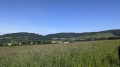
 Easy
Easy 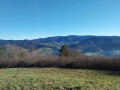
 Difficult