


 Country:

 City:
City:


Start: Berglusthaus, 79283 Bollschweil – St. Ulrich
Access route: Freiburg – Merzhausen – Au – Sölden – St. Ulrich
(S/E) From the Berglusthaus, we walk downhill to the signpost “Gschwendle” (715 m).
(1) There we come to a tarmac road leading to the Gschwendlehof (house no. 23).
Nothing precise can be ascertained about when the property was built. As a so-called ‘mountain cottage’, it formerly belonged to the Trudperthof in Geiersnest. The family history of its owners has been documented since the 18th century. In 1969, Herbert and Annemarie Sumser took over the property, which they passed on to their son Ralf in 2017. Following the renovation of the farm, a holiday let (‘Farm Holidays’) is now available there.
At the signpost, where we also come across the St. Ulrich Life Trail, we turn right towards Heinehof.
The path leads past the Hüslihansenhof (house no. 20), which was built in 1785. The Steiert family had lived on the farm since 1818, where farming was eventually carried out as a sideline. In 1982, the house was sold and converted for residential use in the following years. The land is still used for agricultural purposes.
The trail now descends steeply to district road 4956 (Nesterbachsträßle).
(2) At the crossroads (erected in 1935), we cross the road and follow the signposted track on the opposite side to “Sonners Heinehof” (house no. 21).
The hiking trail runs past the farm chapel and along the farm buildings to the signpost “Heinehof” (617 m). From here, the route continues along the St. Ulrich Circular Trail to the signpost “Eichbühl” (650 m) and then down to the Nesterbach. The hiking trail first leads through a mixed forest.
Here, too, you will find growth forms typical of the former coppice woodland and pasture beech (multi-stemmed trees). The young growth of European beech, fir and sessile oak indicates the forest’s original composition. The old cart track in the forest has cut deep into the ground.
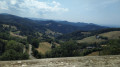
The path then descends into open grassland, from where a magnificent view of the St. Ulrich mountain landscape opens up. Here, goats are increasingly being used to combat scrub encroachment. On the right-hand side is an apiary.
Holly grows at the edge of the mixed beech and fir forest; it is considered an indicator of mild, humid winter climates. The widespread presence of this evergreen plant in the beech and fir forest was once encouraged by forest grazing and is now supported by a high population of game. On the meadow above the tarmac road, stone walls and dry stone walls stand out on the slope; these serve, on the one hand, to reinforce the path. On the other hand, the terraced steps and wall remains in the grassland indicate former arable farming.
From the meadow path, there is a magnificent view of the centre of St. Ulrich and the commanding position of the monastery complex with the parish church.
Where the hiking trail rejoins the tarmac road, you can see a ‘Riese’ (a track for dragging tree trunks) in the forest leading down to the Nesterbach stream. The road continues downhill through a mixed beech forest and meets the hiking trail from Heinehof in the Nesterbach valley. At the junction lies stop 13 of the Lebensweg (“Blickwinkel”).
(4) From the signpost “Am Nesterbach” (583 m), we now follow the yellow diamond symbol on to the centre of St. Ulrich.
(5) At the signpost “St. Ulrich Rössle”, we cross the district road to the inn and follow the track to the former monastery complex. On the climb up to the church, we pass the St. Ulrichsbrunnen Chapel.
It was built in 1771 above the spring at the foot of the monastery complex. The rear wall of the chapel is adorned with the former tomb of St. Ulrich.
The Catholic parish church of St Peter and Paul is a masterpiece of Baroque church architecture. The church and the priory building in their present form were constructed by the Vorarlberg master builder Peter Thumb between 1740 and 1741. The tower was built by Hans Willam in 1763–65 to replace the ridge turret, which was moved to the church in Sölden, where it still stands today. In 1766, the choir was extended by Jakob Natter. The former Benedictine monastery was founded in 1087 on behalf of the Cluniac Order by Prior Ulrich von Grüningen, who is also referred to in the literature as Ulrich von Regensburg, Ulrich von Zell or Ulrich von Cluny, in accordance with his earlier places of activity. St. Ulrich thus belongs, along with Hirsau, Alpirsbach and Sölden, to the Cluniac sites in the Black Forest (see sign at the entrance to the village).
For further information, see “Discoveries”
After visiting the monastery grounds, the walk continues to the signpost “St. Ulrich Klosterkirche” (579 m), where there is also a sign pointing to the Berglusthaus.
The 3.8 km St. Ulrich Life Trail also begins near the upper car park. The circular trail, marked with its own signpost (the words ‘Lebensweg’ flanked by a circle symbol and a yellow diamond), features 15 stopping points where elements of nature and the landscape are linked to themes of life.
The hiking trail (yellow diamond) leads up the Winterberg towards the signpost “Winterberghütte” (642 m). It is characterised by magnificent views of the landscape around St. Ulrich. From the first stopping point, we look back once more at the village with the church and, to the left of it, at the Maierhof.
It is the monastery’s oldest farm building, constructed in 1778 as a two-storey half-timbered house with a hipped roof and a narrow entrance to the barn. In the background, you can make out the farmsteads of Geiersnest. The pastures along the path are bordered in places by dry stone walls. The pastures are dotted with trees and shrubs showing distinct signs of browsing damage, as well as pasture beech trees.
Further up, looking west, there is another magnificent view of the Möhl Valley and its tributaries, the Upper Rhine Plain and the Vosges. The tectonic structure of the landscape is particularly evident here due to the right-angled bends in the river.
The trail then leads up into a species-rich mixed beech and fir forest.
(7) At the signpost for the “Winterberghütte” (642 m), we follow the hiking trail and the nature trail towards the “Kreuz” stop, where we are once again treated to a wonderful view of St. Ulrich.
On the meadow above, the terraced steps and stone walls catch the eye. These indicate the former use of the slope as farmland.
The hike continues to the signpost “Winterbergparkplatz”(642 m), where we come to the valley path that runs from the district road along the Möhlin. At the fork in the path there is an information board for the Lebensweg (Station 5: Source).
From here, you can take the hiking trail to the Berglusthaus along the same route as the St. Ulrich circular walk (turn left into the Kohlwald and towards Gschwendle).
Those wishing to experience a fast-flowing mountain stream in an impressive forest valley should take the stony valley path up towards Kaltwasser. It was already marked as a forest track on the 1884 local map. However, the hiking trail is no longer marked with the Schwarzwaldverein’s new signage. The wooden sign bearing this number has been preserved in a few places, for example behind the junction with the Priorfelsenweg, which crosses the Möhlin on the right-hand side via a concrete bridge with an iron railing. A tree nursery was located on the striking flat area in the 1950s.
Further up, the valley narrows and the slopes become uneven: the slopes on the left (northern) side are steeper than those on the opposite side. The former are characterised by rocks and boulder scree. In some places, rocky ridges appear, bound to resistant gangue rocks. The large boulders below the rocks were blasted away at various times. Even today, this process continues due to frozen water flowing along fissures (frost action). In the valley, several small streams flow into the Möhlin, which rises in the St. Ulrich Forest, including the Horbenbach coming from the north, whose source area is located near Farm No. 55.
In its lower reaches, it has cut deep into the slope, exposing rocky walls. Behind the confluence with the Horbenbach, there is an abandoned quarry on the left-hand side. The bedrock was quarried for road construction. On the right-hand side of the valley, the small streams mostly end in an alluvial fan at the valley floor. A clear example of this can be found near the Hüttenweg, which turns off to the right.
Further up, the valley becomes steeper on both sides. In some places, the Möhlin has exposed layers of scree up to 2 metres thick on the impact slopes.
At the next crossroads, the Kännelesgrundweg branches off to the right and the Kohlwaldweg to the left. Further up, an abandoned footpath leads across the Möhlin to the right. An old
signpost to Gießhübel and the Schauinsland. The valley path continues to climb and leads over the culverted Möhlin.
(9) In the sharp left-hand bend, a path branches off uphill to a trout pond.
Water is channelled from the Möhlin into the pond via a tributary. There were certainly other fish ponds in the upper Möhlin Valley in the past. This is suggested by an outcrop in the Erbmatt field. Beneath a loamy-sandy surface layer, this reveals an organic deposit containing wood remains. Based on the dating of the wood, a pond has existed here since the 15th century and may be linked to the monastic activities of St. Ulrich.
The name Erbmatt refers to a former meadow (Matte) through which the Möhlin and its source streams flow.
(10) About 100 m after crossing the Möhlin, just past the bend, a forest path turns sharply to the left. On a large spruce tree there is still a sign from the old Schwarzwaldverein trail marking (formerly a red dot). It points towards the Berglusthaus (and in the opposite direction towards the Kohlerhof). We follow the forest path to the Berglusthaus, which initially runs parallel to the slope through a spruce forest.
It then climbs gently and curves to the left, skirting a deeply cut stream. Further spring-fed streams appear in the forest, having cut deep into the scree on the slope beneath the forest canopy. Behind the subsequent right-hand bend, open pastureland appears on the upper slope, whilst the steep slope down towards the Möhlin is still wooded.
Fruit trees stand in the pasture, including rows of cherry trees. The edge of the path is lined with beech and fir trees. Behind a tall group of trees comprising birch, larch and silver fir lies Farm No. 55 (Langtannen). Opposite the property, grassland now extends along the left-hand side of the slope, abounding with colourful flowers in May and June, including orchids. Between the meadow and the edge of the forest stand further fruit trees (pear and cherry). From the farm entrance, the road is tarmac-surfaced. On the left-hand side, a depression appears on the slope, forming part of the upper reaches of the Horbenbach.
Its source areas can be recognised by the damp hollow to the right of the path. From the road, there is a magnificent view of the Kammschwarzwald and the Hoher Blauer, as well as the Upper Rhine Valley and the Vosges. In the foreground lies the Berglusthaus with its enclosed solar panel system on the south-facing side of the roof.
Passing the cottage garden of the Steiert estate, we reach the signpost for “Berglusthaus” (831 m) (S/E).
 Visorando Member
 Association / Club / Walk leader
 Very difficult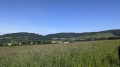
 Easy
Easy 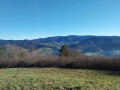
 Difficult
