


Refine your search for walks in Savigné-l'Évêque
Savigné-l'Évêque walks


 Stud farms and châteaux from Savigné-l'Évêque
 Tourism professional
 9.24 mi
 +62 ft
 -62 ft
 4h 20
4h 20
 Moderate
 Departure from Savigné-l'Évêque (Sarthe)
A region once densely populated along the ancient road from Le Mans to Évreux, and an important market town under the Ancien Régime, Savigné has long been favoured, due to its proximity to Le Mans, by the city’s notables, who have built or restored bourgeois houses and châteaux, sometimes on medieval seigneurial sites. Thus, as you follow the route, you will see Nuyet, dating from the late18th century, or, from the19th century, the châteaux of Le Rocher (now the town hall), Mortrie and Le Mesnil, where a major stud farm is located.
La Fosse aux Saneux in Sillé-le-Philippe
 9.40 mi
+256 ft
-246 ft
4h 35
Moderate
Departure from Sillé-le-Philippe (Sarthe)
9.40 mi
+256 ft
-246 ft
4h 35
Moderate
Departure from Sillé-le-Philippe (Sarthe)
The first mention of the parish under the name “Siliaco Philippi” dates back to the years 1145–1187. From the Middle Ages onwards, the parish seigneury was annexed to the Château de Passais, which itself fell under the barony of Touvoie, owned by the bishops of Le Mans, situated on the border between Savigné-L’Evêque and Saint-Corneille. Sillé-le-Philippe gave rise to the creation of a linear village; long remaining modest in size, it is now expanding due to its proximity to the Le Mans conurbation. This development also benefits the hamlet of Chanteloup (situated on the old royal road from Le Mans to Paris via Mortagne, now the RD 301), which once boasted several cafés and inns.
The medieval paths of Sargé-lès-le-Mans
 Visorando Member7.03 mi
+269 ft
-299 ft
3h 30
Moderate
Departure from Sargé-lès-le-Mans (Sarthe)
Visorando Member7.03 mi
+269 ft
-299 ft
3h 30
Moderate
Departure from Sargé-lès-le-Mans (Sarthe)
Walk along the sunken paths on the outskirts of Le Mans.
The Auvours hill in Yvré-l'Evêque
 5.30 mi
+541 ft
-525 ft
2h 55
5.30 mi
+541 ft
-525 ft
2h 55
 Easy
Departure from Yvré-l'Évêque (Sarthe)
Easy
Departure from Yvré-l'Évêque (Sarthe)
An easy walk, 50% of which follows a path around the Auvours hill, which witnessed the War of 1870, where a tragic battle claimed 617 lives on 10 and 11 January 1871. Many mementoes of this war are housed in the church at Yvre, where one chapel is dedicated to the Papal Zouaves.
Yvré-l'Évêque route and its "Nature Boulevard"
 7.00 mi
+269 ft
-246 ft
3h 25
Moderate
Departure from Yvré-l'Évêque (Sarthe)
7.00 mi
+269 ft
-246 ft
3h 25
Moderate
Departure from Yvré-l'Évêque (Sarthe)
During this hike, you will have the opportunity to admire the Yvré countryside, its Roman bridge, the Gérence fountain and catch a glimpse of the beautiful Château de Vaux as you walk along the trails and part of the "Boulevard Nature".
Around the Boulevard Nature: Coulaines, along the hedgerow paths
 3.03 mi
+98 ft
-69 ft
1h 30
Easy
Departure from Coulaines (Sarthe)
3.03 mi
+98 ft
-69 ft
1h 30
Easy
Departure from Coulaines (Sarthe)
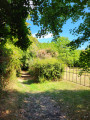
This short walk, accessible only on foot, takes you along the sunken paths of the commune of Coulaines.
Further walking routes can be found on the town hall’s website.
Route des moulins de Neuville
 5.37 mi
+30 ft
-30 ft
2h 30
Easy
Departure from Neuville-sur-Sarthe (Sarthe)
5.37 mi
+30 ft
-30 ft
2h 30
Easy
Departure from Neuville-sur-Sarthe (Sarthe)
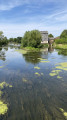
This easy route, more than 80% of which is on paths, will allow you to discover all the charm of Neuville-sur-Sarthe and its surroundings, the banks of the Sarthe, its old restored mills, the Château de Monthéard, as well as the history linked to the Second World War through the presence at that time of an American airfield in the countryside.
Coulaines – Saint Saturnin
5.79 mi
+144 ft
-167 ft
2h 45
Easy
Departure from Coulaines (Sarthe)
The Boulevard Nature is a route project dedicated to sustainable transport modes between the member municipalities of Le Mans Métropole. It allows you to discover various tourist, natural and heritage sites. Once completed, the Boulevard Nature will be 72 km long. Currently, only 45 km have been built. I therefore suggest you follow it where it exists and provide you with routes to link the scattered sections.
In the footsteps of the Crusaders, starting from Lombron
13.61 mi
+515 ft
-509 ft
6h 40
 Difficult
Departure from Lombron (Sarthe)
Difficult
Departure from Lombron (Sarthe)
Although local tradition places the first village at Bresteau, the Church of Saint-Martin, rebuilt by the monks of Saint-Vincent in the early 12th century, provides clear evidence of the antiquity of the village of Lombron. This beautiful church, open during the day, is well worth a visit both for the quality of its architecture (Romanesque choir and lantern tower, nave and chapels remodelled in the 14th and 15th centuries on their original foundations) and for its furnishings (16th-century statues including the Crucified Christ, the seigneurial bench of the Montmorency family, lords of Bresteau, terracotta bas-reliefs by Lebrun, circa 1760, 18th-century nave pews, etc.).
Route des Croisettes starting from Coulaines
 6.36 mi
+338 ft
-358 ft
3h 15
Moderate
Departure from Le Mans (Sarthe)
6.36 mi
+338 ft
-358 ft
3h 15
Moderate
Departure from Le Mans (Sarthe)
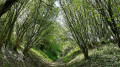
Located in the municipalities of Sargé, Coulaines and Le Mans, this route runs largely along dirt tracks, sometimes tarmac, lined with hedges, trees and shrubs offering generous shade.
The village of Beaufay and the Butte de Montplaisir
 Association / Club / Walk leader
 13.33 mi
+459 ft
-446 ft
6h 30
Difficult
Departure from Beaufay (Sarthe)
13.33 mi
+459 ft
-446 ft
6h 30
Difficult
Departure from Beaufay (Sarthe)
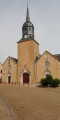
A good twenty kilometres of peaceful walking through the countryside along sunken lanes, with almost 100% of the route on footpaths (less than 1.5 km of tarmac!!!) in the Beaufay countryside.
The banks of the Sarthe in Saint-Pavace
 4.44 mi
+36 ft
-36 ft
2h 05
Easy
Departure from Saint-Pavace (Sarthe)
4.44 mi
+36 ft
-36 ft
2h 05
Easy
Departure from Saint-Pavace (Sarthe)
An easy hike that can be enjoyed by the whole family, including children.
Around the Boulevard Nature: from Gazonfier to the Jardin des Plantes
 4.69 mi
+338 ft
-325 ft
2h 25
Easy
Departure from Le Mans (Sarthe)
4.69 mi
+338 ft
-325 ft
2h 25
Easy
Departure from Le Mans (Sarthe)
This city walk takes you from park to park. From Parc de Gazonfier via the Jardin des Plantes and Parc Banjan, discover or rediscover the streets of Le Mans with its houses steeped in history and its breathtaking views.
The starting point of the 24 Hours of Le Mans from Montfort-le-Gesnois
 5.15 mi
+230 ft
-230 ft
2h 35
Easy
Departure from Montfort-le-Gesnois (Sarthe)
5.15 mi
+230 ft
-230 ft
2h 35
Easy
Departure from Montfort-le-Gesnois (Sarthe)
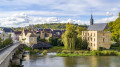
The present-day commune, formed by the merger of two former major market towns, stretches out parallel to the Huisne valley across uneven terrain. The old Pont de Gennes is at the lowest point (60 m), whilst the highest point (100 m) is at Montfort-le-Rotrou. The former is a crossroads village situated at the mouth of an old crossing point over the Huisne. The latter, situated on a strategic defensive site, is a linear settlement built under the protection of the castle. The two were joined by a gradual urban expansion in the 19th century. The walk takes you past the starting point of the first major motor race organised by the Automobile Club de France (ACF) in 1906, the forerunner of the 24 Hours of Le Mans.
Palet de Gargantua Circuit
 5.19 mi
+79 ft
-72 ft
2h 25
Easy
Departure from Torcé-en-Vallée (Sarthe)
5.19 mi
+79 ft
-72 ft
2h 25
Easy
Departure from Torcé-en-Vallée (Sarthe)
Known successively as Ecclesia de Torciaco, then Torcey and Notre Dame de Torcé, the former parish has been called Torcé-en-Vallée since 1926. The documents first mentioning it relate to the construction of the priory and the church. However, it is clear that Torcé’s history predates this, as evidenced by the megalith located at the western entrance to the village, known as the ‘Dolmen de Torcé’ or ‘Palet de Gargantua’. Human occupation may date back to the Middle Neolithic period.
The Butte de Montrentin as seen from Torcé-en-Vallée
6.47 mi
+66 ft
-69 ft
3h 00
Moderate
Departure from Torcé-en-Vallée (Sarthe)
This walk, with little variation in elevation and no great difficulty, will allow you to explore the southern part of Torcé. The paths – sometimes tree-lined, sometimes sunny, and very often sandy – will take you to the foothills of the Butte de Montrentin.
The Tour of Le Mans North
8.37 mi
+276 ft
-305 ft
4h 05
Moderate
Departure from Le Mans (Sarthe)
Discover the Boulevard Nature, nestled between the countryside and the shopping area.
La Mare aux Poissons Rouges and the Arche de la Nature
 2.04 mi
+92 ft
-92 ft
1h 00
Easy
Departure from Changé (Sarthe) (Sarthe)
2.04 mi
+92 ft
-92 ft
1h 00
Easy
Departure from Changé (Sarthe) (Sarthe)
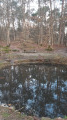
The Mare aux Poissons Rouges is an artificial pond which hosted a procession from the early 20th century until the Second World War.
The procession set off from the church at Yvré-l’Évêque and passed through the grounds of the Château de l’Arche.
Today, the pond has been cleaned up and is home to many protected amphibians, such as the marbled newt.
Around Boulevard Nature: Arche de la Nature, the Prairie House
 2.23 mi
+30 ft
-30 ft
1h 05
Easy
Departure from Yvré-l'Évêque (Sarthe)
2.23 mi
+30 ft
-30 ft
1h 05
Easy
Departure from Yvré-l'Évêque (Sarthe)
This walk is accessible to people with disabilities using a three-wheeled wheelchair and to families with pushchairs, provided they are using a three-wheeled pushchair.
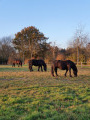
This forest walk takes you past the Maison de la Prairie, where you can see animals in their enclosures.
The green lung of the Arch
 6.63 mi
+98 ft
-98 ft
3h 10
Easy
Departure from Yvré-l'Évêque (Sarthe)
6.63 mi
+98 ft
-98 ft
3h 10
Easy
Departure from Yvré-l'Évêque (Sarthe)
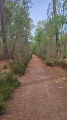
With 350 hectares of forest, 60% of which is made up of conifers such as maritime pines and Scots pines, this trail located at the Arche de la Nature offers hikers a breath of fresh air.
Around the Boulevard Nature: Arche de la Nature, amidst heathland and chestnut trees
 7.72 mi
+138 ft
-138 ft
3h 40
Moderate
Departure from Yvré-l'Évêque (Sarthe)
7.72 mi
+138 ft
-138 ft
3h 40
Moderate
Departure from Yvré-l'Évêque (Sarthe)
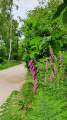
This forest walk from the Arche de la Nature takes you past a variety of tree species.It allows you to explore much of the site, walking along both wide paths and narrow tracks.
Exploring the city of Le Mans
 6.07 mi
+230 ft
-217 ft
3h 00
Easy
Departure from Le Mans (Sarthe)
6.07 mi
+230 ft
-217 ft
3h 00
Easy
Departure from Le Mans (Sarthe)
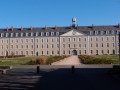
Via the side streets off Rue Nationale, you’ll enjoy making your way to the barracks district before climbing Sainte-Croix Hill, a former village surrounded by vineyards. Hidden lanes, the national monument to the Battle of Le Mans and the legendary Gazonfier climb, famous amongst cyclists.
Around the Boulevard Nature: Le Mans, the City of the Plantagenets
 1.15 mi
+82 ft
-82 ft
0h 35
Easy
Departure from Le Mans (Sarthe)
1.15 mi
+82 ft
-82 ft
0h 35
Easy
Departure from Le Mans (Sarthe)
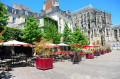
A circular walk along the ramparts of Le Mans, taking in some of the most iconic sites of the city of the Plantagenet kings.
Within the Cité Plantagenêt, protected by its walls
1.81 mi
+138 ft
-112 ft
0h 55
Easy
Departure from Le Mans (Sarthe)
Since 2003, the "Old Mans" has been called "Cité Plantagenêt" after the Plantagenêt dynasty, the English royal family originally from Le Mans. The former provincial capital of Maine and Perche (from the 16th century to the Revolution), this stroll through the streets and alleys of Le Mans' historic district offers a pleasant walk in the natural setting of famous swashbuckling films (Cyrano de Bergerac, Le Bossu, The Man in the Iron Mask, Nicolas Le Floch, etc.).
 Around Boulevard Nature: from Le Mans harbour to Moulin aux Moines
 9.24 mi
+144 ft
-144 ft
2 hrs
Moderate
Departure from Le Mans (Sarthe)
9.24 mi
+144 ft
-144 ft
2 hrs
Moderate
Departure from Le Mans (Sarthe)
This walk, combining town and countryside, takes you along the banks of the Sarthe, passing through the village of Coulaines and past Le Mans’s Saint-Julien Cathedral.It follows cycle paths and trails along the banks of the Sarthe.
Around the Boulevard Nature: from Île aux Planches to Gué-de-Maulny
 3.84 mi
+23 ft
-23 ft
1h 45
Easy
Departure from Le Mans (Sarthe)
3.84 mi
+23 ft
-23 ft
1h 45
Easy
Departure from Le Mans (Sarthe)
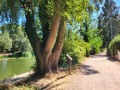
This walk, along the banks of the Sarthe, features information boards about the local flora and fauna.Starting from Le Mans harbour, passing through the Gué de Maulny park with its many street art murals and continuing via Île aux Planches, this family-friendly walk is suitable for wheelchair users (three-wheeled) and pushchairs (also three-wheeled).
Discovering the woods and ponds of Loudon
 4.85 mi
+36 ft
-36 ft
2h 15
Easy
Departure from Saint-Mars-la-Brière (Sarthe)
4.85 mi
+36 ft
-36 ft
2h 15
Easy
Departure from Saint-Mars-la-Brière (Sarthe)
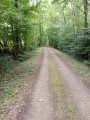
Parigné-Lévêque is a very large and heavily wooded commune: northern pines with sand dunes, and southern chestnut and birch trees. The route allows you to discover the charm of numerous woodlands, vast moors and ponds. The Loudon Stream is crossed in several places.
Loudon Ponds and Wood
2.56 mi
+177 ft
-171 ft
1h 20
Easy
Departure from Parigné-l'Évêque (Sarthe)
This circular walk allows you to discover a site not far from Le Mans that is rich in natural beauty. Ponds, peat bogs, wet and dry heathland, and marshy woods... all form a mosaic of landscapes that are home to species rare in the region: harriers, hobby falcons, goshawks, purple herons (among the birds); and royal ferns, marsh marigolds and sundews (among the plants).