


Refine your search for walks in Querrien
Querrien walks


 The Devil’s Rocks on the Ellé
 Visorando Member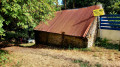
 2.70 mi
 +551 ft
 -564 ft
 1h 45
1h 45
 Moderate
 Departure from Querrien (Finistère)
In the heart of Finistère, between Le Faouët and Quimperlé, the River Ellé has carved its way through the Armorican Plateau. Emerging from gorges 80 metres deep, the river rushes for 300 metres between enormous blocks of granite smoothed by millions of years of erosion: this is the Roches du Diable, one of Brittany’s most beautiful rock formations.Its name has ancient origins: the Breton name for the river, Ellez, means ‘hell’. Legend tells of a confrontation between Saint Guénolé, founder of the parish of Locunolé, and the devil, who hurled enormous boulders at him before plunging into a bottomless chasm. The devil’s hand, seat and bed… the rocks still bear the marks.From the footpaths overlooking the valley, a striking panorama opens up onto the rugged landscape and white-water rapids that attract kayakers every winter. The walk follows the river and its mill for nearly 5 km, as far as Locunolé, crosses the Moulin Neuf bridge and reveals some of the many facets of this rural area.
The valleys north of Lanvenegen
 9.08 mi
+741 ft
-751 ft
4h 50
Moderate
Departure from Lanvénégen (Morbihan)
9.08 mi
+741 ft
-751 ft
4h 50
Moderate
Departure from Lanvénégen (Morbihan)
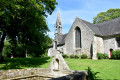
This walk follows sections of the three main routes in the area: the Tour de Locmaria with its chapel and narrow paths, the Circuit des Asphodèles with its ecological and Breton-themed focus, and theGR®38, which crosses the entire region, taking you past the main attractions.
A lovely, mainly wooded, undulating walk, with sunken paths, rivers and unusual spots.
In the footsteps of the Chouans in Tréméven
 2.61 mi
+305 ft
-305 ft
1h 30
2.61 mi
+305 ft
-305 ft
1h 30
 Easy
Departure from Tréméven (Finistère) (Finistère)
Easy
Departure from Tréméven (Finistère) (Finistère)
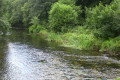
The Roscado-Pontégan route, following in the footsteps of the Chouans. Highlights include the parish enclosure at Tréméven, Roscado Manor, the Chouan Cross, Pontégan Bridge spanning the River Isole, a ruined mill, the Poachers’ Rock, and an ancient Roman road.
Around Saint-Thurien and along the banks of the Isole
 4.31 mi
+459 ft
-479 ft
2h 25
Easy
Departure from Saint-Thurien (Finistère) (Finistère)
4.31 mi
+459 ft
-479 ft
2h 25
Easy
Departure from Saint-Thurien (Finistère) (Finistère)
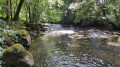
A short hike in the countryside of Saint-Thurien and along the banks of the Isole river, starting from the village of Saint-Thurien.
Route de Saint-Fiacre à Le Faouët
 3.55 mi
+203 ft
-180 ft
1h 50
Easy
Departure from Le Faouët (Morbihan) (Morbihan)
3.55 mi
+203 ft
-180 ft
1h 50
Easy
Departure from Le Faouët (Morbihan) (Morbihan)
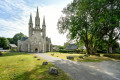
This short circular loop starts at the Saint-Fiacre Chapel. A 15th-century building in the Flamboyant Gothic style, it boasts the oldest and most famous polychrome wooden rood screen in Brittany. On the way back, walkers will discover its fountain, whose water, according to legend, cures skin diseases.
Loc Yvi – Saint-Diboan Chapel and fountain – Ellé Valley
 1.97 mi
+240 ft
-240 ft
1h 05
Easy
Departure from Tréméven (Finistère) (Finistère)
1.97 mi
+240 ft
-240 ft
1h 05
Easy
Departure from Tréméven (Finistère) (Finistère)
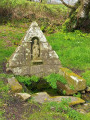
The walk first takes you from the Chapel of Saint-Diboan (in the hamlet of Loc Yvi) to the consecrated fountain of the same name. The shaded path then winds its way into the unspoilt Ellé valley, the natural boundary between the regions of Cornouaille and Vannes, with its striking rocky outcrops and boulder fields shaped by erosion, and its steep-sided valleys carved out by small rapids (known as ‘froud’ in Breton).
 Cycling between Le Faouët and Priziac
 Local authority22.38 mi
+1,142 ft
-1,142 ft
2.5 hrs
Moderate
Departure from Le Faouët (Morbihan) (Morbihan)
Local authority22.38 mi
+1,142 ft
-1,142 ft
2.5 hrs
Moderate
Departure from Le Faouët (Morbihan) (Morbihan)
This loop allows you to discover the varied heritage and landscapes of the communes of Le Faouët and Priziac. It is both pleasant and interesting, with many tourist attractions, such as the 16th-century market halls and the Faouët museum, the ecomuseum and the covered alleyway of Botquenven, and the courtroom in Priziac. Punctuated by magnificent panoramic views throughout the route, you will also discover religious heritage, including the famous St Fiacre chapel and its rood screen. An ideal route for an outing with family or friends.
Cycling between the chapels of Sainte-Barbe and Saint-Fiacre in Le Faouët
6.94 mi
+679 ft
-692 ft
1 hr
Easy
Departure from Le Faouët (Morbihan) (Morbihan)
This loop, suitable for all ages, invites you to discover the history and religious architecture of Le Faouët, with visits to the iconic Sainte-Barbe Chapel and Saint-Fiacre Chapel. A stop in the village allows you to stroll under the market halls and visit the museum, or simply enjoy a gourmet break in one of the shops or restaurants available.
Route of Sainte-Barbe and Saint-Fiacre chapels in Le Faouët
6.67 mi
+522 ft
-535 ft
3h 30
Moderate
Departure from Le Faouët (Morbihan) (Morbihan)
Starting from the 16th-century market halls of Le Faouët, this route climbs up a very pretty rocky path to the Sainte-Barbe plateau, where you can discover the site of the Sainte Barbe Chapel, built between 1489 and 1512. The site is known for its pardon. The path descends towards the fountain and the banks of the Ellé, a fast-flowing river winding between two steep banks. The path follows the river, then heads through the woods towards the Saint-Fiacre Chapel. Built between 1450 and 1480 in a flamboyant Gothic style, it has a splendid polychrome wooden rood screen. The climb back up to the village is through the woods, passing through the beautiful hamlet of Kerly.
The Ellé Valley around Sainte-Barbe
 3.76 mi
+430 ft
-410 ft
2h 05
Easy
Departure from Le Faouët (Morbihan) (Morbihan)
3.76 mi
+430 ft
-410 ft
2h 05
Easy
Departure from Le Faouët (Morbihan) (Morbihan)
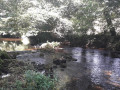
Another walk to recharge your batteries in the heart of nature for hikers who are not afraid of having to bend down to avoid fallen trees and springs that wet the paths.
To the west of Le Faouët, the Ellé flows through a fairly narrow, wooded valley with rocks on either side and in the riverbed. At the top, along the valley, are picturesque hamlets and, above all, the Sainte-Barbe Chapel.
Towards the Sainte-Anne-du-Scorff Chapel from Guilligomarc'h
 10.15 mi
+722 ft
-699 ft
5h 20
Moderate
Departure from Guilligomarc'h (Finistère)
10.15 mi
+722 ft
-699 ft
5h 20
Moderate
Departure from Guilligomarc'h (Finistère)
Starting from Guilligomarc'h, this 16km hike follows both banks of the Scorff between Moulin du Stang and Pont Kerlo, passing by the Sainte-Anne-du-Scorff chapel and the old Paou paper mill.
It will allow you to discover a beautiful wild river with cool, fast-flowing waters
Between Scorff and Ellé in Arzano
 11.65 mi
+833 ft
-830 ft
6h 05
Moderate
Departure from Finistère
11.65 mi
+833 ft
-830 ft
6h 05
Moderate
Departure from Finistère
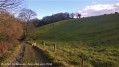
This route will take you on a tour of two beautiful Breton rivers, the Scorff and the Ellé, and three old mills: the Kerlégant, Mohot and Stall mills.
The Scorff at Pont Kerlo
 5.33 mi
+479 ft
-482 ft
2h 50
Easy
Departure from Finistère
5.33 mi
+479 ft
-482 ft
2h 50
Easy
Departure from Finistère
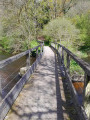
Starting from Kerlo Bridge, a short hike of about 10km will take you along the right bank of the Scorff to the Moulin du Roc'h site and its motte-and-bailey castle. Then, climbing up to the plateau, you will discover the chapels of Locmaria-Grâce and Sainte-Anne, which overlook the valley. The return journey follows the opposite bank of the Scorff.
Loop via Berné, Saint-Caradec, Trégomel and Kernascléden
20.25 mi
+1,043 ft
-1,040 ft
2.5 hrs
 Difficult
Departure from Morbihan
Difficult
Departure from Morbihan
This loop invites you to cycle through the heart of a landscape typical of central Brittany. As you ride along, you will pass through villages and hamlets, discover chapels, churches and fountains, and enjoy superb views of the surrounding countryside, with a magnificent shaded road running alongside the Scorff valley. Halfway up the hill, stop off at the medieval hamlet of Pont Callec, a must-see in the Pays du Roi Morvan!
Your visit to Kernascléden will be an opportunity to enter the famous Notre-Dame de Kernascléden church with its flamboyant Gothic architecture, which houses one of the two danse macabre scenes in Brittany. Opposite, the Maison de la Chauve-Souris (Bat House) will tell you all about the world of this mysterious mammal.
Designed to combine leisure and discovery, this loop proposed by the Roi Morvan Community is suitable for electric bikes (e-bikes) or hybrid bikes.
An ideal circuit for lovers of cycling, natural heritage, architecture and history.
The Scorff between the Poulhibet mill and the old Stang mill
 7.38 mi
+407 ft
-443 ft
3h 45
Moderate
Departure from Plouay (Morbihan)
7.38 mi
+407 ft
-443 ft
3h 45
Moderate
Departure from Plouay (Morbihan)
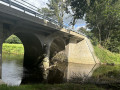
This walk will take you along both banks of a river that winds its way through the beautiful Scorff valley. The route includes an optional circular loop on the plateau overlooking the valley towards the village of Ty Meur, allowing you to visit Saint Julien Chapel before returning to the valley via the hamlet of Kervinel.
The Kerhuennec tour
 5.56 mi
+312 ft
-312 ft
2h 50
Easy
Departure from Plouay (Morbihan)
5.56 mi
+312 ft
-312 ft
2h 50
Easy
Departure from Plouay (Morbihan)
After crossing a countryside landscape with fields and hedges on small roads, you enter the woods on trails and small paths, ending up along the small river Scorff, pure Breton nature!
Through the Cascadec Forest and along the left bank of the Isole
 6.26 mi
+384 ft
-377 ft
3h 15
Moderate
Departure from Scaër (Finistère)
6.26 mi
+384 ft
-377 ft
3h 15
Moderate
Departure from Scaër (Finistère)
This circular route through the Cascadec Forest takes you through old hamlets somewhat lost in the countryside, often undergoing restoration, before returning along the left bank of the River Isole and its granite boulders.
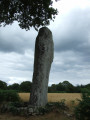
Discover old bread ovens, the imposing Saint-Jean menhir and the chapel of the same name, as well as the former Bolloré paper mills, one of the two sites where the famous ‘OCB’ cigarette paper was manufactured.
NB: The chapel was demolished in 2020.
Toulfouen, Château de Carnoët and the Bishop’s Chair
 5.17 mi
+207 ft
-236 ft
2h 35
Easy
Departure from Quimperlé (Finistère)
5.17 mi
+207 ft
-236 ft
2h 35
Easy
Departure from Quimperlé (Finistère)
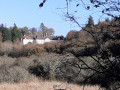
A circular walk on the northern side of the Forest of Toulfoën, offering views of a chapel, the Chemin du Duc, Carnoët Castle and the Bishop’s Chair.
Pont Callec Forest and the Scorff Valley
 11.53 mi
+1,030 ft
-1,040 ft
6h 10
Moderate
Departure from Morbihan
11.53 mi
+1,030 ft
-1,040 ft
6h 10
Moderate
Departure from Morbihan
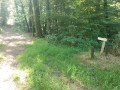
For having opposed the Regent, the Marquis of Pontcallec was once beheaded. His estate still stretches along the Scorff valley.
The paths winding through the state-owned forest and the river’s deep-cut course offer the chance to discover a hidden gem in central Brittany.
Grand Tour of Rédéné via the fountains
 6.27 mi
+299 ft
-315 ft
3h 10
Moderate
Departure from Rédené (Finistère)
6.27 mi
+299 ft
-315 ft
3h 10
Moderate
Departure from Rédené (Finistère)
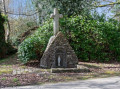
Rédéné is a commune in Finistère. It is situated in the Vannetais region, 8 km from Quimperlé. This grand tour of Rédéné is designed to provide a 10 km route for runners. But it also allows all walkers visiting Rédéné to explore the neighbourhoods of this charming Breton village. Setting out in search of the village’s three fountains adds a little extra interest.
 In the heart of the Carnoët Forest
 3.68 mi
+220 ft
-226 ft
Duration unknown
Easy
Departure from Quimperlé (Finistère)
3.68 mi
+220 ft
-226 ft
Duration unknown
Easy
Departure from Quimperlé (Finistère)
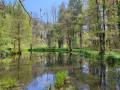
Walk through the heart of the Carnoët Forest, taking in the Tailors’ Pond, the Kerguéguen Stele, the Frout and Fontaine au Loup streams, and the Devil’s Bridge.
Cycling between Guiscriff, Gourin and Le Saint
23.94 mi
+935 ft
-935 ft
3 hrs
Difficult
Departure from Guiscriff (Morbihan)
This pleasant loop will takeyou through villages rich in architectural heritage, with beautiful granite houses and unmissable sites such as chapels, churches, the Château de Tronjoly, Guiscriff railway station and, of course, the Statue of Liberty in Gourin. It also offers superb panoramic views, particularly along the D187 between Le Saint and Guiscriff.
Greenway, Roman road, the Kerzonas hills and the Coatloc’h Forest
 10.90 mi
+577 ft
-561 ft
5h 30
Moderate
Departure from Scaër (Finistère)
10.90 mi
+577 ft
-561 ft
5h 30
Moderate
Departure from Scaër (Finistère)
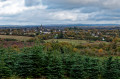
This route begins near the arboretum before heading up to the heights of Scaër, which offer beautiful panoramic views of the countryside and the Montagnes Noires. It continues along the remains of a Roman road and then crosses the Coatloc’h State Forest. The return journey follows a greenway, a former railway line between Rosporden and Carhaix.
Around Lake Bel-Air
 4.20 mi
+157 ft
-157 ft
2h 05
Easy
Departure from Priziac (Morbihan)
4.20 mi
+157 ft
-157 ft
2h 05
Easy
Departure from Priziac (Morbihan)
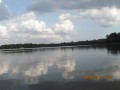
An easy walk with sections along the shores of Lake Bel-Air, then along sunken paths and quiet country lanes.
Cycling between Priziac and Langonnet
14.91 mi
+620 ft
-620 ft
1.5 hrs
Easy
Departure from Priziac (Morbihan)
This easy, accessible loop takes you to the Abbaye Notre-Dame de Langonnet, a remarkable site in the Pays du Roi Morvan that is not to be missed, as well as two archaeological sites: the Tumulus and Motte Castrale de Kermain. You will also discover chapels, churches and fountains, as well as the courtroom in Priziac.
At the end of the route, extend your walk with a relaxing break at the Lac du Bel Air in Priziac, where you can picnic, go paddleboarding, windsurfing or pedal boating, or simply enjoy the natural surroundings. There is also a well-equipped children's playground by the lake and at the Pontigou pond in Langonnet.
Route Saint-Trémeur, Croix de Kerflao and Saint-Samuel from Le Saint
 9.02 mi
+758 ft
-771 ft
4h 50
Moderate
Departure from Le Saint (Morbihan)
9.02 mi
+758 ft
-771 ft
4h 50
Moderate
Departure from Le Saint (Morbihan)
The route mainly follows a sunken path, featuring a small stone bridge, a wooden footbridge, a winding stream, a chapel nestled in a valley hollow, and a chance to explore the picturesque village of Le Saint.
Loop in the Carnoët National Forest and along the banks of the Laïta
5.30 mi
+433 ft
-433 ft
2h 50
Easy
Departure from Quimperlé (Finistère)
A peaceful walk, part of which is through the heart of the forest and part along the banks of the beautiful Laïta. There are many places with picturesque names (Fontaine aux Loups, Fontaine des Dimanches, Pont du Diable, Pont de Pierre, Port du Passage, Étang de Tailleurs, etc.), which bear witness to the former life of the "forest people".
Cléguer station route
 6.02 mi
+472 ft
-469 ft
3h 10
Easy
Departure from Cléguer (Morbihan)
6.02 mi
+472 ft
-469 ft
3h 10
Easy
Departure from Cléguer (Morbihan)
A beautiful, shaded walk between the Crano stream and the Scorff.
Route from Coët Letune to Cléguer
 5.54 mi
+410 ft
-440 ft
2h 55
Easy
Departure from Cléguer (Morbihan)
5.54 mi
+410 ft
-440 ft
2h 55
Easy
Departure from Cléguer (Morbihan)
Linking the village of Cléguer with Bas Pont-Scorff, the Coët Letune route takes you through the Cléguer countryside, past woodland and meadows, alongside the River Scorff and its streams. Don’t miss the partly Romanesque Saint-Gérand Church and the heritage sites in Bas Pont-Scorff, notably the Notre-Dame de Bonne Nouvelle Chapel and its 13th-century recumbent statue. The walk will also give you the chance to discover heritage linked to water, including a fountain, a washhouse, a mill and a brewery…
The King Morvan route in Langonnet
7.26 mi
+233 ft
-230 ft
3h 35
Moderate
Departure from Langonnet (Morbihan)
An easy 11 km route with little elevation gain. There are relatively few sections on tarmac roads; the route mainly follows paths, a good portion of which run through very pleasant woodland.
Circular Pont-Scorff: the Scorff Valley, Sainte-Flamine and the greenway
 12.06 mi
+561 ft
-571 ft
6h 00
Difficult
Departure from Pont-Scorff (Morbihan)
12.06 mi
+561 ft
-571 ft
6h 00
Difficult
Departure from Pont-Scorff (Morbihan)
From the charming village of Pont-Scorff, the walk descends through the Scorff valley and its highlights (Saint-Urchaud, Rocher du Corbeau), then winds through varied landscapes punctuated by the many chapels marking the various hamlets along the way.
Route from Saint-Urchaut to Pont-Scorff
 8.17 mi
+371 ft
-377 ft
4h 05
Moderate
Departure from Pont-Scorff (Morbihan)
8.17 mi
+371 ft
-377 ft
4h 05
Moderate
Departure from Pont-Scorff (Morbihan)
From the Scorff estuary to the Scave.
Starting from the historic town of Pont-Scorff, explore the Scorff and Scave valleys with their wild and unspoilt landscapes, home to protected species such as salmon. On your return, stroll through the narrow streets, discover the Cour des Métiers d’Art and its artisans, the contemporary art spaces, and the landscaped gardens of this town, which has been awarded the ‘Petite Cité de Caractère’ label.
Bois de Kermeur and the banks of the Bélon
 7.46 mi
+266 ft
-295 ft
3h 40
Moderate
Departure from Moëlan-sur-Mer (Finistère)
7.46 mi
+266 ft
-295 ft
3h 40
Moderate
Departure from Moëlan-sur-Mer (Finistère)
This route combines a countryside section through small villages with the Bois de Kermeur, where you will discover the Fontaine Sainte-Thumette and the long covered walkway of Kermor Bihan.
The return journey follows the left bank of the Bélon, a major oyster farming area.
Kergoulouët and Sainte-Thumette circular loop
 3.90 mi
+135 ft
-135 ft
1h 55
Easy
Departure from Moëlan-sur-Mer (Finistère)
3.90 mi
+135 ft
-135 ft
1h 55
Easy
Departure from Moëlan-sur-Mer (Finistère)
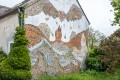
Walk through the fields then return through the undergrowth, along the banks of the Bélon.
Along the Belon and the estuary of the Karstic Cave
 9.03 mi
+433 ft
-456 ft
4h 30
Moderate
Departure from Riec-sur-Belon (Finistère)
9.03 mi
+433 ft
-456 ft
4h 30
Moderate
Departure from Riec-sur-Belon (Finistère)
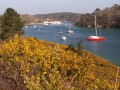
Discover the right bank of the Belon and where it meets the Aven, where these two rivers flow into the sea.
Return via quiet country lanes before reaching another cove on the Belon.
The banks of the Belon and Anse de Penmor
 5.25 mi
+256 ft
-259 ft
2h 40
Easy
Departure from Riec-sur-Belon (Finistère)
5.25 mi
+256 ft
-259 ft
2h 40
Easy
Departure from Riec-sur-Belon (Finistère)
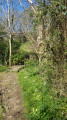
Two coastal rivers, the Aven and the Belon, have the same estuary facing Port Manec'h. This circuit largely follows the edge of the Belon and one of its coves, Penmor. During the walk, you will discover two beautiful fountains and the Saint-Léger Chapel.
Between Pont-Scorff and Quéven on the banks of the Scave and the Scorff
 6.22 mi
+266 ft
-276 ft
3h 05
Moderate
Departure from Pont-Scorff (Morbihan)
6.22 mi
+266 ft
-276 ft
3h 05
Moderate
Departure from Pont-Scorff (Morbihan)
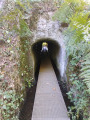
Between Pont-Scorff and Quéven, in the heart of the countryside, alongside the Scave and Scorff rivers and a stream. Sheltered by trees for most of the route, with minimal elevation gain.A shorter version of the Saint-Urchaut to Pont-Scorff route.
From Bélon Castle to Anse de Goulet, Riec
5.41 mi
+289 ft
-289 ft
2h 45
Easy
Departure from Riec-sur-Belon (Finistère)
Explore the banks of the Belon and the karstic cave along the GR®34. If you love coastal walks, you’ll be spoilt for choice. Take the time to admire the panoramic view at Pointe de Penquernèo. Lush vegetation, turquoise water and a breathtaking viewpoint. Ideal for a picnic break.
Countryside and banks of the Aven and Belon rivers via the Port de Rosbraz
 6.66 mi
+446 ft
-472 ft
3h 25
Moderate
Departure from Riec-sur-Belon (Finistère)
6.66 mi
+446 ft
-472 ft
3h 25
Moderate
Departure from Riec-sur-Belon (Finistère)
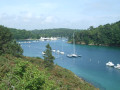
After a peaceful walk along small country roads to discover the Allée Couverte Arc Boutée de Kerantiec, this circuit joins the karstic cave at the Rosbraz marina. The return via the GR®34 overlooks the left bank of the Aven and then the right bank of the Belon, offering views of the opposite bank of each river.
Walk in the Belon region
 5.00 mi
+269 ft
-256 ft
2h 30
Easy
Departure from Moëlan-sur-Mer (Finistère)
5.00 mi
+269 ft
-256 ft
2h 30
Easy
Departure from Moëlan-sur-Mer (Finistère)
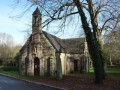
The banks of the Belon and its oysters, chapel, fountains and covered walkway are all part of this very easy hike. You will walk through the Kermeur woods and along the river on a coastal path that offers beautiful panoramic views.
Circular starting from Port du Belon via Kermeur Bihan and Kerfany
 7.18 mi
+348 ft
-344 ft
3h 35
Moderate
Departure from Moëlan-sur-Mer (Finistère)
7.18 mi
+348 ft
-344 ft
3h 35
Moderate
Departure from Moëlan-sur-Mer (Finistère)
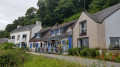
Hiking tour to discover the banks of the Belon and the surrounding heritage: Lanriot and Saint-Guinal chapels, fountains, covered walkway, coastal path and oyster beds.