Country:
 City:
City:


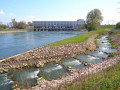
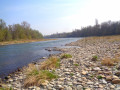
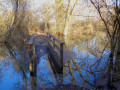
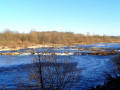
Walk along the old bed of the Rhine.
Start from the car park on Rue de Rosenau, near the EDF roundabout decorated with a collection of turbine blades.
(S/E) Walk past the restaurant to join the cycle path, then turn left onto the tarmac access ramp leading up to the hydroelectric power station.
Leave the path leading down to the left bank of the Grand Canal on your left. Go straight on and continue to the power station.
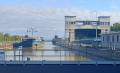
(1) Cross the canal in front of the six turbines, then continue to the right towards the large locks. Pass the ‘Rhin et Découvertes’ shops on your right and cross the bridge in front of the imposing gates closing off the lock chambers, until you reach a small car park on Île du Rhin.
(2) Turn right towards the Kembs Dam (or Märkt Dam), go through the barrier at the end of the locks, ignore the path leading down the steps immediately on the left marked with a Green Ring (emergency route, see practical information) and continue for 700 m along the tarmac path beside the canal.
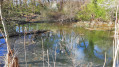
(3) Shortly after the end of the strip of land that divides the canal into two channels (one leading to the power station and the other to the locks), don’t miss the path on the left that descends towards the Old Rhine and the Barre d’Istein. Cross the tarmac road and enter the Petite Camargue Alsacienne nature reserve via a picturesque little path leading to the left bank of the Old Rhine.
(4) Turn right for a return walk upstream towards the Barre d’Istein.
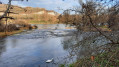
(5) The Barre d’Istein is a rock formation creating rapids – a wild spot favoured by many birds (and swimmers in summer on the German bank). After enjoying the spot, retrace your steps. Alternative route – see practical information.
(4) Follow the wild banks of the Old Rhine downstream to the junction with the emergency path 700 metres further on.
At this junction, in dry weather and when the water level is low, you can take the path on the right down a steep descent (take care) to a pebble-strewn islet often frequented by Alsatians in summer. On the left, a shortcut is available for a quick return to the locks.
(6) Continue straight on for about 2 km to the spot known as ‘Le Bouchon’, where the Rhine and the Grand Canal run very close together. Just before reaching this point, a small fishermen’s path leads down to the riverbank and the islets, which are sometimes accessible (if the water level is low and with caution).
(7) This lovely spot is ideal for a break or for heading down to the banks of the Rhine (via a small flight of steps) to look out over the German bank, the islets and the surrounding vegetation. Then return to the Grand Canal and take the wide, carriageable path which leads back up to the locks and then the hydroelectric power station. Cross the bridge over the spillways.
(1) At the end of the bridge, before the bend, some steps lead down to the right towards the plant rooms and the fish ladder. You’ll reach a small car park; turn right to walk alongside the fish ladder, then follow the riverbank for about 600 metres.
(8) Just after a stream – a branch of the Augraben which flows into the canal – leave the riverbank to the left via a wide path. Cross the road and turn left towards the EDF roundabout. Go round the roundabout on the right to go up onto the bridge overlooking a pretty, now disused lock, with a view of the Huningue Canal and its towpath, which has been converted into a cycle path.
(9) Retrace your steps to return to the starting point (S/E).







 Visorando Member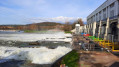
 Moderate
 Tourist office