Country:
 City:
City:


From the Rond-point de l'Énergie roundabout in Kembs, take Rue de Rosenau (EDF road). After the last houses, pass under the high-voltage wires and note a disused building on the left. Immediately after, park in the car park on the left, at the edge of the forest.
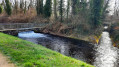
(S/E) At the end of the car park, follow the cycle path between the trees and take the footbridge over the drainage canal. Ignore the steps leading up the dyke to the bank of the Grand Canal (return route) and continue along the cycle path beside the drainage canal. Pass a bench at the foot of the only tree on the left of the path. On the right, the Scheidgraben stream joins the drainage canal. About a hundred metres further on, just before a footbridge, a path branches off to the left.
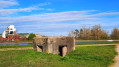
(1) Climb the dyke via this path, which leads to the bank of the Grand Canal d'Alsace after a landing. Note a blockhouse on the left, turn right, follow the bank marked with white hectometre markers, and note the piezometric markers. See Practical Information.
After two blockhouses, a few dozen metres before a third, a path marked with a green triangle descends to the right.
(2) Leave the bank and go down the steps to the drainage canal, cross the cycle path and go over the footbridge. Just before a small car park, turn left between the trees. You will come out onto the Route de l'EDF at the roundabout.
Go around the roundabout on the right (pedestrian crossing), passing in front of the Second World War tank, a memorial to Lieutenant Jean de Loisy. See During the hike or nearby.
(3) To the left of the memorial, cross Rue du Moulin (pedestrian crossing) and follow it to the right until you reach the next crossroads. The Rosenau Mill is on your right. Turn left onto Rue du Ruisseau, cross it (carefully) and walk along the stream on the right-hand pavement until you reach the stop sign. The stream temporarily disappears.
(4) Cross (pedestrian crossing) and follow Rue de Village Neuf until the crossroads, a few metres after the "Les Pêcheurs" bus stop.
(5) Turn right into a housing estate, following the street that winds between the properties and ends opposite the car park of a residence. Take the lane on the right, and at the end turn left onto a path that leads to the bank of the Canal de Huningue.
Turn right onto the wide track, which is the Chemin des Planètes ( see Practical Information).
After about thirty metres, you will see a small pond below on the right.
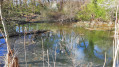
(6) A few steps (not very easy to navigate) lead down the dyke on the right. The pond is at the outlet of the "Ruisseau de Rosenau" stream, which passes under the canal. It is fed by groundwater from the Grand Marais de la Petite Camargue Alsacienne on the other side of the canal.
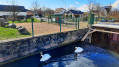
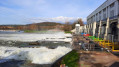
Climb back up the dyke and continue along the path to the Rosenau lock and its mini power station. Cross the bridge to reach the picnic area. For possible variations, see Practical Information.
(7) Cross in front of the bridge and follow the riverbank (on your right) along the cycle path, passing a car park on your left. Go under the road bridge and turn left to climb the stairs leading to the road. Cross the bridge, staying on the left-hand pavement.
(8) There are two options:
1) If the towpath is muddy or grassy, continue along the pavement for about 100 metres, turn left at the roundabout, then right, and continue to the junction with Rue de l'Au. Then take the street on the right (closed to traffic by planters) which leads to No. 44 Rue de Kembs. Turn left along this street until you reach Chemin du Scheidgraben (10).
2) Option chosen on the map: go down the steps to the other bank, on an old towpath. After about 200 metres, a passage opens up on the right towards the houses.
(9) It joins Rue de l'Au and then Rue de Kembs, which leads to Chemin du Scheidgraben (option 1 if the path seems difficult), otherwise continue straight ahead for about 700 metres. On the right, you will see a yellow sign (marked 33) and the start of a footpath. It crosses a meadow, runs alongside a pond and joins Chemin du Scheidgraben.
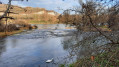
(10) Walk along the dead arm of the Rhine, which receives the Scheidgraben stream from the other side of the canal. It forms a wide right-hand bend, then joins Route EDF.
Follow it to the right and cross at the speed bumps (take care). After about 100 metres, turn left at the entrance to the "Parcours touristiques" (tourist trails). Take the footbridge over the drainage canal, then turn left onto the track. On the left, the Rosenau stream flows into the canal, and just after that you will find the path you took on the way there.
(1) Climb the Grand Canal dyke to reach the bank. Follow it to the left, passing close to afirst blockhouse. Continue towards the factory and the locks. When you reach a second blockhouse, turn left, go down the stairs and find the footbridge and the path you took on the way there to return to the car park (S/E).


 Visorando Member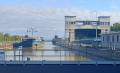

 Moderate