Country:
 City:
City:


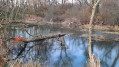
Park in the Rond-point de l'Énergie car park on Rue de Rosenau in Kembs. There is an information board presenting the turbines that adorn the roundabout.
(S/E) With your back to the sign, go around the roundabout on the left to reach the Route de Niffer on the opposite side. To do this, take the cycle path to the end of the central reservation and cross the road (take care). A path at the foot of a road sign crosses the hill and leads to the road on the right. Follow it to the left for about 50 metres. Cross the road and take the path that leads to the Grand Canal d'Alsace.
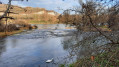
(1) Turn right on the bank, cross over the Augraben stream and then climb up along the fish pass to the bottom of the road, at the start of the access road to the hydroelectric site.
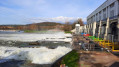
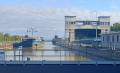
(2) Turn left to the staff car park and climb the stairs. The landings offer views of the plant and the turbulent waters of the spillways.
When you reach the end of the bridge, turn right along the road. Overlooking the previous access road, you can enjoy a sweeping view of the entire site. Continue, leaving the "Visitor Car Park" on your right, and 150 metres further on you will find a large red and white portico.
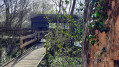
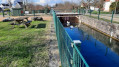
(3) Pass through the archway, turning completely to the left, and join a wide cycle path. Continue south, pass under the high-voltage lines and arrive at a small car park on the edge of the forest. At the end of the car park, follow the cycle path between the trees and take the footbridge over the drainage canal, which collects water from the west.
(4) Leave the path (return route) and climb the stairs on the left. They lead to the bank of the Grand Canal at the locks. Notice thefirst blockhouse opposite. With your back to the factory, follow the bank marked with white hectometre markers. Also note the piezometric markers marked with a red sign. These measure the water table level. Head towards asecond blockhouse visible in the distance, followed immediately by marker no. 7. About 50 metres further on, turn right towards two piezometric markers and the start of a path.
(5) It descends steeply towards the cycle path. Head left towards a footbridge over the drainage canal, which just before it receives water from the Rosenau stream. When you reach Route du Sipes, cross carefully, pass the Rosenau exit sign and shortly afterwards enter the Scheidgraben path.
(6) It runs alongside a dead arm of the Rhine, forming a wide left turn. At the end of the turn, note the start of a path on the right (near a yellow sign marked 35).
(7) There are two options:
1) Cross the meadow, veering to the right to reach the bank of the Canal de Huningue, then turn left to rejoin the route at point (9). Avoid this route in wet weather, as the often grassy bank becomes muddy.
2) Option chosen on the map and in the description: continue along the wide path shaded by a pond, then along the paved section, Rue de Kembs, until you reach the crossroads at no. 44.
(8) Turn right into the street and continue along Rue de l'Au. At the end, pass between two residences, "Les Jardins de Jules", to reach the bank of the Canal de Huningue. Follow it to the left until you reach the steps and climb up onto the road bridge.
Please note: if the path is very overgrown, return to the front of the residences, turn right and then right twice to reach the bridge at point (9).
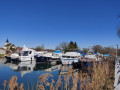
(9) Keep to the right on the bridge to descend to the bank and the cycle path, passing under the bridge. Along this left bank, you will soon reach a crossroads, opposite a picnic area and the Rosenau lock. See Practical Information.
(10) Stay on the left bank along the canal dyke to begin a 3.5 km circular route around the Grand Marais. Leave the return path and the Grand Étang de l'Au below on your right. After about 600 m, you will come to thefirst observatory.
(11) It offers an extensive view of the northern part of the Grand Marais. Continue along the route for about 300 m, then descend to the right, a few steps down a staircase leading to the bucolic sentier des marres (pond trail). Further on at the crossroads, keep to the right until you reach thesecond observatory.
(12) Beautiful view of the southern part of the Grand Marais, sometimes frequented by Highland cows. Return to the previous crossroads, turn right twice and you will find yourself back on the canal dyke. Shortly afterwards, a path descends to the right.
(13) This is the beautiful Mittlere Au (middle marsh) path, between ponds and marshes, which leads to a crossroads marked on the left by a majestic black poplar. Turn left and you will reach the Georges Muller Observatory, popular with birdwatchers.
(14) Return to the crossroads, leaving apathon duckboards on your left and the black poplar on your right. Take thesecond path on the left, which passes by a beautiful observatory on the southern part of the Grand Marais. Highland cows and Konik Polski horses can sometimes be seen from this observatory.
(15) Return to the path. It leads to a lane opposite thefifth observatory, the Étang Nord.
(16) Return to the lane coming out of the observatory and turn left. At the crossroads, leave the bridge on your left and continue straight ahead. The Augraben river flows on your left. A few dozen metres further on, you will come to a crossroads.
(17) There are two options: see Practical Information:
1) Between1 Marchand1 July: keep to the left, straight ahead between the fields until you reach the first cross path, just after a sign for "Petite Camargue". Turn right between two fields, then left towards a hunting shelter and the Grand Étang. Follow the riverbank to the Huningue Canal dyke, then turn left to reach the picnic area.
2) Outside the period from1Marchto1 July: continue right on the Grand Marais trail (see map). It runs alongside the shrubs bordering the marsh and then the Canal de Huningue dyke to reach the end of the Grand Étang de l'Au. Continue below the dyke to reach the picnic area.
(10) Take the bridge on the right, then the path immediately on the right along the lock, continuing on the right bank of the canal. You are now on the "Chemin des Planètes" ( Planet Trail). See Practical Information.
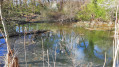
After a few hundred metres, you will see a small pond on your left, formed by a stream flowing from the Grand Marais under the canal.
(18) This is the "Ruisseau de Rosenau". A few steps (not very easy to navigate) lead down to the stream for a possible return trip. Shortly afterwards, leave the bank via the path that descends to the left and leads to a street. Turn right and then immediately left onto Rue du Soleil. It winds through a housing estate to reach the junction with Rue de Village Neuf.
(19) Turn left for about 300 metres, just after the restaurant, and cross Rue du Ruisseau. Turn right along the Rosenau Stream and you will arrive at the mill and the street of the same name. Turn right until you reach the roundabout.
(20) Go around the roundabout on the left, passing in front of theSecond World War tank, "Mémorial du Lieutenant Jean de Loisy". See During the hike or nearby.
Cross the road and enter the path between the trees. At the small car park, turn right and take the footbridge over the drainage canal.
(21) Cross the cycle path and climb the stairs leading to the bank of the Grand Canal. Follow the bank to the left and you will find marker no. 7 and the blockhouse you saw on the way there.
(5) As on the way there, go down the path on the left. Continue to the right on the cycle path. After 150 m, you will see the confluence of the Scheidgraben. At the end, you will find the footbridge over the drainage canal, which forms the fish pass.
(4) Continue in the opposite direction to the outward journey until you reach the portico, then continue straight ahead to finish the route on the track that passes asecond portico and crosses Rue de Rosenau towards the energy roundabout (S/E).


 Visorando Member
 Easy
Easy 
 Tourist office