Country:
 City:
City:


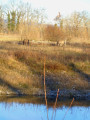
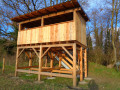
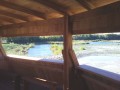
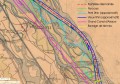
Walk along the old bed of the Rhine.
Car park near the Kembs Dam on the German bank: Rheinstraße 1, 79576 Weil am Rhein, Germany.
(S/E) From the car park, head towards and cross the footbridge overlooking the five monumental sluice gates that regulate the flow of the Old Rhine. Pass the mini power station A, then go over a fish ladder and go round the new mini power station B on the left. Continue for 100 metres along the bank of the Grand Canal.
(1) Leave the bank of the Grand Canal, heading down to the right towards the Old Rhine. Cross the bridge over the source of the Little Rhine. Continue for 100 m with the power station’s tailrace on your right, flowing towards the Old Rhine, then turn left towards a gate where the “Path from the Little Rhine to the Old Rhine” begins.
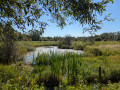
(2) The path winds its way through the trees on a return trip to a viewing point. After a bend to the right, the path leads to an access ramp up a hillock on the left. Enjoy the view from viewing point No. 1 over the ponds, reed beds and woodland, and the birds that inhabit them.
Retrace your steps to rejoin the path leading to the banks of the Old Rhine.
(3) As you climb onto the embankment, look to your right at the downstream section of the dam before continuing along the Old Rhine on this shaded path, a former towpath.
The vegetation is dense and the path features viewing points, some of which can be reached via short, return-trip paths of a few metres that allow you to get closer to the bank (please follow the instructions on the signs at each entrance).
(4) Take advantage of a clearing on the left to reach the end of the “Sentier du Petit Rhin au Vieux Rhin” path; observation point No. 2 has been set up there. Highland cattle, sheep and goats are often visible from this spot or nearby. Return to the towpath. 1 km further on, turn left towards a bridge over a branch of the Petit Rhin, offering a 360° view of the area.
(5) From the bridge, continue between the two branches of the Petit Rhin. Enter the forest to reach, just before a left-hand bend, the mouth – somewhat hidden by the vegetation – ofthe first branch, which flows into the Vieux Rhin. Further on, rapids on the Vieux Rhin herald the Istain sandbar 500 metres downstream – a rocky sandbar popular with many birds, as well as numerous bathers on the German bank in summer.
(6) Shortly after the Istein bar, a path on the left climbs parallel to the towpath. It turns left onto a picturesque cross-country path leading to the Grand Canal. It crosses the forest, a bridge over a wetland area, then a dry area – home to orchids – and emerges onto a track suitable for vehicles. Opposite, climb the hill to reach the bank of the Grand Canal.
(7) To the right, the two large locks at Kembs seem very close by (they are 1 km away; see ‘During the walk’ or nearby). Take the return path to the left, heading upstream. (See alternative route in ‘Practical information’.)
The constant flow of barges on the Grand Canal breaks up the monotony of the long tarmac path somewhat.
You can also alternate with the parallel path below, which is more shaded and offers a few views of the renaturation area whilst you wait for cross-country paths to be created. Continue to observation point No. 3.
(8) The bank of the Grand Canal overhangs by several metres and often offers views of the ponds, dry meadows and plantations on the southern side of Île du Rhin. A stop at the observation point or nearby often provides a chance to see the Konik Polski horses introduced to the island.
(1) Resume your walk and return to the starting path, then pass the fish ladder, the weir and the car park (S/E), with the Huningue-Village Neuf water sports centre to the right and the port of Basel to the left, both visible in the distance upstream of the Grand Canal.




 Visorando Member

 Moderate