Pic de Rochebrune circular walk

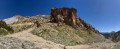
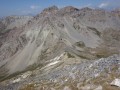
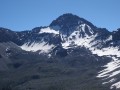
A spectacular alternative route up the Pic de Rochebrune, which explores the wild Casse des Clausins – home to golden eagles and edelweiss – and returns to the Col de l’Izoard via the Casse Déserte and the monoliths of l’Agnel.
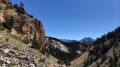
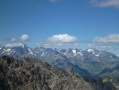
The peak, the highest in the Briançonnais region, offers panoramic views of the French, Swiss and Italian peaks.
A good quarter of the walk takes place off the marked trail, and reaching the summit requires a single grade 3 climbing move on very good rock.

Moderator’s note: access to the Pic de Rochebrune has been authorised again since 22 July 2024 following the rockfalls of 2023. However, it is advisable to consult the guidelines provided via this link

Details

3684600
Creation:
Last update:
Last review:
  • Walking
    Activity: Walking
  • ↔
    Distance: 8.57 mi
  • ◔
    Duration according to the author: 8 hrs 
  • ▲
    Difficulty: Very difficult

  • ⚐
    Back to start: Yes
  • ↗
    Ascent: + 4,386 ft
  • ↘
    Descent: - 4,403 ft

  • ▲
    Highest point: 10,764 ft
  • ▼
    Lowest point: 6,791 ft

Photos

Description of the walk

N.B. See the practical information on how to get to the start of the hike ?️ and also to understand the directions ? and the terminology used for peaks and waypoints.

(S/E) From the pass, take the clearly visible north-easterly path heading towards a signpost indicating the Col Perdu. Follow the path, which reaches the Col Perdu in less than 800 m.

(1) At the pass, do not take the path heading south-east! Instead, head back down the other side towards the north for less than 100 m and take the first path that descends to the right towards the east, along the slope below the Pic Ouest de Côte Belle. Then follow this very good path along the slope to go round a rocky shoulder and then climb up the Casse des Oules. Just before the Col des Portes, cairns mark a shelter in the rock which can be used in the event of a storm.

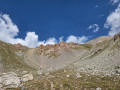
(2) From the Col des Portes, head due east up the ridge, following the sometimes contradictory cairns to take the easiest route and aim for the clearly visible gap between the South Tower and the South Summit. The couloir descending from this gap features a rocky spur in the middle. First, head for the left-hand side (right-hand branch) of the couloir to reach the base of this spur, then traverse to the right-hand side beneath this base and complete the ascent on that side. A snowfield covers the gap all year round.

(3) At the gap, look out for the fixed rope on the left on the north face. This rope is not essential but it indicates where to climb on the rock, which has good holds. At the top of the fixed rope, take the ledge running off to the right towards the north-east. Follow this ledge (see orientation photo), which quickly becomes almost horizontal and descends slightly before leading to a small dihedral, allowing you to gain a foothold in the small, gullied cirque beneath the summits, whose ‘antennas’ you will soon be able to see.

Climb up the easy gully in this hollow to reach the central summit.

(4) From the central summit, follow the ridge on the eastern flank to reach the southern summit and admire the South Tower.

(5) Return to the saddle (3) via the ascent route. A rope may provide reassurance for those who are not comfortable with downclimbing. From the saddle, descend to the Col des Portes.

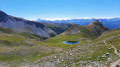
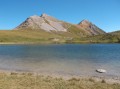
(2). At the pass, descend by sight down the scree slope to the south-west. There are no cairns, but simply head for the grassy ledges below, keeping a south-easterly bearing (right bank of the Casse des Clausins). Reach an almost horizontal path skirting the foot of a shoulder descending from the Crête des Oules and continue along this path towards Lac de Souliers, which is clearly visible.

(6) From the lake, take the excellent path descending south then south-west. It skirts the ridge extending from the Crête de Coste Belle before heading slightly downwards north-west towards the Col de l’Izoard road.

(7) Once you reach the road and the car park, look to the left (at the southern end of the car park) for the start of the path leading down to Brunissard (signposted). Follow this path down to the pebbly bed of the Izoard torrent.

(8) Cross the tributary of the Izoard flowing down from the Casse Déserte, then follow the Izoard torrent northwards, first on the left bank and then on the right bank. After a few hairpin bends, the path crosses the tarmac road four times before reaching the Col de l’Izoard (S/E).

Waypoints

  1. S/E : mi 0 - alt. 7,746 ft - Col d'Izoard
  2. 1 : mi 0.77 - alt. 8,123 ft - Col Perdu (2479m)
  3. 2 : mi 2.99 - alt. 9,475 ft - Col des Portes (2962m)
  4. 3 : mi 3.36 - alt. 10,732 ft - Brèche du Pic de Rochebrune
  5. 4 : mi 3.42 - alt. 10,764 ft - Sommet Central du Pic de Rochebrune
  6. 5 : mi 3.46 - alt. 10,741 ft - Sommet Sud du Pic de Rochebrune
  7. 6 : mi 5.63 - alt. 8,169 ft - Lac de Soulier
  8. 7 : mi 7.23 - alt. 7,231 ft - Car park at La Casse Déserte below the Izoard
  9. 8 : mi 7.62 - alt. 6,811 ft - Junction with the Izoard torrent
  10. S/E : mi 8.57 - alt. 7,746 ft - Col d'Izoard

Notes

?️ Park at the Col d’Izoard car park, N 44.819685° / E 6.735028°. By clicking on this Waze link, you can enter these coordinates directly into your favourite sat-nav app.

? Water is scarce, so make sure you bring enough with you. If you have a filter, you can refill your water at Lac de Souliers (6).

? Dogs are allowed in the Queyras National Park, but this hike is not particularly suitable due to the easy climbing section at (3) (however, you can leave your dog at the pass whilst you climb to the summit and back).

?‍♀️ The difficulty of this hike lies on the borderline between ‘Very difficult’ and ‘Extremely difficult’. There is a single section (3) requiring a ‘climb’ of less than 3 metres, and a fixed rope is available to assist you there.

? Due to the climbing section at the pass and the exposed ledges between point (3) and the summits at (4) and (5), it is essential to undertake this hike in dry weather.

? The hike is short and not suitable for bivouacking.

? Standard hiking kit is sufficient. However, if you wish to climb directly from the col at (3) to the southern summit at (5), a 30-metre rope and traditional climbing gear (slings, harness, etc.) will allow you to bypass an exposed ledge section via solid rock (bolts and pitons in place).

⏰ At the start of the season, it is essential to set off very early to ensure the snow is firm enough for the descent below the south-facing Col des Portes. In early June, you need to leave the pass at 3 am to stay safe in the Casse des Clausins. From August onwards, there are no longer any time constraints.

? The IBP statistics for the route give an index of 182HKG, a distance of 16.66 km, a cumulative elevation gain of 1,588 m, a walking time of 6h 25m 44s and an average speed of 2.59 km/h.

? Finding your way is straightforward and involves skirting the ridges of Côte Belle and Les Oules. The description of this hike uses the following terminology: the three summits of the Pic de Rochebrune are the northern summit (see photo), the central summit, which has a radio mast powered by large solar panels (see this photo), and the southern summit, which also has a mast (see this photo); these summits are separated by a gap from the South Tower of the Pic de Rochebrune (see this photo), from which the couloir descends (see view from above and view from below) leading to the Col des Portes (see this photo).

? There is only one emergency number in France: 112. Other numbers (15, 17, or direct numbers…) have no priority on mobile networks, do not route via other operators’ networks when there is no signal, and in the event of an overload of calls, ongoing calls are cut off to prioritise 112. So forget about them as soon as possible; they are dangerous and no longer serve any purpose (contrary to what some outdated first-aid training courses claim). If you cannot speak or hear, use 114 to communicate via text message. 112 works on any mobile phone (and landlines too, of course), including on a locked phone and even if the SIM card is blocked (however, since 2004, France has been in breach of European recommendations and blocks calls to 112 when there is no SIM card in the phone. This blocking measure required special investment, as the GSM standard naturally allows calls without a SIM card. Taxpayers will appreciate this particularly clever use of public funds).

Please note: if your call is cut off, it is up to you to ring the emergency services again: they have no way of contacting you or locating you. Remember to note down your GPS coordinates before calling, as the French government has not seen fit to equip emergency centres with AML (Advanced Mobile Location) technology, even though this has been mandatory in Europe since 2018).

? In the mountains, switch your phone to 2G: the coverage of this technology is 4 to 8 times greater than that of newer technologies, and it uses significantly less power. Remember to switch off your Wi-Fi, which drains the battery quickly and serves absolutely no purpose outside homes and offices. Bear in mind that your phone’s GPS tracking works even in aeroplane mode (GPS has nothing to do with mobile networks); in areas with no mobile coverage, you can switch off mobile data without affecting your GPS tracking.

⚠️ As a general rule, remain sceptical about IGN topographical maps (in my experience, the institute never corrects reported errors, even after serious accidents caused by these errors – see my profile for further details). The base maps for IGN topographical maps date back more than 25 years and have not been updated since (!). The free OpenStreetMap, updated by volunteers, is usually much more up to date; it is best to consult its OpenTopoMap version, which is easier to read.

Worth a visit

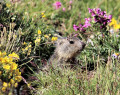
? Alpine wildlife is present, in particular chamois and golden eagles. During my first exploration of the peak, I had the (once-in-a-lifetime) chance to see five young golden eagles circling in a group around the 3,197-metre summit just south of the Pic de Rochebrune massif. The Casse des Clausins is rich in edelweiss (picking is prohibited!).

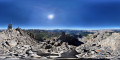
? The views from the summits are magnificent. See these interactive photos taken from the central peak (the highest) and the southern peak, as well as from the Casse des Clausins. If you camp for the night at the Col de l’Izoard, the sunset there is superb. This photo album documents my first visit to the area.

? Several alternative routes are possible. From the breach (3), it is possible to climb almost directly to the southern summit (5) by following the climbing route equipped with bolts (climbing equipment required).
If you’re in a hurry, simply head back down via the same route you took up (see the round-trip hike). If you’d like to make it a bit more challenging, simply climb from Lac de Souliers (6) to the western peak of Côte Belle, then descend by sight along a clearly visible gully on the path between (2).

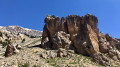
? A ‘casse’ (Casse Déserte) is a scree slope. An ‘agnel’ is a young lamb. The ‘Clausins’ are an enclosed, circled area.
The terms ‘right bank’ and ‘left bank’ are always used in the orographic sense: they refer to the right or left when looking downstream (in the direction the water flows).

Reviews and comments

4.7 / 5
Based on 3 reviews

Reliability of the description
4.7 / 5
Ease of following the route
4.3 / 5
Route interest
5 / 5
rage2001
rage2001

Overall rating : 5 / 5

Date of your route : Jul 22, 2024
Reliability of the description : ★★★★★ Very good
Ease of following the route : ★★★★★ Very good
Route interest : ★★★★★ Very good
Very busy route : No

The isolated and imposing Rochebrune peak is the highest point in the Queyras massif. It is a summit that has to be earned, a challenging climb from the Col des Portes over difficult terrain. Some sections are beyond the scope of a classic hike, bordering on mountaineering.
For a map and photos, visit: https://treksrandos.fr/alpes/hautes-alpe...

Machine-translated

Pytheas
Pytheas

Overall rating : 4 / 5

Date of your route : Nov 10, 2024
Reliability of the description : ★★★★☆ Good
Ease of following the route : ★★★☆☆ Average
Route interest : ★★★★★ Very good
Very busy route : No

Hello,
Route taken on Sunday 10 November. The route is almost entirely dry, apart from a few dozen metres before the Col des Portes and, of course, the snowfield beneath the breach. The ascent can therefore still be done without any equipment (apart from a helmet)

The path is very well marked and easy to follow up to the Col des Portes. (Be sure to take the most clearly marked path which descends to the first hairpin bend below the Col Perdu. If you head straight south-east towards the spur, you’ll have to climb back down through the scree to find the correct path).

Due to the highly unstable scree between the Col des Portes and the Brèche, I would classify this route as ED.
WARNING: spontaneous rockfalls in the recent scree field. Take care to stay on the higher side of the shoulder, from the pass to the breach. The ascent is gruelling, and the descent is extremely dangerous for those below. Under no circumstances should you enter the valley to the south of the shoulder. The debris cone lies in the direction of the descent from the Col des Portes.

IT IS STRONGLY RECOMMENDED THAT YOU WEAR A HELMET, WALK AS CLOSELY TOGETHER AS POSSIBLE, AND BE EXTRA VIGILANT REGARDING THE RISK OF ROCKFALL, WHETHER TRIGGERED BY YOURSELF OR FROM ABOVE. I saw a 40cm boulder fly and bounce from 50m below the breach all the way down to just below the pass.

After the fixed rope, on the right it is possible to set up a rope (there are bolts and carabiners). The easiest route without a rope is on the left (large steps and a few cairns). I climbed up via the bolted route (easy climbing with good holds), and descended via the cairns for an easier and less exposed descent.

The scree slope below the Col des Portes isn’t very pleasant (alternating between loose scree and coarser rocks). Watch your ankles.

Once you reach the grassy ledges, the path becomes increasingly easier all the way to the lake, then follows the GR route all the way to the deserted car park at La Casse. Don’t miss the start of the path that descends into the valley of the Torrent d’Izoard; otherwise, it’s still possible (though less pleasant) to return to the Col de l’Izoard via the road (about 2 km).

Machine-translated

GrandJe
GrandJe
• Edited:

Overall rating : 5 / 5

Date of your route : Aug 25, 2021
Reliability of the description : ★★★★★ Very good
Ease of following the route : ★★★★★ Very good
Route interest : ★★★★★ Very good
Very busy route : No

an excellent presentation, as well as the research context in the event of a call to 112

Machine-translated

Other walks in the area

For more walks, use our search engine .

The GPS track and description are the property of this route's author. Please do not copy them without permission.