Not Charassons and Arche Miracle

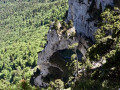
A breathtaking circular route linking together numerous wonders: the rugged Pas des Charassons, the scenic Crête de l’Alpette, the magnificent Écaille du Pas de Ragris, the famous Tour Percée, the precarious Arche Miracle and the beautiful Aup du Seuil pass.

This hike, covering less than 13km with 1,500m of elevation gain, requires a good sense of direction and sure-footedness (short sections of grade 3c climbing). Please note: the IGN topographic map is completely unreliable here!

An agreement has been signed between the department and the owner of the 800 hectares in the Hauts de Chartreuse nature reserve to allow free access to the two paths that run across the Marcieu plateau. The exit at Pas des Charassons, which leads back onto the plateau, joins one of these paths within a few metres. You may request permission to pass from the landowner, although there are no visible prohibition signs on the ground.

Details

2229313
Creation:
Last update:
Last review:
  • Walking
    Activity: Walking
  • ↔
    Distance: 8.16 mi
  • ◔
    Duration according to the author: 6 hrs 
  • ▲
    Difficulty: Extremely difficult

  • ⚐
    Back to start: Yes
  • ↗
    Ascent: + 4,783 ft
  • ↘
    Descent: - 4,780 ft

  • ▲
    Highest point: 6,224 ft
  • ▼
    Lowest point: 3,576 ft

Photos

Description of the walk

Warnings: this hike is particularly difficult and a minimum of preparation is required before attempting it. It is recommended that you read the practical information in full, observe the landscape, consult the captions for all the waypoint photos listed in the description below, and use maps other than the IGN topographic map (which is significantly inaccurate).

See the practical information for the car park.

(S/E) At the car park, do not go through the barrier on the forest track (usually open), but walk 10m in the opposite direction, towards the south-west, to find a path leading up into the woods on the right (west-north-west).
This path turns right to cross the forest track and continues climbing northwards through the forest. Shortly after crossing the ski run and the Grand Essart ski lift, it takes a right-angle turn to the left (yellow and red markings) and reaches a junction.

(1) Ignore the steep, gravelly path climbing to the right and continue south-west along the forest track ascending beneath the Alpette. During a long descent, this track crosses another: take the latter to the right (north-east) to climb back up to a signpost (yellow and red markings).

(2) At the signpost, turn left towards Les Playères and the Tour des Petites Roches. The track, overgrown with grass, climbs steeply westwards before levelling out and crossing a first small stream, then a second one next to plastic water collection tanks. Shortly afterwards, where the forest thins out, a tiny cairn beneath a rock marks the start of the Pas des Charassons path (see location photo) on the right.

(3) Take the faint path that climbs north-northeast to reach a less dense area of woodland beneath a ravine. Climb the ravine on its left bank, heading generally north-west. The path heads into the woodland on the right before returning to cross the ravine. Yellow markings indicate the path. You will reach the top of the ravine at a small rocky escarpment on which a yellow arrow is painted.

(4) Follow the path in the direction of the yellow arrow, south-west, to reach a three-way junction marked on the rock by old yellow inscriptions. With a little imagination, you can make out the words ‘cheminée’ to the right and ‘direct’ to the left.

(5) Turn your back on the covered ridge to the right and head left to continue climbing westwards. You’ll reach a shoulder from which you can see the ridge leading to the Petit Tas. Do not cross this shoulder; instead, turn right and climb it north-westwards until you come to a high rocky ledge.

(6) A cable provides a belay to help you cross the ledge and gain a foothold on the grassy bench. The path heads off to the right (north-east) and leads to the final obstacle before the exit onto the ridge: a short, unprotected grade 3 climb, marked with a yellow line.

(7) Climb the short section using the good holds (check they are secure before relying on them) to emerge onto the Alpette ridge, still following the yellow markings. A panoramic view allows you to get your bearings.
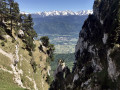
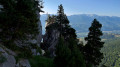
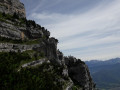
Head north then, through the grass on the ridge and along the cattle fence, staying as close as possible to the cliff to enjoy the view of Belledonne and the numerous rock outcrops offering spectacular scenery. The ridge slopes north-west, and after passing several small humps, reaches the summit of Les Charassons.

(8) From the summit (where the IGN map marks the Pas des Charassons), admire the Aulp du Seuil path, then, as you wish, continue along the ridge or go round the final peak (1,864m) to the north-east before reaching the Passage de l’Aulp du Seuil and its metal cross.
From the cross, continue north-east along the path closest to the ridge to reach a narrow passage through the rocks leading towards Belledonne. A yellow mark indicates this passage, the Pas de Ragris.

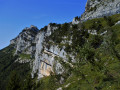
(9) Descend the very steep path below the pass, first eastwards then veering north-east to reach a gully preceded by cables on the rock. Descend the gully to arrive above the distinctive Écaille du Pas de Ragris.
The path, still sporadically marked in yellow, passes to the left of the rock formation and heads generally north-east, winding a few times along the way and passing a few rocky ledges. It arrives beneath overhangs on the cliff face, to which a few fixed ropes are attached (unnecessary for the hike!). Continue north-east to join an ascending path coming up from the right.
Do not turn right (unless you wish to shorten the hike, see alternatives described below) but take the path in the opposite direction, northwards, to follow the base of the cliff.
After about 500m, cross the scree slope separating the Aiguillette (on your left) from the cliff to the south, then cross the next ravine separating the Aiguillette from the cliff to the north. Do not take the rope traverse on the rock face opposite this ravine, but descend about ten metres into the ravine (briefly due east) before continuing northwards along the path.
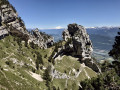
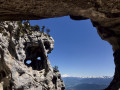
The path leads to a scree gully and does not continue beyond it. Climb up to the left, due west, preferably staying on the left-hand side of the scree, on one of the paths through the grass and rocks, and reach the small climbing move (arrow indicating where to go) allowing you to gain a foothold in a grassy cirque. Take the correct winding path that climbs up the left-hand side of this cirque until you reach the double arch of the Tour Percée, an arch that comes into view at the last moment and through which you can see the ‘eyes’ of the rock.

(10) After visiting the Tour Percée, return to the path that climbs eastwards above it and turns south to cross a small section where you may need to use your hands. After rounding a rocky outcrop, the path, now a narrow track, descends slightly towards the bottom of a steep grassy and clay-soil gully.

(11) Climb up this clayey gully (an ice axe is very useful) to emerge, after using a few trees for support, onto the Aulp du Seuil ridge path. Follow this ridge path to the right (north, see the orientation photo taken from slightly lower down) to exit the Tour Percée cirque.
The path then crosses a first gully, before entering a steeper one. Proceed to the bottom of this gully, against the cliff face, to look down atthe Arche Miracle, which is quite difficult to see.
Continue northwards towards the end of the gully, and descend the ridge separating it from the next one to approach the edge of the rocks overlooking the arch. Without the use of a rope, this is the best spot from which to observe its size and delicate balance.

(12) After viewing the Miracle Arch, turn back (unless you wish to take the alternative route out via the north, see below) and head south along the Aulp du Seuil ridge. Pass over the clayey gully and follow the sheltered path beneath the cliff. In the next valley, on the right, there is a passage through a weakness in the cliff; this passage is recognisable by the thin slab of rock at the top of a gully.

(13) Climb this easy grassy and rocky gully to emerge onto the ridge. Take the ridge path on the left (south), which zigzags over the small peaks and returns to the Ragris before reaching the Passage de l’Aup du Seuil (cross).
Then take the marked and fenced path which descends towards the Col de Marcieu via the Pré de l’Alpette. It is possible to avoid the awkward steep gravel slope mentioned in (1): just before this, a path branches off to the right and leads via log steps to the junction.

(1). From there, descend to the car park either via the ascent route or by taking the grass-covered ski run that crosses the path taken on the way up. Turn right (south) onto this path and follow it to the track leading to the car park (S/E).

Waypoints

  1. S/E : mi 0 - alt. 3,576 ft - Car park at the hamlet of Saint-Michel - Col de Marcieu
  2. 1 : mi 0.71 - alt. 4,232 ft - Junction
  3. 2 : mi 1.61 - alt. 4,360 ft - Les Playères signpost
  4. 3 : mi 2.05 - alt. 4,685 ft - Mini cairn under a small rock
  5. 4 : mi 2.53 - alt. 5,299 ft - Yellow arrow
  6. 5 : mi 2.61 - alt. 5,364 ft - Worn yellow three-way junction signs
  7. 6 : mi 2.68 - alt. 5,574 ft - Cable or 3c route
  8. 7 : mi 2.71 - alt. 5,702 ft - Ridge route (3a)
  9. 8 : mi 3.13 - alt. 6,047 ft - Sommet des Charassons
  10. 9 : mi 3.5 - alt. 5,968 ft - No Ragris
  11. 10 : mi 4.48 - alt. 5,738 ft - Tour Percée
  12. 11 : mi 4.6 - alt. 6,014 ft - Clayey corridor towards the Sangle de l’Aulp du Seuil
  13. 12 : mi 4.93 - alt. 5,899 ft - View of the Arche Miracle
  14. 13 : mi 5.6 - alt. 6,033 ft - Hike towards the ridge
  15. S/E : mi 8.16 - alt. 3,579 ft - Car park at the hamlet of Saint-Michel - Col de Marcieu

Notes

The route runs almost entirely through the Hauts de Chartreuse nature reserve and it is essential to respect the rules:

  • Do not make noise,
  • Do not pick plants,
  • Do not light fires,
  • Do not pitch a tent (bivouacking in a sleeping bag is permitted from sunset to sunrise and prohibited in July and August),
  • Do not bring dogs, even on a lead,
  • Take all rubbish away with you, including tissues, fruit peelings, etc.,
  • Bury your waste,
  • Stay on the existing paths and never cut across the switchbacks.

Furthermore, this hike is very unsuitable for group outings. A maximum of four people will be safe (rockfalls in the gullies are inevitable, and it is essential to stay together).

  • Park above the Col de Marcieu, at the hairpin bend on the forest track that follows the tarmac road up to the hamlet of Saint-Michel (private estate), at the start of the classic Aulp du Seuil route.
  • Water is scarce, as is often the case in the Chartreuse; make sure you bring enough with you.
  • Dogs, even on a lead, are prohibited on the high plateaus of the Chartreuse.
  • The difficulty rating of this hike is due to a few short climbing sections (two 3c sections), the difficulty of navigation, and the exposure to a drop on the ledges. Be careful: on the short exit section onto the ridge, the rocks are embedded in loose soil and can easily shift; check their stability carefully before leaning on them.
  • The hike is short and not suitable for camping unless you wish to experience both sunset and sunrise. In that case, the Pas de Ragris (on the ridge) is a good spot.
  • Standard hiking kit is usually sufficient, but a rope may reassure some people on the tricky sections of the Pas des Charassons and around the Tour Percée. A via ferrata lanyard allows you to secure yourself to the cable (6). Far more useful than a rope, an ice axe—or even two—allows you to progress safely through the muddy gullies (11) and (13). For those who enjoy sunrises or sunsets, a head torch is essential.
  • The IBP statistics for my initial route show a distance of 13.5 km, a total elevation gain of 1,407 m, a walking time of 4:09:54 and an average speed of 3.27 km/h.
  • Navigation is straightforward except between the signpost (2) and the exit (7) on the ridge. Take a good look at the reference photos before the hike. As the IGN topographic map is particularly inaccurate, a GPS — or, of course, the Visorando app — is recommended to ensure you stay on course.

⚠️ The IGN topographic map is notoriously inaccurate, but here it is even more so than usual. In particular, the Pas des Charassons (7) is incorrectly named Pas de l’Écharasson, but more importantly, it is located nearly half a kilometre (!) too far north, and what’s more, on the summit (8). The route of the cliff-foot path between (9) and (10) is also too short and could lead you down a dead-end valley if you were to follow it. The contour lines and obstacles on the Aup du Seuil ridge are completely made up.
Generally speaking, remain critical of IGN topographic maps (from experience, the institute never corrects reported errors, even after serious accidents caused by these errors – see my profile for further details). The OpenStreetMap is generally much more accurate, but the Visorando app would need to use the OpenTopoMap version for it to be truly user-friendly.

This route passes through a protected area, which may be subject to special regulations:

Worth a visit

  • Alpine wildlife is, of course, present, with numerous chamois in the less-frequented cirques, particularly below the Pas des Charassons. The Cirque de la Tour Percée often hosts chamois even in the middle of the day.
  • The views along the hike are magnificent. This interactive photo allows you to see the landscape from the exit at (7) from the Pas des Charassons. The full album of the trip is available on Google Photos.
  • Several alternative routes are possible. The simplest is not to exit onto the ridge at (13) but to continue south along the Aup du Seuil ridge, towards the Pas de Ragris. Shortly before this, a short tricky section is equipped with a rope handrail. Once at the Pas de Ragris (9), you can either climb back up onto the ridge and follow its path southwards until you reach the main path of the Passage de l’Aup du Seuil, or join this path by following the ridge path that continues southwards below the Pas de Ragris.
    It is also possible to continue northwards along the Aup du Seuil path beyond the (12), to emerge onto the ridge via steep grassy slopes interspersed with rocky ledges, at the point where the GPX track ends to the north: a line of pine trees descending from the ridge onto the rocks marks the spot where you should climb up (either to the right or left of the line; both routes lead to the same place). ⚠️ The track on OpenStreetMap goes too far north! Once on the ridge, head left towards the south to rejoin the route shortly afterwards (13).
    If you’re short on time, you can do just half the hike. The Tour Percée circular route is described as a separate route. The lesser-known Pas des Charassons route involves descending directly via the Pas de Ragris route without going via Tour Percée.
    For the ascent to the Pas des Charassons, you can turn right at the (5) towards the chimney. Please note that this is located below, right at the end of the covered path. You can descend towards the ravine via this chimney, following the yellow markings. But to continue towards the ridges, you must stay close to the cliff and follow the path towards the valley floor beneath the Cirque des Charassons (easy to spot beneath the ochre overhang of the cliff). From there, a short exposed climbing section allows you to get past a rocky outcrop, then steep slopes lead to the path at the foot of the cirque’s cliff. Turn left (south) onto this path to reach the base of a steep gully that appears to lead out towards the ridge (do not attempt this: it is proper climbing). Descend below this gully towards the east, heading for the main trail, which you will reach shortly before the cable-assisted section (6).

(*) Pascal Sombardier isthe inspiration behind this circular loop, as he is for many others; see the excellent *Vercors secret* or his other works (which are unfortunately often out of print).

In the Chartrousin dialect, a ‘pas’ is a difficult passage or a pass. A ‘sangle’ (masculine!) is a path that follows a ledge along a cliff face, usually with little elevation gain. A ‘casse’ is a scree slope and a ‘ravine’ is a steep gully carved out by rainwater, often difficult to cross.

ⓒ I was able to complete and describe this hike, like many others around Grenoble, thanks to the books and guidebooks by Pascal Sombardier.

Reviews and comments

4.4 / 5
Based on 4 reviews

Reliability of the description
4 / 5
Ease of following the route
4.3 / 5
Route interest
5 / 5
Jean pierre @gsza1
Jean pierre @gsza1
• Edited:

Overall rating : 4 / 5

Date of your route : Jul 17, 2023
Reliability of the description : ★★★★☆ Good
Ease of following the route : ★★★☆☆ Average
Route interest : ★★★★★ Very good
Very busy route : No

I’d read that it was ‘easy to get lost’ – it’s true that you really mustn’t take a wrong turn; I explored several paths and ended up turning back, having gone up and down for nothing! But the place is well worth the effort because it’s so beautiful; once I know the area better, I’ll be back.

Machine-translated

Charlie 38
Charlie 38
• Edited:

Overall rating : 5 / 5

Date of your route : Sep 04, 2022
Reliability of the description : ★★★★★ Very good
Ease of following the route : ★★★★★ Very good
Route interest : ★★★★★ Very good
Very busy route : No

A superb hike with stunning scenery.

The route is fairly easy if you follow the GPS track.
It’s quite strenuous at times, with several sections of scrambling to reach the Isabelle Tower.

But it’s well worth the detour; the arch is simply stunning.
We climbed back up to reach the ridge, which offers a breathtaking view.

I recommend heading down to the Vallon de Marcieu – the valley is magical – and continuing on to the Dôme de Bellefond.

I recommend doing this as a group; it’s much more enjoyable, and the path is full of stunning spots.

I’ll be back, that’s for sure!

Machine-translated

Mimizen38
Mimizen38
• Edited:

Overall rating : 4.3 / 5

Date of your route : Aug 30, 2021
Reliability of the description : ★★★☆☆ Average
Ease of following the route : ★★★★★ Very good
Route interest : ★★★★★ Very good
Very busy route : No

Hello,

I did the hike this weekend and it really is quite challenging: in some places, the slightest slip could be fatal... so it should only be attempted in dry conditions.
Apart from the start of the Pas de Ragris, it isn’t particularly any more difficult than the standard path to the Isabelle Tower (though it is longer... so you need to be able to manage your energy levels to stay focused for longer).

However, we had quite a bit of trouble finding our way in the Pas de Charasson: the yellow arrows aren’t always very visible. We lost time, particularly at the fork leading to the climbing route (there’s a rope there… a path you shouldn’t follow).
It took us 9 hours to complete the route at a leisurely pace (including breaks, time to find our way, and taking photos)... but given the difficulty and the beauty of the views, it’s best to take your time.

Machine-translated

mbrivedegier
mbrivedegier
• Edited:

Overall rating : 4 / 5

Date of your route : Jul 26, 2019
Reliability of the description : ★★★★☆ Good
Ease of following the route : Not used / Not applicable
Route interest : Not used / Not applicable

Hello
I was interested in this route, but given the reported difficulties, I won’t be doing it – you have to know your limits!
However, well done for the warning about the IGN maps. I agree with your comments
It’s true that for my club, I’m used to mapping out routes that stray from the beaten track. Of course, that inevitably involves a recce. And I can confirm: ouch, ouch!!! The IGN map has become a poor guide for me
For your information, the latest route: 22 km, including 8 km off the IGN map, found through discussions with local FFRP clubs, and yet very beautiful paths, and 4 km marked on the IGN map, but completely nonsensical, and marked trails that aren’t on any map!!
In these cases, the GPS has only one function left: to re-calibrate a little when you’ve lost your way

Michel from Trévoux:

Machine-translated

Other walks in the area

For more walks, use our search engine .

The GPS track and description are the property of this route's author. Please do not copy them without permission.