Country:

 City:
City:


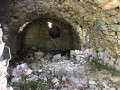
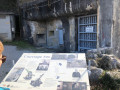
Park in the car park near the war memorial, Route de Suez. Toilets available.
(S/E) Head towards the roundabout then turn right onto the D2566 until you reach the Tourist Office. Turn left onto the small Place Saint-Pierre, where the Tourist Office is located. Turn right just past it; a sign points to Mont Barbonnet. Follow the paved slanting street, Rue des Romains, to the left, past the old houses. Walk alongside the ruins of the 12th-century castle, then the River Merlansson, which flows on your left. Continue to the railway bridge.
(1) Cross the railway bridge, continue straight ahead along the path that enters the woods until you reach the Route du Col Saint-Jean and reach marker 109.
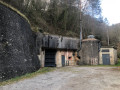
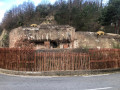
(2) Turn right. You will see the first Maginot Line fortification, built between 1931 and 1933. Continue with caution along the Route du Col Saint-Jean until the next bend. Follow the road to the left towards Fort Saint-Roch. Walk alongside a high stone wall dating from the 1930s. Continue along this road until you reach the entrance to Fort Saint-Roch.
(3) Leave the road and turn onto the wooded path leading uphill to the left. Go round another blockhouse. Continue through the woods until you reach a bend in the road. Turn right, follow the yellow markings, and continue to the Route de la Coletta. Follow this road for about fifty metres, then take a steep concrete ramp on the left. You will reach an old paved slanting street.
(4) Turn left; be careful here: do not follow the direction indicated by the Mont Barbonnet sign. Continue along the stony path which leads to the foot of a house.
(5) Continue along the stony path uphill to the Route du Barbonnet. Please note: the yellow markings end here
(6) Turn left onto the old military road. Follow a series of hairpin bends to reach the Maginot E06 fortification located below Mont Barbonnet.
(7) Walk alongside the fort and complete the climb to Fort du Knoll, also known as Fort du Barbonnet.
(8) Turn around and head back down the Route du Barbonnet to return to the junction of this road.
(6) Continue left and follow marker 112. Carry on a few metres further to Col Saint-Jean, located at thefirst marker 113 . Here you will find the GR®510.
(9) Turn left onto it and follow the red and white markings, taking great care; after about a hundred metres, you will reach asecond marker 113.
(10) Turn left and walk carefully along the Route du Col de Braus until you reach marker 114.
(11) Turn left, still on the GR®, towards La Baisse du Pape. Climb through a beautiful, open woodland. Walk past some ruins, a sign of past agricultural activity. Then, following a long path, reach marker 115 at La Baisse du Pape.
(12) Turn right onto the path running parallel to a track suitable for vehicles. Follow the signs for Col de Braus. Walk here, in an area devoid of any vegetation, along a strip of land about fifty metres wide. Reach a path junction.
(13) Leave the GR® and turn right at the edge of the forest onto a lovely unmarked track. Pass afirst, then asecond water reservoir. Continue to the nearby Tête de la Lavina.
(14) Turn back and take the track on the right to reach a multi-directional junction marked by two signposts, numbers 69 and 68.
(15) Follow the signs for Col de Braus, and turn right at marker 68. Head towards Sospel. Follow the yellow markings on this beautiful, gently sloping, wooded path to marker 62.
(16) Turn right towards Sospel onto the D2204 and follow it carefully until you reach marker 61.
(17) Leave the road and take the path on the left towards Sospel. Continue to marker 60.
(18) Continue straight on, running alongside a fenced-off property. This path has a soul. The cobblestones and stones were laid many generations ago. You will cross several tracks, but keep going straight on. There are a few faded yellow markings. Reach and cross the Impasse du Kaki, a track serving the hamlets. Continue straight ahead on the descending path to the Roccas crossroads.
(19) Descend carefully to the right along this road.
(20) Leave the road on this slope at the ‘Dead End’ sign. In the first bend, the ground becomes grassy; the chapel is in ruins. Continue straight ahead along this path to Impasse des Planquetta.
(21) Turn right, then immediately left. Cross the bridge over the railway line, follow the paved slanting street which ends in a long flight of stone steps. Continue left along Avenue Jean Médecin to the sports facilities.
(22) Turn left into the park and then towards the River Brévéra. Follow the river to the modern bridge known as the Pont de la Libération.
(23) Cross this bridge. Turn right onto Avenue des Arcs-sur-Argens. Walk past the wash house on Place Garibaldi. Take a look at the old buildings. Cross the old fortified bridge, dating from the 12th century, the town’s emblem, built over the River Bévéra, a tributary of the Roya. Head to the nearby car park (S/E).


 Visorando Member
 Very difficult
 Moderate