Bataville
Bataville is the name given to an industrial and urban complex in the Moselle department of the Lorraine region (France), which has been recognised as a historic monument and protected heritage site since 2014.
Unique in France, Bataville forms part of a series of around thirty Bata towns worldwide.
In the spirit of the Bauhaus movement, it was built from 1931 onwards on behalf of Tomáš Baťa (1876–1932), founder of the Bata shoe brand and the world’s leading manufacturer, as an industrial complex comprising two rows of parallel buildings.
The buildings are standardised, rectangular in shape, measuring 80 m by 20 m, constructed of concrete with brick infill between regular rows of windows across five storeys.
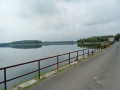
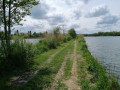
Although entirely self-sufficient, with its own shops, schools, a swimming pool and a church, the workers’ estate is situated on the edge of a forest within the municipalities of Moussey, Maizières-lès-Vic and Réchicourt-le-Château, in the heart of the Pays des Étangs.
Bataville developed mainly in the 1930s and 1950s and has inherited an architecture of detached houses and well-maintained facilities with an iconic, albeit modest, aesthetic.
For hygiene reasons, all the houses in Bataville were built with bathrooms and flat roofs, thus avoiding attics, which Bata considered unhealthy.
The built heritage retains a paternalistic character even in its facilities, as the village is one of the best-equipped in the department for sport and youth activities.
Hellocourt Castle
The Hellocourt estate in the commune of Moussey was owned successively by several noble families before being purchased in 1890, during thefirst annexation of Alsace-Moselle, by Wilhelm Lorenz, an engineer from Karlsruhe.
Situated in the former commune of Hellocourt, it was incorporated into Maizières-lès-Vic in 1885.
Wilhelm Lorenz transformed and modernised the estate, turning it into a sort of model farm with horse breeding, fish farming, cattle rearing, and so on.
The architecture of the buildings is impressive; the rib-vaulted ceilings in the stables are splendid, and the water tower – a huge advance for its time – takes the form of a tower, and so on. Today, alongside traditional livestock farming, there is a Swiss Mountain Dog breeding programme on the premises.
In the early 1930s, the BATA shoe factories were built nearby.
Romécourt Castle
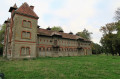
The château was built by Michel l’Enfant in 1564 and was then nicknamed Kinthaus (l’Enfant’s house)². It was subsequently extended in the 17th and 19th centuries with the addition of stables and the refurbishment of the chapel’s interior.
The façades, the well and the roofs of Romécourt Castle are listed in the register of historic monuments.
A rare and exceptional feature for a castle in Lorraine, the building is constructed entirely of brick. In keeping with the Renaissance style, the façade features geometric diamond-shaped motifs, which are particularly prominent on the doors. Access to the château is via the ‘French’ and ‘German’ gates, built from cut stone; their bossed stonework reflects the geographical location of Romécourt Castle near a former border between France and Germany.
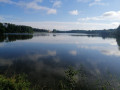
The Romécourt estate covers 300 hectares of woodland, fields and countryside. The English-style park is shaded by tall, centuries-old trees. It features two quarries dug to extract the earth needed to make the castle’s bricks and tiles³.
The castle chapel served as the parish place of worship until 1793. One of the stained-glass windows depicts Saint Louis and Hugues de Martimprey accompanying the king on the Crusades. Since 1698, the castle chapel has served as the burial place for the de Martimprey de Romécourt family.



 Country:
 City:
City:




 Visorando Member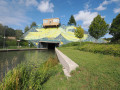

 Easy
Easy 
 Difficult