


Refine your search for walks in Lac de Bassia
Lac de Bassia walks


 Lake Bassia from Gèdre-Dessus
 Visorando Member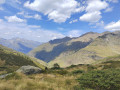
 7.96 mi
 +3,625 ft
 -3,655 ft
 6h 50
6h 50
 Difficult
 Departure from Gèdre (Hautes-Pyrénées)
A beautiful, long hike through large areas of summer pastures, starting from a small village.A sense of direction is necessary. The return journey described here is for when there is no snow, bad weather or fog.Old yellow markings are still visible in places.Part of the climb via the Campbieil barns is in the Pyrenees National Park. Special regulations apply.To get to the start of the hike, see the directions in the practical information section.
Please note: the Gavarnie Valleys Tourist Office reports that on 8 May 2025
> that access restrictions for hiking in the Campbieilh valley may be lifted.> Thank you very much.
Walks near Lac de Bassia
Troumouse Cirque – Héas Chapel
5.19 mi
+535 ft
-2,451 ft
2h 50
 Moderate
Departure from Gèdre (Hautes-Pyrénées)
Moderate
Departure from Gèdre (Hautes-Pyrénées)
From the Cirque de Troumouse to the Chapel of Héas, via Fontaine and the Oratory of the Holy Family.
Estaubé Cirque – Troumouse Cirque
9.52 mi
+2,106 ft
-1,237 ft
6h 15
Moderate
Departure from Gèdre (Hautes-Pyrénées)
Set off from the Cirque d’Estaubé, passing by the Lac des Gloriettes, to the Cirque de Troumouse for a completely self-catering bivouac.
Refuge des Espugettes – Cirque d’Estaubé.
7.61 mi
+3,235 ft
-3,740 ft
6h 20
Difficult
Departure from Gavarnie (Hautes-Pyrénées)
Route from the Espuguettes refuge to the Cirque d’Estaubé, including the ascent of the Petit and Grand Piméné (2,801 m) via the Hourquette d’Alans. Bivouac in the cirque, entirely self-sufficient.
From the Espuguettes refuge to the Tuquerouye refuge via the Piméné
 5.82 mi
+4,114 ft
-2,044 ft
8 hrs
5.82 mi
+4,114 ft
-2,044 ft
8 hrs
 Very difficult
Departure from Gavarnie (Hautes-Pyrénées)
Very difficult
Departure from Gavarnie (Hautes-Pyrénées)
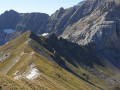
Day 2This beautiful day-long high-mountain hike offers breathtaking views of the Cirque de Gavarnie from the summit of the Pic de Pimené (2,801 m), as well as a 360° panorama of the entire Pyrenean border range and the French Piedmont region of the Hautes-Pyrénées.The walk then follows the Pimené ridge, offering a fun and exhilarating experience.The highlight of the day is the gruelling ascent of the Couloir de Tuquerouye to reach the highest unmanned mountain hut in the Pyrenees.
Chalet Hôtel d'Orédon - Tournaboup
 9.05 mi
+2,096 ft
-3,494 ft
6h 00
Moderate
Departure from Aragnouet (Hautes-Pyrénées)
9.05 mi
+2,096 ft
-3,494 ft
6h 00
Moderate
Departure from Aragnouet (Hautes-Pyrénées)
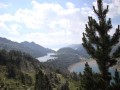
Third stage of the Three Days in the Néouvielle Reserve and its lakesFrom the Chalet-Hôtel d'Orédon to the Tournaboup car park.The multi-day hike is coming to an end, but the beauty of the 20 lakes remains.You are entering the Néouvielle National Nature Reserve, which is protected by regulations. Please respect these regulations (see practical information).
Gavarnie – Refuge des Espuguettes
7.36 mi
+3,901 ft
-1,759 ft
6h 45
Difficult
Departure from Gavarnie (Hautes-Pyrénées)
Start from Gavarnie and climb towards the Plateau de Bellevue, then descend to the Grande Waterfall. From the Hôtellerie du Cirque, climb via the ledges to the Refuge des Espuguettes, with a campsite nearby.
Route of the three cirques: Gavarnie, Estaubé and Troumouse
29.94 mi
+9,777 ft
-9,252 ft
4 days
Moderate
Departure from Gavarnie (Hautes-Pyrénées)
A four-day route of the three cirques of Gavarnie, Estaubé and Troumouse, including the ascent of the Piméné. A self-guided route with nights spent in bivouacs.
Gavarnie to the Espuguettes Refuge
 7.16 mi
+3,868 ft
-1,677 ft
6h 40
Difficult
Departure from Gavarnie (Hautes-Pyrénées)
7.16 mi
+3,868 ft
-1,677 ft
6h 40
Difficult
Departure from Gavarnie (Hautes-Pyrénées)
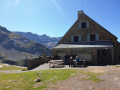
Day 1The Cirque de Gavarnie needs no introduction; it is a monument, a cathedral, a colossus.The route via the Plateau de Bellevue allows you to discover it from this remarkable vantage point.The path running along the slopes of the Bosquet Long adds an element of excitement, allowing you to appreciate it in all its splendour, whilst offering a tranquillity not found on the better-known routes.The return route along the ledge on the right-hand side takes you back to the Refuge des Espuguettes, where you’ll spend the first night.
From the Refuge de l’Oule to the village of Artigues
10.75 mi
+2,365 ft
-4,377 ft
7h 00
Moderate
Departure from Saint-Lary-Soulan (Hautes-Pyrénées)
Second day of a three-day circular route. You can book a packed lunch if you’re staying overnight at the Refuge de l’Oule, as well as top up your water flasks. Afterwards, the trail is lovely as it runs alongside the lake. It passes through the Col de Bastanet and takes in magnificent lakes all along the route. At the Campana de Cloutou mountain refuge, you can sit at a table to eat your packed lunch and refill your water flask. The trail then descends, passing by pretty lakes, to the village of Artigues.
Aygues-Cluses Refuge - Campana de Cloutou Refuge
 4.62 mi
+2,146 ft
-1,867 ft
4h 00
Difficult
Departure from Barèges (Hautes-Pyrénées)
4.62 mi
+2,146 ft
-1,867 ft
4h 00
Difficult
Departure from Barèges (Hautes-Pyrénées)
Day three of the four-day Tour du Massif de Néouvielle, the shortest route of the four days, but no less magnificent.This hike is classified as difficult due to the ascent of Pic d'Aygues-Cluses (T5 ridge). See the variants if you wish to avoid the peak or climb it in the other direction (less complicated).