Date of your route : Apr 10, 2026
Reliability of the description : ★★★★★ Very good
Ease of following the route : ★★★★★ Very good
Route interest : ★★★★★ Very good
Very busy route : No
Barre des Dourbes, climbed on this spring day in 2026: what a treat!
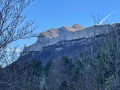
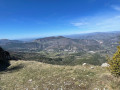
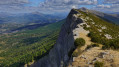
This ridge is absolutely stunning even when viewed from below, and it offers a magnificent 360° view once you reach the top.
The limestone it’s made of takes on shades ranging from grey to golden; you could stay at the bottom and gaze at it endlessly, as its hues shift constantly depending on the colour of the sky, the angle of the sun, the time of day and the weather. A visual delight!
For those who like to discover things for themselves, don’t read on!
The designers of the Barre trails have done an admirable job: all the trails are even and predictable, and none are so steep as to require ropes or cables.
DIZZYING SECTIONS: only the climb up the Pas de la Faye features sections of this kind.
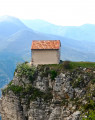
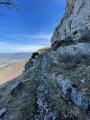
Just before you reach the top, there are 30 or 40 metres of flat ground where you have the normal path of small stones, bordered by 30 to 50 cm of grass on either side, with the cliff face to your right and the drop-off to your left.
If even over 30 to 40 metres you’re not sure you’ll be able to cope, then perhaps it’s best to give up. As always, it becomes dangerous if there are gusts of wind.
But the section is very short! And there isn’t a single obstacle; you can look at the photos if that reassures you. As for the Pas de Tartonne, it’s very simple: there is NO dizzying section, nothing, nada.
FITNESS LEVEL: the climb up to the Pas de la Faye is the only really physically demanding part.
It gets steeper and steeper as you approach the summit. Towards the end, there’s a section that climbs very steeply and you have to go round or over rocks; sometimes you need to use your hands a bit.
Anyone who walks regularly can manage this climb; no special technique is required.
The descent from the Pas de Tartonne is only challenging for the first 300 metres, where you need to be careful. It’s steep but there are no loose stones. Once you’re lower down, it’s a classic winding descent. Let’s be honest: those with weak knees will suffer.
HORSEFLIES: anyone allergic to horseflies must wear long trousers and long sleeves from around May to August. I was bitten by numerous horseflies in 2024 whilst climbing Pic de Couard and also near Clappe in the southern part of the Barre, so the entire Barre area is affected.
Minor details: the summit of the Barre is, unsurprisingly, very rocky and stony; walking is a bit tricky, but nothing more.
Navigation is dead easy with the markings, except on the ridge where you can get a bit lost with all the bushes, but nothing that will really throw you off course.
Relevance of the date (10 April): patches of snow remain; we had to walk through some of them and snow got into our shoes, so it was a bit of a struggle in walking shoes. Wait until May if you don’t have snow boots or don’t want to use them.
Vegetation: spring flowers everywhere – primroses and crocuses – a riot of colour. Below and on the ridge, boxwood bushes absolutely everywhere.
Traffic: no one.
Weather: mild spring weather, a climb in the shade in the morning, sunny at the summit and on the descents. Perfect.
In short: go for it!!!
Machine-translated



 Country:

 City:
City:



 Visorando Member
 Easy
Easy 
 Association / Club / Walk leader