Country:
 City:
City:


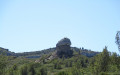
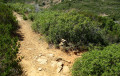
In La Ciotat, follow the Chemin de Saint-Loup to its end, marked by a forest gate, and park in any available spaces, taking care not to obstruct access to the DFCI tracks.
No signposting
(S/E) Take the DFCI track on the left as you approach the end, go round the forest barrier and head gently downhill to a three-way junction. Take the sharp left-hand bend and continue to the next junction.
(1) Turn right and climb steadily to join the Route des Crêtes at a signpost. Cross this road – which is very busy in the summer months – with care and head to the car park opposite.
Yellow markings
(2) Cross the road diagonally to the left to find the signposted path which climbs steeply straight away. After skirting the cliffs, rejoin the road and follow it for a few dozen metres to reach another car park with a viewpoint situated on a bend.
(3) Return to the path, which climbs and then descends before rejoining the road once more; it continues along the cliff edge before climbing steeply again to reach a secure viewpoint, which is often very crowded with tourists and walkers.
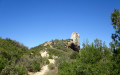
(4) Take in the exceptional view and rejoin the path, which alternates between ascents and descents, heading towards the Bec de l’Aigle semaphore. You’ll emerge onto the road about fifty metres before the gate and fence blocking access to the secured site. Cross over and, on the opposite side, rejoin the path which starts with a few steps and goes round the semaphore station to the left.
Very old blue markings, now almost completely worn away
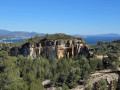
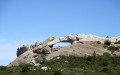
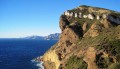
(5) Tricky junction: look out for the tiny cairn on the right marking the start of a very narrow path. Shortly afterwards, this path takes you over a short section requiring some scrambling down, then descends the rocky ridge, offering stunning views of the Bec de l’Aigle and the shipyard at La Ciotat. The descent, which is rather tricky, passes by the old Vigie quarry (unsecured) and leads to a stony path heading towards an isolated, uninhabited house covered in graffiti. Turn left until you reach the bend.
No signposting
(6) Head down to the right via a few steps, walk alongside a terraced olive grove and reach the bottom of a small valley. Climb up the opposite slope to a ruined building, the numerous graffiti marks on which indicate that it is occasionally occupied. Turn left and follow the well-marked path which leads onto the Chemin du Sémaphore.
Yellow markings
(7) Turn left onto the road, then turn right at the first junction to tackle a very steep climb of about a hundred metres. Once you reach the end of the tarmac section, continue along the path that follows it and head up the valley to a sharp left-hand bend.
No markings
(8) Turn right, reach a junction marked by a small solitary pine tree and turn right again. You’ll come out onto a cross-path; follow it to the left, then turn right about fifty metres further on to climb a steep slope leading to a five-way junction.
Yellow markings
(9) Turn right towards the three electricity poles. Go round them on the right and you’ll reach another junction.
No markings
Ignore the yellow markings heading off to the right; head straight ahead and keep a close eye out so as not to miss the inconspicuous cairn marking the start of a path on the left.
(10) A tricky junction: take this path and head down to the Route des Crêtes.
(11) Cross carefully to rejoin, almost directly opposite, the path leading towards the Fardeloup apartment blocks. Cross the first path junction, then turn left at the second. Keep an eye out further on, past a solitary pine tree, for the small cairn marking the start of a path on the right.
(12) A tricky junction: turn right onto this path, which goes round the rocky outcrop housing the Grotte de Fardeloup (not part of the route). Continue to the right at the next junction, then turn left at a 90° angle to follow a contour path that leads out onto the tarmac road heading towards a shooting range.
(13) Cross the road and rejoin the path opposite, passing close to a large boulder. You’ll come to a junction; turn left onto the path leading to the Dent du Chat, which is clearly visible straight ahead. At the next junction, do not continue in this direction but turn right onto a path which soon joins another, wider path where you must turn left. This path passes several abandoned quarries, forming a very picturesque site, and leads to an old ramp supported by remarkable drystone walls.
(14) Tricky junction: at the base of the ramp, look out for the very tiny cairn marking the start of a track on the left. Do not take the better-defined path that climbs up, but turn immediately right to stay at the same level. Progress is a little difficult here as the vegetation is dense and the track is almost overgrown. You’ll emerge at a three-way junction.
(15) Continue to the left, join a cross-country path opposite the Terrevaine climbing crags and follow it to the right to quickly reach the unnamed pass of Bau Rous.
(16) Turn left for a few metres, then turn right onto a hidden path that is difficult to spot (cairn). This path leads into dense undergrowth, then emerges from it before joining a wider track; follow this to the right to reach, further on, another track which serves as an access route to an isolated house.
(17) Turn right. Further on, the ‘Private Property’ sign by the side of the path is misleading: in fact, the route you are following is a right of way running between two cadastral plots without crossing them. Join a tarmac road and follow it to the left until you reach the first junction.
(18) Turn left onto the DFCI CQ120 and head up the pretty, shaded valley which leads to the junction of the circular route.
(1) Go straight on and follow the route taken on the way out to return to the car park (S/E).


 Visorando Member
 Moderate

 Association / Club / Walk leader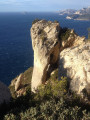
 Very difficult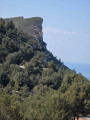
 Extremely difficult