Country:
 City:
City:


Start from the hamlet of Quehinet.
(S/E) At the cross at the entrance to the hamlet, head due north towards the Étang du Doyenné, which you’ll reach after a few hundred metres and a couple of bends. Go past the lake and you’ll come to a road.
(1) Follow this road to the right for about 300 m, then turn left in the centre of the village of Kervily. The street that winds its way between the houses soon becomes a lovely straight path which you follow until you are almost at the D20.
About 100 metres before the two roads meet, cut right, following a path through a copse. Join the departmental road just where you need to cross it.
(2) Cross the road carefully, climb up the opposite embankment, and join the footpath on the other side just behind it. Continue to the left until you come to a crossroad. Cross this road, continue straight ahead and turn right at the next three-way junction. Continue along this small road until you reach the junction with the D774.
(3) Turn right and follow the departmental road for about 350 m. Take care on this stretch; the road is not very wide and the verges are narrow and unpaved. Turn right onto the first track and immediately turn left at the next three-way junction. Reach and pass quickly through Carapibo on the right, before leaving the village via the lower part of the village. The track then descends into a clearly defined valley before climbing steeply to reach the hamlet of Pahongé.
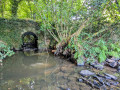
(4) After taking a moment to admire the beautiful farmhouse with its curved lintels, turn left and follow the road until you rejoin the D774. As soon as possible, cross this road to walk on the left-hand side, which offers a better view of oncoming traffic. After a long right-hand bend, you’ll soon come to the site of the Moulin de Couéguel, where you can still see the waterwheel.
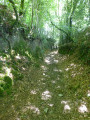
(5) Just before reaching the stream, cross the departmental road and take the path on the right that runs alongside the watercourse. This magnificent path, carved into the slope, winds its way a few metres above the stream, beneath lush vegetation. As you round a bend, you’ll reach Gougeon Mill, of which only the farmhouse and part of the old weir remain.
(6) Continue along this path until you come to a track on the right that climbs towards a wooded area. This track winds its way through the wooded slope, at the foot of which you can hear the stream flowing. Along the way, you’ll catch sight, slightly below, of the remains of another mill, currently being restored. Pass the barriers restricting access to this section and continue along the same bank until you come to the path linking Saint-Leufroy to the Moulin de Colon.
(7) Leave the mill on your left, cut across the path and carry on straight ahead to continue following the stream. You’ll very soon catch sight of the Moulin du Pesle’s retention pond, which seems to block the valley. As you pass, take note of the beautiful garden surrounding the building.
Ignore the path leading to it and carry on along the right bank. As the path curves widely to the right, it gradually moves away from the stream and begins the climb towards the village of Saint-Leufroy.
(8) Walk through the village and turn left just before the tiny chapel. The path then veers left towards some farm buildings, which it skirts to the right before beginning another descent towards the stream. Throughout this descent, you won’t be able to take your eyes off the beautiful façade of the Château du Bois de Roz on the opposite hillside.
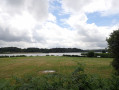
(9) At the bottom of the slope, turn right onto the small path which, further on, winds its way into a small valley before climbing again through a wooded section and emerging onto a vast agricultural field. This field overlooks the meadows at the bottom of the valley on either side of the stream.
The path climbs through the vast expanse whilst your gaze wanders towards the valley and the village of Caden, high up on the opposite slope.
(10) When you reach the top of the field, ignore the path branching off to the left and continue straight on along the edge of the woodland. Then go round a recently cleared plot to join a farm track. Follow it to the left and you’ll soon come out onto a small road.
(11) Head to the right until you rejoin the D21. As you pass, be sure to take a look at the dovecote of the former Quisteny manor, a little further on to the left.
At the departmental road, turn left onto the path that has been carved out behind the road embankment, allowing you to walk safely back up the slope. When this path ends, cross the road and continue straight on along the path on the opposite side. When you reach a wooded area, turn right at the first opportunity, then head down into the valley leading to the village of Tréluban.
(12) As you emerge into the village, carry on straight ahead, even though it may seem as though you are entering private property. As you pass, don’t miss the imposing, half-buried oven to the left of the path.
Then turn right to reach the heart of the village, noting the quality of the buildings and the restoration work that has been carried out there. At the cross, turn left and head up the road towards Saint-André until you reach the chapel.
(13) When you reach the chapel, turn right and head down between the houses, towards the fountain and the old washhouse. Just before you reach the fountain, turn right to walk alongside a ruin, which you go round on the right before coming out onto a wider path. Follow this path until you cross the footbridge over the Ruisseau de l’Étang du Doyenné, which you will follow in the next section.
(14) Turn right after the footbridge and head up the path which roughly follows the course of the stream. At the first path you come to, turn right to head back towards the stream, then immediately left just before crossing it. Walk through another undulating landscape until you reach the outskirts of the village of Kertreton.
(15) As you approach the village green (a typical feature of Breton villages, often home to everyday facilities such as an oven, a fountain or well, and a washhouse), turn right onto a narrow path lined with camellias. After crossing a footbridge over a trickle of water, head uphill along a lovely, tree-lined path towards the village of Quehinet and the wayside cross where the walk began (S/E).

 Visorando Member
 Easy
Easy