Country:
 City:
City:


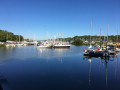
Park near the Chapel of Saint Cornély.
(S/E) Return to the last crossroads you came to. Turn left onto the road towards Quéral, follow it for about 200 metres, then turn left again. At the next crossroads, take the path on the right towards Carado.
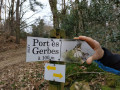
(1) Before reaching the village, turn left and continue, ignoring the two paths on your left. After the Carado fountain, the path enters the wooded valley. Pass another path on the left, then join theGR® 39. Continue straight ahead until you reach the path that descends towards Port-es-Gerbes. This path leads to a jetty on the banks of the Vilaine, where the view of the river's winding course is particularly striking. (Off the route and not described on the map).
(2) Continue along the main path which climbs to the left. This first hill is the prelude to a series of more or less steep climbs and descents that punctuate more than half of the route. In Brittany, the landscape is hilly, as evidenced by the scenery you are passing through.
Once you reach the flat, take the path that descends again and leads to the houses of La Falaise.
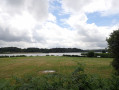
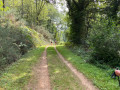
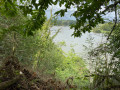
(3) Immediately after the second, turn right, then right again just before Kerubaud. Continue along the path that winds along the hillside and follows the riverbank at a distance. Between the wooded areas, views open up onto the shimmering water and the cirque formed by the wooded opposite bank.
Pass two paths on the left before walking along the meadows closest to the Vilaine.
(4) From the path, the panorama opens up onto the Rocher de la Dame promontory, which is located on the other side of the water and in the hollow of the meander. A few boats equipped with fishing nets line the riverbank, a reminder of the fishing activity that took place here before the Arzal dam interrupted the ebb and flow of the tides that once punctuated life in the Basse-Vilaine.
Continue along the path, which soon climbs the hillside again. A beautiful rocky climb under the power lines brings you back to flat ground.
The path continues through wooded countryside, occasionally opening up to offer the first views of the port of Foleux, before descending into the valley below Pont Cavéro.
(5) Halfway along, turn right, go downhill and cross the stream. The route follows the boundary between woods and farmland, at the edge of the steepest slopes. Take the first path on the right and then start the descent towards the Étier du Trévelo. At the start of the descent, leave the main steep path, which is impassable when the ground is wet, and take the parallel path on the left that has been laid out in the woods.
At the bottom of the slope, turn left and join the footbridge over the stream.
(6) Note: Until July 2018, it was only possible to cross the stream by boat. This meant that theGR® 39 had to cover more than 9 km to reach Foleux, more than half of which was along the roadside. The construction of this long-awaited structure now makes it possible to reach Béganne territory and, if desired, take a break there. The crossing may be temporarily interrupted when the footbridge opens to allow boats to pass.
Whether you attempt the crossing or not, you must then take the wide path that leads back up to the castle. At the first crossroads, turn right, descend into the valley, then after a sharp bend, climb back up to the left onto the agricultural plateau. To the right of the path, you can see the calm waters of the Étier du Trévelo spreading out at the foot of the slope.
Take the first path on the left which descends to the riverbank.
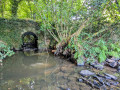
(7) When you reach the marshes (former floodplains), take the path that leads left between two stone embankments. After climbing a final rocky hill, the path enters a beech forest where you will soon hear the babbling of the stream. Follow it to the footbridge built on an old dam. Although this dam is no longer in use, the vegetation upstream gives a glimpse of the reservoir that once powered a mill.
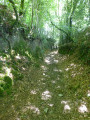
At the footbridge, turn left and literally plunge into the path that gently climbs the hillside. For a sunken path, it's quite a sunken path!
Continue along this path until you find a road that leads straight to the village of Kergo. Cross this village with its pretty granite houses and continue along the main road that extends from the village. Pass the first path on your left and take the second one.
(8) Leave the main path and head between woods and fields. After a large bend that climbs up through the undergrowth, the path splits into two parallel tracks. Take the left-hand track, the old path lined with embankments, which has been preserved. Cross a farm track and continue straight ahead until you reach the village of Bolouan. Turn left before you reach the first houses.
(9) In the centre of the village, you will find two old ovens a few metres apart. Both have retained the stone slab held in place by a piece of wood, which was used to close the oven door. One is covered with slate, while the other, which is probably older, is covered with a mound of earth and vegetation.
At the ovens, turn right to cross the old part of the village, then go around it on the left to return to the tarmac road. Turn right until you reach the Saint-Cornély road, then turn left. The chapel is 500 metres further on, at the end of the straight road (S/E).

 A mostly shaded route, very pleasant in hot weather, allowing you to enjoy the banks of the Vilaine
 Visorando Member
 Easy
Easy