Country:
 City:
City:


Park in the small car park, located right next to the state school, Route de Caden.
(S/E) Take the narrow lane at the far end of the car park. It leads down to Rue du Chemin Creux. Turn right and follow this road to the next junction.
Follow the path that starts almost opposite, between two hedges. It continues between two fences before reaching Tréhourmay. At the road, continue straight on until you reach the banks of the Trévelo stream
(1) Leave the road where it bends, above the wet meadows, and take the path that heads off to the right. It is a gem of a sunken path that winds just above the valley floor and the Pinieux stream.
When you reach the RD774, keep to the left, following the crash barrier. Carefully follow this road for about 250 m until you find a path on the right that leads under the trees and around a livestock building. It leads to the hamlet of Moulin de Bourg Pommier.
At the road leading to the village, turn left and follow it until you rejoin the RD 774. Follow the main road for about fifty metres, then turn right towards the farm just before the village of Bourg Pommier.
To your right, the landscape opens up onto the valley of the Moulin de Pinieux stream and the village of Limerzel, nestled against the hillside. The church’s majestic bell tower dominates the landscape like the lord of the manor.
(2) As soon as you pass the farm at Bourg Pommier, turn left onto the path that goes round the farm buildings and continue towards the woods. Join the path that runs along the edge of the woods by crossing the embankment and continue to the left along the edge of the woods until you reach a small road. Turn left to reach Coëtfau, then right at the entrance to the village. Follow the road to Le Boulin.
As you pass, take a moment to note the quality of the architecture of some of the houses, particularly the large farmhouse at Le Boulin. In the background, the Château de Pinieux rises up with its tall 15th-century façade. The lichen adds a light touch to the granite of which it is built.
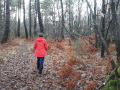
(3) Turn right immediately after the last house in the hamlet and follow the path as it winds its way towards the first woods. After the gate, head down to the right, along the edge of the woodland. At the bottom of the slope, a path branches off to the left: this is yet another fine example of a sunken path that leaves one wondering why it is so deep. It is clear here that this path was dug out and that the excavated earth was used to build the embankments that line it.
Where it joins a farm track, continue straight on, skirting the woods once more.
(4) Just before Le Questro, a path branches off to the right into the woods and descends towards a cultivated plot. On the edge of this plot, recent felling and planting work has transformed the area and the paths have disappeared.
Keep the rectangular agricultural plot in sight until you reach it, then go round it to the right, following the edge of the forest. Once you reach the point opposite where you entered the plot, turn right and follow the edge of the cleared area. This leads back to the access road to the castle and the signposted section of the route.
(5) Cross the castle driveway and take the path through the trees that runs along the edge of the woodland. At one point, head back into the woods, then at the crossroads of paths, turn left to find the road (RD153) a little further down.
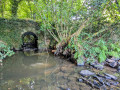
Cross this small road and continue down into the valley, following the edge of the wooded areas. The path leads to a footbridge over the Moulin de Pinieux stream. This mill, like those dotted along the watercourse, was used to harness its energy.
(6) After the footbridge, the path climbs to the right and joins an old forest track; follow this to the left; it winds through the woods above the stream until it reaches the vicinity of the Moulin de Coët Bihan. Once past this point, continue following the stream upstream until you reach the footbridge beneath Pont Kergoff. If you feel like it, from this point you can cross the stream again and visit the 13th-century Notre-Dame de l’Ô chapel and its miraculous fountain (an additional 1.3 km round trip).
(7) The footbridge at Pont Kergoff marks the end of the walk upstream along the stream. The path climbs the hillside, following a slope that is the remnant of an old track which used to cut through the farmland. The path is interrupted by several electric fences which must be opened and closed after passing through, before it emerges at a bend in a small road. Continue straight on, then turn right onto the first path. This runs alongside the woods at the bottom of the hillside, then, after crossing a stream, climbs up a gully.
(8) Just before leaving the woods, take the path that heads off to the right.
It first runs along the edge of the plateau and farmland before plunging into a new valley, north of Kervazo. Take a sharp left to cross a stream. The slope rises again to reach the moorland, which soon replaces the woodland. Ignore the farm track linking the meadows on either side of the hillside.
(9) Turn right at the first path you come to. As the bell tower of Limerzel comes into view, the path descends once more into a wooded valley. After crossing another stream, take the path that descends to the right, following the left bank of the stream.
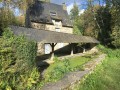
(10) At the D153 road, cross over to the gate on the other side of the road. This gate leads into the enclosure surrounding the old wash house, which is maintained by the few black Ouessant sheep that have found refuge there.
Once past the building, another gate opens onto the path that used to take the village’s washerwomen to their workplace. Follow this path uphill to reach the first houses and cross through the village centre, via Rue Saint-Laurent, to reach the public school car park (S/E).
As you pass, note the quality of the architecture in the village of Limerzel, including the old chapel converted into a media library. This small rural village has the feel of a town and suggests that these lands were once prosperous.



 Visorando Member

 Easy
Easy 
 Difficult