Country:
 City:
City:


Starting point and access: Souppes - Château-Landon station.
- Transilien - Line R, on the section between Paris-Lyon and Montargis.
Take the Rue Paul Rollin exit on the side of platform 1, the one for the Paris to Montargis direction (if arriving in the opposite direction, platform 2, take the footbridge at the rear of the train).
No signposting
(S) On leaving the station, cross the square with the war memorial and follow the road to the left. At the roundabout, continue straight ahead onto Rue Carnot. At the stop sign, turn left onto Rue Léon Frot.
Red and white markings
At the Stop sign, cross Rue du 21 Août and continue straight ahead, diagonally to the left, along Rue Hoche. Cross Rue des Jardins on the right-hand side, then follow the railway line on your left.
(1) Just past the pier of an old bridge, climb the steps on the right. At the top, follow the grassy path to the left, which runs along the platform of an old railway line. Pass a hairpin bend and continue along a gravel path. Cross Avenue du Maréchal Leclerc (D607; pedestrian crossing on the right) and take Rue des Eaux opposite. Follow this street, lined with houses on the right and overlooking the D607 on the left.
(2) At the Stop sign, cross a wide road and take the path opposite that leads into a wood. Stay on this main path, which gradually curves to the right. After a sign pointing left, take the parallel path on the left a little further down as soon as possible. Follow this path to the right, running parallel to the previous one (the purple line on the 1:25,000 map, which is supposed to represent theGR®13, is not up to date here). After a short climb, you will emerge onto Rue de Glandelles (sign on the left).
(3) Follow this street to the right for about fifty metres and, shortly after the road sign for “Le Coudray”, turn left onto a wide, hard-surfaced track. Ignore a turn-off on the right and continue along the tarmac road. At the Stop sign, cross Rue de Nemours and continue straight ahead along a small road towards Chignard. Pass the farmhouse at this hamlet (ignore the turn-offs on the left) and continue along the small road, the surface of which becomes rough.
(4) When the road curves slightly to the left, turn left onto a grassy track that runs between the fields. At the next junction, cross a farm track and go straight on. Head north towards a wooded horizon. As you approach a farmhouse on the left, ignore a path on the right and head downhill. You’ll reach the tarmac road at a building on the right (with a stone cross opposite).
(5) Leave the road and take the path opposite, which starts to the right of the cross and heads downhill. Ignore a path coming from the left and continue downhill. Cross a road and head downhill opposite along a grassy path. Pass a metal gate (old wash house on the right) then follow a road to the left. Cross Rue des Sources on the left, veer slightly to the right and head straight towards the church bell tower, which is clearly visible.
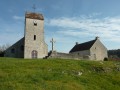
(6) At the junction, follow Rue de la Forêt straight ahead towards Bagneaux and, after No. 42, climb a flight of steps on the right then across a lawn towards the church bell tower. At the top, turn left, passing a beautiful stone cross on your right, and head down a path suitable for vehicles. At the bottom, rejoin Rue de la Forêt and follow it to the right. At the corner of No. 34, take a path on the right that follows a route across a junction. You’ll come out onto Rue des Gouttières and follow it to the right (north). Soon, the tarmac gives way to a track. Enter a wood, head north along the main path and ignore the side paths. You’ll come out onto a road; follow it to the left for about a hundred metres.
(7) Then turn left onto a path closed to vehicles that leads into the woods. Ignore a track on the right and, immediately after, a path on the left. At the next junction (elevation 108; forest plots nos. 106, 110 and 109), go straight on.
No signposting
(8) About 200m further on, at a junction (plots nos. 106 and 109), turn right. Ignore a path on the left leading to beehives and continue along a track that winds between the trees and small rocks. At the end, follow the Chemin de la Tonne to the left (plot no. 104). After about 100 metres, turn right (red arrow painted on a tree trunk). Pass a four-trunked chestnut tree and then climb up a sandy path. At a fork in the road, take the path on the left. The two paths soon meet at a sort of pass: head back down through birch trees and heather, then once again under chestnut trees.
Red and white markings
(9) At the end of the path, rejoin theGR®13and follow it to the right. Pass through a forest gate (destroyed in November 2019) and, at the junction immediately ahead, turn right. About fifty metres further on, take the discreet path on the left (be careful). Wind your way through the undergrowth and, at the next junction, turn left.
(10) At a three-way junction, take the left-hand path. At a second three-way junction that appears shortly afterwards, turn left again. Wind your way through a pine forest with heather undergrowth. Then cross a copse of young birch trees. Return to a pine forest and wind your way down. At the end of the path, turn left onto a wide track and follow a wire fence on your right. At the end of this, go straight on and pass a sign indicating that you are on the Chemin de la Vallée Pierre le Sault.
N.B. Between points (11) and (12), the purple line on the map intended to represent theGR®13is not always up to date. In a few places, theGR® follows tracks or paths not shown on the map, which route around wider paths.
(11) At the junction about a hundred metres past the sign, turn right onto a stony path that climbs. When the path turns left, leave it and continue straight on along a track. Join the wide path again, which has become sandier, and follow it to the right. Shortly after a sign indicating that you are on the Chemin de Nemours to Poligny, take a path on the right that winds through the trees. Join a wide path again and follow it to the right.
(12) At the next junction, go straight on (north-west). Ignore the Chemin de la Platière on the right and continue straight on.
(13) At the next junction, turn right onto the Chemin des Robiniers. Immediately ignore a path branching off to the right and continue along the track. At a three-way junction (not shown on the map), take the track on the right, which goes uphill.
Caution! Between points (14) and (18), the route mainly follows paths or faint tracks that wind between the rocks. Not all the paths you cross are shown on the map. Follow the markings closely, as they are generally frequent. Where they are less frequent, be vigilant and do not hesitate to take your time to ensure you are heading in the right direction.
Red and white markings + numbers painted in blue on some rocks
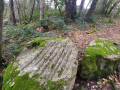
(14) Cross a wider path and continue along the path opposite (north-east). Wind your way along, ignoring a track on the right. Further on, turn left, descend slightly and turn immediately right. Facing rock no. 10, which can serve as a shelter, turn sharply left. Pass at the foot of rock no. 8, on your right. Continue winding along the path, which often runs along the edge of a downward slope on the left. Facing a sort of dead end, veer to the right. Pass at the foot of rock no. 6 and continue winding your way along.
(15) At a junction, take the well-marked path on the right under the pine trees. At the next crossroads, take thesecond path on the left. At the Fork in the road that appears immediately, take the path on the right. You’ll come out onto a sandy track; follow it to the left. Soon turn left again, then climb the rocky hill opposite. At the top, veer left. You’ll reach a fence; follow it to your right to descend to a sort of pass offering, on the right, a view of a sandpit.
Then turn left and head downwards. Pass the base of a large boulder on your right. At a tree marked No. 3, veer right and go past rock No. 2. Pass a small wall on the left and, at the Fork in the road ahead, take either the left or right branch to reach the wide Chemin des Crottes au Loup. Follow this path to the right, pass a bench on the left and reach a crossroads with picnic tables on the right.
Red and white + yellow markings + numbers painted in blue on some rocks
(16) Then turn sharply left. Pass at the foot of a boulder on your right, then climb the winding path between the rocks. Climb a few “steps” by stepping onto small rocks. At two successive T-junctions, go left. At a Fork in the road, take the path on the right. Ignore a path branching off to the left, then pass between rocks nos. 26 and 27.
Shortly after the 121m mark, turn right, immediately ignore a path descending to the left and continue on roughly level ground. Continue winding your way... At a fork in the road, take the path on the right (be careful, this path is less marked and less obvious than the one on the left). Pass at the foot of rock no. 25 and turn left. At a T-junction, turn left and you’ll soon reach a crossroads.
Then veer right, leaving rock no. 23 on your left. Further on, pass a rock bearing two markers on your right and continue along a path. Soon, leave the path to follow the markings on the right along the edge of the plateau. The path is poorly marked and zigzags. You’ll reach a junction from where you can see the buildings of the Museum of Prehistory below on the right.
(17) Continue straight ahead (do not follow the markings that descend to the right towards the museum). Wind your way along, ignoring the wide path situated some distance to your left. Then turn left to rejoin this path and follow it to the right. At the T-junction that follows, turn left and you will immediately come to a crossroads (bench).
Red and white markings + numbers painted in blue on some rocks
N.B. The purple line on the map, which is supposed to represent theGR®13, is not up to date here.
Follow the path located roughly opposite, leaving the bench on your right. At a crossroads (with a hillock to the left), turn right. Cross an area of small boulders. Pass the large boulder no. 19 on your left and, at the corner, turn left. Pass boulder no. 20 on your right. Further on, turn right and head downhill.
Red and white markings
At the bottom, at a T-junction, go right. At a fork in the road, take the left-hand path. When you reach a fence, veer right and follow the fence on your left. At the corner of the fence, continue straight ahead to reach a wide stony path (south of elevation 118 on the map).
Follow the path uphill to the left and leave it after a few metres to take a track branching off to the right. Then turn left with the track and head downhill. At a junction (sandstone marker), ignore the path on the right and continue straight on. Ignore the faint tracks on either side and head downhill. At the end of the path, turn left and follow a wire fence on your right. At the corner of the fence, turn right and head downhill to a street.
(18) Cross the street and take the Chemin des Dames opposite, between two fences (hospital on the left). At the end of the path, continue along the tarmac. At the Stop sign, turn left. When you reach a small square, turn right, cross Rue Clemenceau and follow Rue du Châtelet (dead end). You’ll come to a small car park with a clearly visible staircase leading up to the right.
No signposting
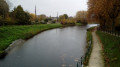
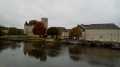
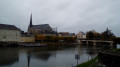
(19) Then go down the more inconspicuous staircase on the left. After several flights of steps, this leads onto a gravel path running alongside the post office building on the right-hand side. At the end of the path, turn right and walk along the Loing on your left (lovely view of the church and Nemours Castle).
At the traffic lights, turn left onto the bridge spanning the river. Walk past the church on your left and continue straight on along Rue de Paris, preferably on the right-hand pavement. Cross a tributary of the Loing and continue straight on. Cross the Canal du Loing and arrive at a junction. First cross Rue du Général Leclerc on the right, then the D607 on the left. Turn right to cross the D16, then you’ll soon reach Nemours-Saint-Pierre station (E).
To get back home:
- Transilien - Line R, towards Montargis (direct access) or Melun and Paris (use the underpass).

 No particular difficulties apart from that. On this lovely sunny day, we only started to see a few people on the last 3–4 km as we approached Nemours; the rest was very quiet.
 Visorando Member
 Moderate