Country:
 City:
City:


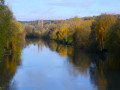
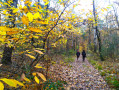
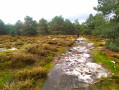
(S) Coming from Paris, leave the platform at the rear of the train, turn right onto Rue de la Gare. Pass the beautiful Bagneaux town hall (on the left), cross the main road (D44) to take Rue de la Poste (just before the post office), heading towards the canal.
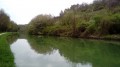
(1) At the canal, turn right and follow it southwards to the church.
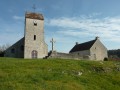
Before the church, turn right up the few steps, go round the church and enter the cemetery.
Walk through the cemetery and exit at the southern end.
Climb up the embankment opposite, turn left to follow the main road, and cross the bridge. Cross the D607 at the traffic lights and turn left, continuing for 50 m.
GR® signposting
(2) Turn right onto Rue de la Montagne and continue for about 600 m.
(3) At the start of the right-hand bend, turn left onto the path at the edge of the field running alongside the forest. At the crossroads, turn right along the edge of the forest and, after 150 m, turn left to enter the forest via a path blocked to cars by a barrier. Continue along this path until you reach the tarmac road.
No signposting after leaving the road
(4) Turn right and follow the road. After about 50 metres, turn left onto a good forest track for approximately 250 metres.
(5) Turn right, then follow the path/track winding to the left as it zigzags between the old quarries. Follow the main track and rejoin the path you left: turn right.
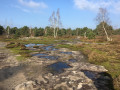
Continue to follow the main track, which turns left and winds through a landscape where rocks come into view. 110 m after a right-hand bend, leave the main track heading due north to take the slightly narrower track that branches off at a 45° angle to the left and leads to a junction.
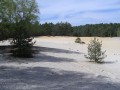
(6) Cross a fairly wide plateau and continue straight ahead, more or less north-west, along tracks leading to a ridge overlooking the Mer de Sable.
(7) Take the path on the left that skirts the Mer de Sable along the ridge, staying close to the edge of the forest. When you reach the south-western end, veer to the right: there are numerous tracks; choose to stay on the forest/sand boundary. At one point, after climbing up to a vantage point, take a track heading due north which joins the wide sandy track running north of the Mer de Sable. Take this track to the left.
(8) At the junction with a path coming from the right, take the path that veers sharply left and meets a road 150 m further on. Cross the road and take the path opposite, which starts between two rocks at the roadside. Continue for about 500 m until you reach a good track: take it to the left (barrier on the right).
GR® markings
(9) Continue for 250 m along this lovely track, following theGR® markings which turn right onto a path. After about 500 m on this winding path, theGR® turns right, whilst a good path continues straight ahead, heading south-south-west. Take this path, noting the sign for “Carrière de Pierre le Sault” on the left, and continue to the viewpoint overlooking a vast sandy basin.
You may wish to walk a little further along the ridge path on the right to enjoy various views (it is also possible to descend into the basin).
(10) Retrace your steps to rejoin theGR®, keeping left for 300 m. You’ll reach a junction with aPR®
PR® Yellow markings
(11) Turn left onto a path that winds through rocky terrain. You will reach the Grotte des Troglodytes.
(12) Continue along the path, clearly marked in yellow, to the Grands Monts viewpoint.
(13) Continue along the main path, which is clearly marked in yellow. You will reach the Chemin de Nemours; turn left onto it and, after 100 m, turn right onto the path leading up to the Pain de Sucre.
(14) Continue straight ahead, reach a good path and take it to the right for about a hundred metres until you reach a junction.
GR® markings
(15) Turn left onto theGR®. Follow this very ‘Bellifontain’-style path until you come back down onto the Chemin des Crottes du Loup. Turn right onto this path and continue for about 200 m.
(16) Just before the picnic area, next to the car park, turn left. Follow theGR® until you reach a sort of pass with several tracks.
(17) Look out for the Tête de Singe rock on the left.
(18) Look out for a building on the right, below: this is the Museum of Prehistory, which can be reached by following one of theGR® paths that goes round the fence.
(19) Then retrace your steps back to the pass. Please note: on the next section there are numerous tracks, andGR® signposting is sparse.
(18) Choose a route heading generally westwards, staying close to the ridge line.
After about 300 m, you’ll reach some climbing rocks; go round them to the north, then descend the hill before climbing another hill to the north, dominated by an antenna. TheGR® heads more or less north, goes round the hill, then reaches a road at the edge of the town.
No signposting
(20) Cross it, then take thefirst left, followed by the first right. Cross the Route de Montagnant (D225). Immediately on the left, you’ll come to a small square with three lime trees. Turn right onto Rue du Châtelet.
After 200 m, you’ll reach the corner of a small embankment bordering a green space lined with chestnut trees.
(21) Climb the embankment to enjoy the “Point de Vue du Châtelet” view over the town of Nemours.
Cross the green space, turn left to take a path leading down to Rue du Souvenir: turn left, then cross the bridge.
Walk round the church, turn left towards the Loing, then enter through the gate on the right which leads into the Parc du Château. Walk round the château.
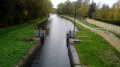
(22) Exit via the alley opposite the castle façade, turn left, then right onto Place Jean-Jaurès, continue straight ahead, cross another branch of the Loing, then reach the banks of the canal.
Turn right and cross the canal via the bridge: Nemours station is a little further on the right (E).

 around the Beauregards rocks. The route, which is quite winding in places, is generally well signposted. The finish in Nemours offers views of the castle-museum, the very pleasant banks of the Loing, and the picturesque town centre with a few half-timbered houses, bringing this successful walk to a close.
 Visorando Member