La Couarde
History
‘The Commune of Goux: Local History’
Written in 1902 by Louis Pigeau, appointed as a primary school teacher in 1885
(Archives of the Jean Rivierre Documentation Centre in La Couarde)
“Eight hundred years ago, Goux was called Goos. The exact origin of the name is unknown. Everything suggests that this village was never particularly notable, as the old records mention it only very rarely. Those kept at the Town Hall date back only as far as the year 1693.
At that time, parish priests were responsible for keeping the civil registers, and as they were not very literate, this resulted in confused entries and handwriting that was often so poor that it is difficult to decipher today.
There used to be a church in the hamlet of Goux. It was a very small, dark building, not very tall and of a rather dreary appearance. It still stands, but it is now part of the outbuildings of the Goux farm, and the farmer uses it to store his firewood, potatoes and so on…
Catholic services were held there until 1792. Immediately after the suppression of the Catholic faith, members of the higher clergy took care to have all the small furnishings inside removed.
The number of Catholics has always been small in the parish of Goux. Legend even has it that at one time there was only the parish priest, and that his sacristan was a Protestant; so, on Sundays, the sacristan would say to the priest: ‘Come on, hurry up and say your Mass so that I can go to church.’
The River Lambon, which rises in Goux, is not rich in fish; the water there is too cold.
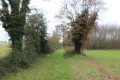
On the land known as ‘Les Combes’, which belongs to La Perjaudière farm, stands a remarkable oak tree. Its circumference is 5 metres at the centre of a trunk measuring 4.70 metres. Some branches extend up to 13 metres from the trunk, giving it a diameter of 26 metres. This tree attracts many visitors and is even renowned for killing… The heads are presented at the town hall and buried immediately. The number is recorded in a register. Each head is paid approximately 0.20F. It seems, according to the viper hunters, that the profession is less dangerous than one might reasonably suppose!
At a place called Fonquiérée, on the edge of the forest, there is a mound covering an area of several ares.
Legend has it that an ancient castle once stood there, though there is no evidence to support this.
Near the village of La Foix, on land belonging to the Aiglemier farm and known as ‘Le Château’, there is a mound covering an area of 12 to 15 ares and approximately 5 metres high. About 1 km from this mound, at a place called La Garenne – which also belongs to Aiglemier – there are five pits, each about 10 metres long and 5 metres wide.
The commune of Goux is crossed from east to west by an ancient Roman road known as the ‘Chemin des Sauniers’, coming from Poitiers and Lusignan via Loubigné and Bagnaux, passing very close to La Bosse, Le Souci and La Couarde, and then heading towards Thorigné. This road, which was heavily used in the days when mule drivers would fetch salt from the coast to transport it throughout France, is now little more than a local track – if it has not been completely abandoned altogether.
At a place called Faugeré, on the edge of the magnificent little Lambon valley, stands a fairly well-preserved old castle. There is no indication of when this castle was built; although uninhabited today, it is nevertheless well maintained by the owner. The last lord to have lived there was Jacques René Sermanton, squire to Louis XV. The Sermanton family owned the castle as well as the magnificent farms surrounding it.
In 1699, following the death of a member of the Sermanton family, the following notice was posted in Goux: ‘On 25 December 1699, a sale to be held within the courtyard of Faugeré Castle of the furniture and livestock belonging to Sir René de Sermanton, squire and Lord of Faugeré, at the request of his widow, Dame Scholastique Thebault.
Posted in front of and against the door of the church at Goux, following High Mass.”
Two inscriptions relating to the last members of the Sermanton family were found on the tombstones in the floor of the former church at Goux. These tombstones were transported to Faugeré on 1 June 1866 by Mr de La Revranchère, the current owner of the château.
In 1661, the King’s dragoons were sweeping through the region. 105 inhabitants of Goux, frightened by the threats, renounced Protestantism. In 1697, clandestine religious gatherings took place at Les Côtes, in Maupertuis, and in the woods of La Foix. A man named Jean Vinet, a farmer in Faugeré, was sentenced in 1715 to life in the galleys. In 1751, Monsieur Savariaux was thrown into prison for his faith.
Marriage certificate: ‘On this 8th day of June 1722, I, the undersigned priest, blessed the marriage of François Proust, the adult son of the late François Proust and Marie Broussart, his father and mother, to Magdeleine Albert, the adult daughter of the late Jacques Albert and Marie Pichebrun, her father and mother, both of this parish, following the publication of banns without opposition and the reception of the sacrament of penance, preceded by thesolemn abjuration of heresy made by them in the parish church before me.
1840: 540 inhabitants – 84 deaths
From 1843 to 1853: 113 births – 56 marriages *
Between 1849 and 1885: 88 conscripts. Of this number, only one could neither read nor write.
In 1866, a road mender was employed there for six months each year.
The inhabitants are hard-working; for the most part, they stick to traditional methods, cutting hay with a scythe, reaping wheat with a sickle and ploughing in furrows. However, progress seems to be advancing fairly rapidly, and some farmers have adopted mowers and reapers for their large farms, and consequently switched to flat ploughing. Almost everywhere, crop rotation is practised as follows: 1st year – weedy crops; 2nd year – wheat; 3rd year – oats; 4th year – clover.
There are few craftsmen. Everyone is engaged in farming. Many smallholders are landowners, and, whilst not wealthy, they live comfortably. There are no poor people, so the municipal authorities find it very difficult to distribute bread to the needy.”
- In 1865: 565 inhabitants, all Protestants – Local school for girls and boys: 50 pupils (in the 1865 Protestant Yearbook)
In 1906: 525 inhabitants
In 1975: 302 inhabitants
Decree of 15 December 1890 signed by President Carnot
Article 1. The administrative centre of the commune of Goux (district of Melle, department of Deux-Sèvres) is transferred to La Couarde.
Origin of the name
A ‘couarde’ is a piece of land shaped like a point… By extension, the name ‘La Couarde’ was given to our village, situated at the southern tip of the Forêt de l’Hermitain.
Protestant history
‘Hand in Hand’
Tales of the Poitou region (from the year 250 to the year 1900)
Jean Rivierre
Published by the Société Centrale d’Evangélisation, 1952
Excerpt from ‘Resurrection: The Life of a Farmer from Goux in the Year 1720’ – Chapter I
“In the heart of Huguenot Poitou lies a mysterious land.
This region has no name. You will find no mention of it on any map. When you pass through it, ask anyone you like what the region is called: they will reply with the name of a hamlet, or a farm lost amongst the tall trees. But that will not be the name of this region, which has none.
Nor does this region have any very precise boundaries. No prefect of the Deux-Sèvres will be able to point them out to you, nor will any rural constable. Yet these are well-informed gentlemen, but they cannot perceive such things. The country of which I speak stretches across several parishes, but it does not entirely cover any of them. What I am asserting is that it is a country distinct from all the others. You would have to be a traveller in a great hurry along the new tarmac road not to notice anything as you pass through it. For anyone travelling there on foot, for anyone who knows how to speak with the trees, the earth and the water, with the voice that is both present and close to the past, it is clear that there is something there that cannot be found elsewhere.
This country is a closed country. Not that one cannot come here from anywhere. But the very moment one enters it, it feels as though something is closing in on you. You feel trapped, between these woods and these hedgerows. At the four corners of this land, no doubt four angels stand, gigantic, invisible and silent. It is they, then, who hold out over the fields this veil of very light, almost impalpable mist, which is not made of moisture but of silence, and which has been floating there for centuries. I strongly suspect that those born here, and who live here, have not even noticed it. But for the visitor from elsewhere, there can be no doubt: a mysterious presence hovers over this land, placing a finger to the lips and whispering: ‘Hush!’
The sounds in this land seem destined to fade away. The paths seem made to vanish round the nearest bend. The houses seem made to hide, and they do not hesitate to do so, drawing curtains of trees before them. The leaves seem made to fall, so thick are the carpets of them on the ground, even in spring. Finally, the people seem made to flee: they need take but a single step to vanish.
You always think you’re alone in this countryside, but that doesn’t mean you actually are. Is there steam rising from nostrils behind the hedge? That means someone’s ploughing. Did twigs crack to the right? That means someone’s making a bundle of brushwood. Just because you can’t see anyone, never say: ‘No one can see me!’ Several pairs of eyes may be watching you, and from very close by.
Whether one comes up from Saint-Maixent, or La Mothe, or Celles, or Melle—which are, in truth, large and
populous towns, numbering as many as a few thousand inhabitants, one always discovers this land of silence. And whether one comes from the vast, bare plain of Niort and Mougon, barely broken by a few scattered cypresses, or from the limestone lands of Exoudun, dotted with walnut trees, or even from the sun-drenched hills which, towards Melle, slope down towards the south, sooner or later one enters this strange land, where the light dims a little, where even the sun and its warmth, even the wind and its harshness, must slip through and be fragmented by countless partitions.
This country is the summit, the heart, the secret stronghold of an entire region. It is the refuge one would seek if one had to flee. In the final days of the Huguenots, it was the citadel of resistance: the valleys and towns had opened themselves up to the enemy, welcoming, as always, the wind that comes from afar. When people wished to find God, they would climb silently up there at night, along the paths. There they would always find some gathering and some preacher. They would realise with joy that there were still thousands of them. Then they would descend again, like streams of rushing water, in all directions.
For this is a land of springs. Do you know what the villages here are called? They are called Fomblanche, Fombedoire, Fombelle, Fonmorte, Fonquerré, Fonchâtré, Fontagnou, Fonfréroux… and they are all named after fountains.
Take a few steps, with hardly any ascent or descent: you’ll pass from one hillside to another. There is a hill, a few dozen metres high, from which the waters radiate, before your very eyes, towards the Sèvre and Niort, towards the Charente and Rochefort, towards Poitiers and Nantes, and finally, via the distant Loire.
There are some very curious paths in this region. They are sometimes very narrow, to a disconcerting degree. They
are squeezed between hedges wider than themselves, which never cease to encroach upon them, and the carts that stubbornly persist in using them crush and soil the drooping fronds of the ferns at the bottom of the ruts. Elsewhere, these paths
widen and are covered in a splendid, reddish, thick layer of plant-based mud, marked by a thousand holes—the thousand footsteps of oxen—but a mud in which one does not get lost, for the rock is not far away, and pokes out here and there in sharp, jagged outcrops that tear through the soles of one’s shoes. Elsewhere still, these paths become avenues, where several competing ruts run side by side, forming vast, bumpy clearings at the crossroads, watched over by a few chestnut trees which, in times gone by, witnessed the peculiar revelries of witches. And these main paths are far from being the only ones: they are by no means footpaths. Pedestrians prefer to take simple shortcuts, cutting the shortest route through gaps in the hedges, which no outsider would suspect.
The true king of the countryside is the tree: the chestnut tree, above all, or, as they say, the ‘talle’. There are trees of every kind and every age. In the woods one sees whole armies of very young ones, shivering and pale, huddled close together, knowing they will not be allowed to live, and that one day they will perish together as brothers: the stump will remain, but it is always a case of starting afresh! Others, by contrast, are venerable old-timers, enormous, visible from a great distance, gnarled, tormented, terrifying in the night, ranging from splendour to decrepitude, and who live in solitude, scattered here and there, mingling with no other species of tree, mingling only with themselves, and thus forming, upon the stubble, majestic royal gardens.
One could speak at length about this land. Let us bring this to a close! The best thing is to set off there at once, and to make our way through all this mystery to the place which, of all these places, is the most mysterious.
It is a wood.
A wood of a kind one does not often see in Poitou.
It stands on a fairly high ridge and ought to dominate the horizon.
But we are in a land where the trees are enough to hide the mountains. It can only be glimpsed by chance, through some gap in the foliage, from afar—perhaps whilst, up close, beneath the canopy, one can reach it without ever having seen it.
I do, however, know of places from which it can be seen quite clearly. One then beholds a sight unusual for the region: a very dark, almost black wood, a wood of firs and pines. It turns its back on the northerly winds. It slopes steeply down towards the south. Once you have found the way in, you are still held up by broom, scrub and ferns. But if you persevere, you finally reach the sandy ground where the fine golden needles fall from above. The breeze takes on a tone that it possesses only there. It seems as though you are utterly far removed from all living things. The branches start so low that one cannot see very far, but on summer evenings, the setting sun slips in from below, reaching the very depths of the wood, and everything becomes luminous and golden. The ground is strewn with small, very hard rocks, which is why this wood has always been called the Bois des Roches. Look no further: this is where it all comes together.
To the right lies the old hamlet of Goux – the Celtic ‘Goos’ – consisting of barely four houses. To the left lies the wooded hamlet of Fombedoire, which was long known as Thérouanne. Opposite, some two hundred paces away, stands the sombre, rounded mass—uncleared, indecipherable, full of ruins beneath the tall trees—the remains of a medieval fortress known as the Motte d’Aiglemier. Nestled between these two immense, silent sentinels is a farmhouse, the roofs of which are barely visible. And this is La Foye, La Foye-de-Goux (1).
There, in the year 1720, lived the newly converted farmer, Jean Savariau, with his wife and children; we shall now turn our attention to his affairs.”
(1) Now the commune of La Couarde (Deux-Sèvres)



 Country:
 City:




 /A::.

 Visorando Member
 Moderate