


Refine your search for walks in Col du Pansier (2251m)
Col du Pansier (2251m) walks


 Col de Néal
 Visorando Member
 6.29 mi
 +2,044 ft
 -1,998 ft
 4h 40
4h 40
 Moderate
 Departure from Arvieux (Hautes-Alpes)
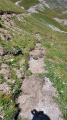
Col de Néal and the nearby lake are part of many routes on the site. This very easy double circular path allows you to discover them and enjoy the chalets and mountain pastures that precede these places.
Clapeyto and Col du Néal chalets and lakes
 8.11 mi
+2,772 ft
-2,769 ft
6h 10
Moderate
Departure from Arvieux (Hautes-Alpes)
8.11 mi
+2,772 ft
-2,769 ft
6h 10
Moderate
Departure from Arvieux (Hautes-Alpes)
Long loop to explore the Clapeyto chalets, then climb above to the Terres Blanche ridge where there are several lakes. Return via the Col du Néal and theGR® 5.
Well-marked trails.
Following the closure of the trail that started from the cross-country ski centre, we will start from the small lake at the entrance to the campsite
which is an extra kilometre on the road in summer.
This hike can also be done in winter on snowshoes, starting from theGR® 5 between the cross-country ski trails.
Walks near Col du Pansier (2251m)
The Lacs de l’Ascension and the Pic de Haut Mouriare
 10.06 mi
+4,252 ft
-4,259 ft
8h 20
10.06 mi
+4,252 ft
-4,259 ft
8h 20
 Difficult
Departure from La Roche-de-Rame (Hautes-Alpes)
Difficult
Departure from La Roche-de-Rame (Hautes-Alpes)
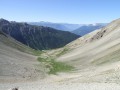
A hike with some very steep and vertiginous sections! This hike is a variation on the one marked as PR®.
La Chalp – Ceillac
 15.36 mi
+5,279 ft
-5,358 ft
10 hrs
15.36 mi
+5,279 ft
-5,358 ft
10 hrs
 Very difficult
Departure from Arvieux (Hautes-Alpes)
Very difficult
Departure from Arvieux (Hautes-Alpes)
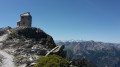
Ascent to Col Fromage through fields of flowers in July.The alternative route via the old signal station offers a 360° panoramic view and a bird’s-eye view of the valley.
From La Chalp to the Cime du Mélezet mountain hut
 15.97 mi
+4,888 ft
-4,452 ft
11h 35
Difficult
Departure from Arvieux (Hautes-Alpes)
15.97 mi
+4,888 ft
-4,452 ft
11h 35
Difficult
Departure from Arvieux (Hautes-Alpes)
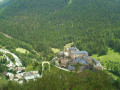
This fourteenth stage completes the crossing of the Queyras Massif. From La Chalp, the GR® 5 climbs along the left bank of the Torrent de l’Izoard above Arvieux, then reaches the hamlet of Les Maisons. From there, it heads towards Lac de Roue before descending to Château-Queyras. The route climbs the steep slope on the opposite side, on the right bank of the Torrent de Bramousse, joins a road at a hairpin bend and leaves it at the next one. It continues through the torrent’s valley, reaches the ridge separating the Bramousse and Riou Vert valleys, and, hugging the hillside beneath the peaks of La Selle and Rasis, reaches the Col Fromage. The path descends along the right bank of the Ravin de Rasis to reach Le Villard before arriving at Ceillac, from where it follows the Torrent du Mélezet, alternating between the left and right banks, before reaching the Refuge de la Cime du Mélezet.
La Chalp - Ceillac
12.81 mi
+4,272 ft
-4,416 ft
9h 35
Difficult
Departure from Arvieux (Hautes-Alpes)
Étape du GR®5 de La Chalp à Ceillac par le Col du Fromage dans le Queyras authentique et sauvage en passant par Chateau-Queyras.
Arvieux – Furfande Refuge
 4.30 mi
+3,123 ft
-676 ft
4h 40
Moderate
Departure from Arvieux (Hautes-Alpes)
4.30 mi
+3,123 ft
-676 ft
4h 40
Moderate
Departure from Arvieux (Hautes-Alpes)
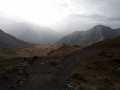
Ascent to the Furfande Refuge from Arvieux via theGR®58.
Hike completed on 5 July 2018 as part of a route.
 Ascent via the trails to the Col de Furfande from Arvieux
3.90 mi
+3,117 ft
-33 ft
1.5 hrs
Very difficult
Departure from Arvieux (Hautes-Alpes)
Instead of taking the ‘classic’ ascent via the forest road, opt for a route that climbs more steeply and features much more technical single-track sections – this will give you a good warm-up for the descent towards Les Granges de Furfande, then on to Le Queyron and finally back to Arvieux. I’ve only described the ascent route here. For the descent, use the Col de Furfande route guide , described by morgiou13, available at (2). Given the difficulty of the climb (steep sections and tight, steep hairpin bends), this route is best suited to e-MTBs.
Furfande – Souliers
 11.69 mi
+2,339 ft
-3,858 ft
7h 25
Difficult
Departure from Arvieux (Hautes-Alpes)
11.69 mi
+2,339 ft
-3,858 ft
7h 25
Difficult
Departure from Arvieux (Hautes-Alpes)
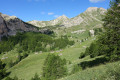
This walk, starting from the Furfande refuge, will take you past the magnificent barns and chalets of Furfande and lead you along a path running along a ridge above the Queyras valley, where the River Guil winds its way through, then on to Souliers via an ascent from the hamlet of Les Moullins in the Arvieux valley.
Alpage de la Selle - Moussière
4.92 mi
+358 ft
-1,581 ft
2h 35
Moderate
Departure from Saint-Crépin (Hautes-Alpes)
This pleasant second day begins with a climb to the Col de Moussière before passing by the very pleasant Lac du Lauzet, then taking the long forest track back to the Moussière car park.
Moussière - Alpage de la Selle
1.89 mi
+1,283 ft
-59 ft
2h 00
Moderate
Departure from Saint-Crépin (Hautes-Alpes)
Access from the alpine hamlet of Moussière to the bivouac area located between the Selle and Crousas mountain pastures. This mountain pasture overlooks the Cabane Sainte-Marie, where the sheep are kept at night.
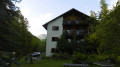
Lodge du Grand Rochebrune – Lodge le Teppio
 9.80 mi
+2,635 ft
-3,176 ft
6h 50
Difficult
Departure from Château-Ville-Vieille (Hautes-Alpes)
9.80 mi
+2,635 ft
-3,176 ft
6h 50
Difficult
Departure from Château-Ville-Vieille (Hautes-Alpes)
This stage follows part of theGR®® 58, then takes a route offthe GR®® to climb to the Col d’Izoard. Admittedly, this ascent is via the road, but on a day when vehicles are banned, allowing you to enjoy this lunar landscape with its monoliths. The return journey takes you through a deserted ravine. The limestone landscapes of this stage are nothing like those encountered since the start of the Tour du Queyras, which is characterised by slate.