Châteaux autour du Pouyalet

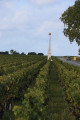
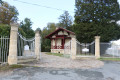
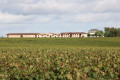
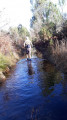
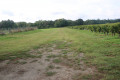
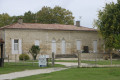
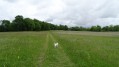
Agréable randonnée à proximité de Pauillac à la découverte de célébres châteaux du bordelais comme les châteaux Mouton Rothschild, Lafite Rothschild, Pibran et Pontet Canet. Le parcours très nature longe de belles parcelles de vignes, des bois dont certains sont pâturés par des bovins et offre de belles surprises architecturales.

Details

3634567
Creation:
Last update:
Last review:
  • Walking
    Activity: Walking
  • ↔
    Distance: 6.32 mi
  • ◔
    Average duration: 3h 00 
  • ▲
    Difficulty: Moderate

  • ⚐
    Back to start: Yes
  • ↗
    Ascent: + 148 ft
  • ↘
    Descent: - 138 ft

  • ▲
    Highest point: 95 ft
  • ▼
    Lowest point: 10 ft

Photos

Description of the walk

The car park is located at Le Pouyalet, on a car park at the junction of the Route de Bordeaux (D2) and the Route du Plantier Cornu.

(S/E) Cross the D2 road carefully at the pedestrian crossing and follow Rue Daniel Dejean. Turn left and continue along Rue Bonnefous. You will come out onto Rue Paul Doumer; follow it to the right.

(1) When you reach a snail-shell-shaped building on the right, turn right onto a path that runs alongside the Château Mouton Rothschild estate. Stay on the main path, heading north then north-north-west, and ignore all side paths until you reach the small road.

(2) Turn left onto this road and follow it to the next T-junction. Turn right, reach the hamlet of Milon and ignore two small lanes on the left.

(3) Turn left onto Chemin de Radet (beautiful gate). The path goes round the hamlet of Milon on the right and leads to Chemin de Milon. Follow this path to the right.

(4) When the stony path turns left, take a path on the right and cross a stream. Turn immediately right, climbing whilst skirting vineyards on your left. Then follow a wood on your right and ignore all the turnings on the left.

(5) At a three-way junction, turn left (south-east) and stay on the edge of the woodland.

(6) After about 600 m, turn right, still between the woods and the vineyards. Cross the D205 with care and continue straight ahead along a grassy path. At a fork, turn left and walk alongside the vineyards again.

(7) You will come out onto the D104E2; follow it carefully to the right. After about 150 m, take a path on the left. Walk alongside the vineyards on your left and, after about 150 m, turn left into a lane between two vineyard plots. You will soon reach the Chemin de la Lande de Berret and, shortly afterwards, turn right. Follow a path that winds its way along a stream.

(8) At the T-junction, follow a small road to the right which soon gives way to a path. Walk alongside a hedge of trees on your right for about fifty metres. Then turn left (south) and walk alongside a vineyard on your left. At the corner of the vineyard, turn left. Continue straight ahead (east) until you reach a small road.
(9) Follow the road to the left and, after about 100 metres, take a path on the right (small clearing). Walk alongside a pond on your left and continue along a path through the forest (east-northeast). Then turn right under a high-voltage power line. At the junction before a stream, turn right and walk alongside the stream, with vineyards on the other side.

(10) At the crossroads, at a place called Le Parc, turn left onto an uphill path. Pass under the high-voltage power line again, then ignore a turn-off on the left. At the T-junction, turn right. At a place called Pibran, follow a road to the left.

(11) Immediately after passing the winery building, turn left onto a path between the vineyards. At the junction that appears straight away, turn right. Walk alongside the Château Pontet-Canet estate and reach a small road leading to it. Cross this road carefully and continue straight ahead onto a small road between the vineyards. Cross the D205 with care and continue straight ahead along a road that soon becomes Rue des Verdots. At the end, turn right onto Rue Paul Doumer. At the next junction, turn left and go straight on to the starting point (S/E).

Waypoints

  1. S/E : mi 0 - alt. 49 ft - Car park on Route D2 – Rue du Plantier Cornu
  2. 1 : mi 0.32 - alt. 66 ft - Path to La Rigotte
  3. 2 : mi 0.8 - alt. 56 ft - Small road
  4. 3 : mi 1.41 - alt. 79 ft - Chemin de Radet
  5. 4 : mi 1.61 - alt. 23 ft - Crossroads
  6. 5 : mi 2.38 - alt. 20 ft - Three-Way Junction
  7. 6 : mi 2.7 - alt. 75 ft - Junction
  8. 7 : mi 3.14 - alt. 89 ft - D104E2 road
  9. 8 : mi 3.66 - alt. 85 ft - Small road
  10. 9 : mi 4.51 - alt. 72 ft - Small road
  11. 10 : mi 4.98 - alt. 20 ft - A place known as Le Parc
  12. 11 : mi 5.46 - alt. 52 ft - Path on the left after Le Pibran
  13. S/E : mi 6.32 - alt. 49 ft - Car park on Route D2 – Rue du Plantier Cornu

Notes

Warning: during vineyard treatments (which occur frequently throughout the year), you use the hiking trail at your own risk. Furthermore, as this route crosses private property, hikers are asked to stay on the paths and, where necessary, keep dogs on a lead.

This hike across varied terrain requires sturdy footwear.

This route is partially marked in yellow. In addition, it is advisable to follow the directions in this description and on the map, whilst also observing the surrounding landscape. Distance markers from the starting point, or even the GPS coordinates of waypoints (including the start), can also help hikers find their way.

Using a GPS or a smartphone with the Visorando app can help the walker navigate.

Hike completed by the author on 24 September 2020

Worth a visit

Pauillac
Located halfway between Bordeaux and Pointe de Grave, Pauillac stretches along Europe’s largest estuary, the Gironde. The undisputed capital of the Médoc wine region, with 18 Crus Classés from 1855, including the top three (Châteaux Lafite-Rothschild, Latour and Mouton-Rothschild), and just a few minutes from the seaside resorts of the Atlantic Ocean, Pauillac opens up a magical world where culture and heritage, fine dining, entertainment and leisure activities come together…
Places and Monuments:
- Airbus A380 landing stage
- The Monument to the People of Pauillac
- The Village Hall
- Pablo Neruda
- The Centenary of Airmail
- The Rotunda
- The Marquis de Lafayette
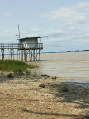
- The fishing huts on the estuary
- The Aspic Tower
- The Artigues Cave
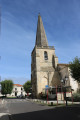
- Saint Martin’s Church
For further information, visit the Pauillac municipal website.

Château Mouton Rothschild
Acquired in 1853 by Baron Nathaniel de Rothschild, the estate has been in the same family for six generations.
The close link between art and wine gives Château Mouton Rothschild its unique character. This is evident in the architecture of the Grand Chai and the new vat house, the Museum of Wine in Art, which houses a collection of precious objects associated with vines and wine, and the space dedicated to exhibiting original works created by leading contemporary artists to illustrate the estate’s labels.

The estate’s reputation stems from the personality of the Baron and his wife. Set within a superb English-style park, the buildings are arranged around a U-shaped courtyard housing the ‘Grand Chai’, designed by the architect Charles Siclis. A veritable ‘theatre of wine’, as Baron Philippe liked to say, this building is imposing in its size and the perfectly straight rows of oak barrels in which this Premier Grand Cru Classé is aged. Next to it, the Rothschild family has displayed its personal collection of artworks depicting vines and wine from antiquity to the present day. A museum of wine in art, which explains the relatively high cost of a visit that is certainly well worth it, particularly for the exceptional collection of labels created since 1945 by the greatest artists, as well as 17th-century German silverware (jugs and goblets from the treasury of the King of Naples). The estate’s wines include: Château Mouton-Rothschild, Le Petit Mouton de Mouton-Rothschild, Aile d’Argent, Château d’Armailhac, Château Clerc Milon, Opus One, Almaviva and Domaine de Baronarques. A host of magical bottles that transport you to another world…
Source: the château’s website and Le Petit Futé

Château Lafite Rothschild
Whilst the first known reference to Lafite dates back to 1234, with a Gombaud de Lafite, abbot of the Monastery of Vertheuil north of Pauillac, the existence of Lafite as a medieval seigneury is attested as early as the 14th century. The name Lafite derives from the Gascon word ‘la hite’, meaning ‘the hill’. There were probably already vineyards on the estate, but it was under the Ségurs, in the 17th century, that the vineyard was organised and Lafite’s reputation as a great wine estate was established. Jacques de Ségur was responsible for planting the Lafite vineyard, around 1670 and in the early 1680s. In 1695, Jacques de Ségur’s heir, Alexandre, married the heiress of Château Latour, and this union produced Nicolas-Alexandre de Ségur. The two seigneurial estates of Lafite and Latour were thus united, marking the beginning of a shared wine-growing history.
The vineyard comprises three main areas: the hillsides surrounding the Château, the Carruades plateau adjoining it to the west, and a 4.5-hectare plot in the neighbouring commune of Saint-Estèphe. The total area is 112 hectares, consisting of deep, fine gravel soils mixed with wind-blown sand on a subsoil of Tertiary limestone, well-drained and well-exposed.
The grape varieties are Cabernet Sauvignon (70%), Merlot (25%), Cabernet Franc (3%) and Petit Verdot (2%).
The average age of the vines is 39 years, but it should be noted that vines under 10 years old are not used in the grand vin, meaning that the average age of the vines producing the grand vin is closer to 45 years. The oldest plot, known as ‘La Gravière’, was planted in 1886.
Source: the château’s website

Château Pibran
Established in the early 20th century and classified as a Cru Bourgeois in 1932, Pibran was acquired by Paul Billa in 1941 and remained in the hands of the Billa family until 1987. During this period, the estate’s reputation was maintained, notably with some excellent vintages in the 1980s. The estate was bought in 1987 by Axa Millésimes, a subsidiary of Axa headed at the time by Jean-Michel Cazes, owner of the neighbouring Château Lynch-Bages. From that date onwards, Pibran benefited, under Daniel Llose, from the expertise of the technical teams at Axa Millésimes and Pichon-Longueville Baron, as well as from significant financial resources.
The vines were replanted, drainage improved and a new winery built. In 2000, Christian Seely succeeded J.-M. Cazes, who was retiring, and has since managed the estate with the support of R. Matignon, Technical Director, and Jacques Boissenot, the renowned Médoc oenologist. Finally, in 2001, the vineyard was significantly expanded with the purchase of the neighbouring Château La Tour Pibran (also a Cru Bourgeois in 1932). Pibran was classified as a Cru Bourgeois Supérieur in 2003.
Located just north of Pauillac and just south of Pontet-Canet, the 17-hectare vineyard stretches across a gravelly hilltop. The grape varieties consist of Merlot (54%), Cabernet Sauvignon (45%) and Petit Verdot (1%). The average age of the vines is 30 years and the planting density is 9,000 vines per hectare. As with Pichon-Longueville Baron, viticulture is both traditional and modern. It follows ‘Integrated Production’ practices and is certified as environmentally friendly. The estate produces a second wine, ‘La Tour Pibran’.
Source: Le Figaro.fr wine website

Château Pontet-Canet
Three families over three centuries
Jean-François de Pontet had made his career at Versailles; highly favoured at court, he had held the post of Grand Equerry to Louis XV. Returning to Guyenne, he became Governor of the Médoc. In 1705, he purchased a few acres of land north of the village of Pauillac to establish a vineyard. A few years later, he added plots in the locality known as Canet. As was the custom at the time, he combined his name with that of the Médoc estate to give the domaine its identity. A century later, Château Pontet-Canet flourished and joined the ranks of the greats by being classified as a Grand Cru Classé in the famous 1855 classification ordered by Emperor Napoleon III.
In 1865, the estate changed hands for the first time, becoming the property of Herman Cruse, a wine merchant. The Cruse family retained ownership of the estate for 110 years, until 1975, when it was purchased by Guy Tesseron, a cognac merchant. Over nearly three centuries, Château Pontet-Canet has had only three owners, three families… A rarity in the Médoc.
Pontet-Canet is biodynamic
In 1895, Charles Skawinski, the estate manager at the time, created a revolutionary cellar, consisting of wooden vats fed by gravity with the aid of a platform running on rails on the first floor.
Since then, Pontet-Canet has returned to this gravity-fed principle by renovating the wooden vat room and adapting it to modern conditions. In 2005, the ‘Nicole’ vat room was inaugurated, based on the same principles as its predecessor but incorporating small truncated-cone-shaped concrete vats.
The use of these two materials is part of the quest for quality, as they provide excellent thermal inertia during the vinification of red wines intended for ageing.
Source: the château’s website

Reviews and comments

4.1 / 5
Based on 5 reviews

Reliability of the description
4 / 5
Ease of following the route
4.6 / 5
Route interest
3.8 / 5
François Gonon
François Gonon

Overall rating : 4 / 5

Date of your route : Jun 05, 2021
Reliability of the description : ★★★★☆ Good
Ease of following the route : ★★★★★ Very good
Route interest : ★★★☆☆ Average
Very busy route : No

We had a bit of trouble after point 9 getting through the small wood because the start of the path isn’t very visible: you have to climb over a slope. What’s more, the path is starting to get overgrown with brambles, but it’s passable. After walking along the pond on your left, make sure you take the north-east path and not the west-south-west one, which disappears into the brambles a little further on.

Machine-translated

mortagne17
mortagne17

Overall rating : 4 / 5

Date of your route : Apr 05, 2021
Reliability of the description : ★★★★☆ Good
Ease of following the route : ★★★★☆ Good
Route interest : ★★★★☆ Good
Very busy route : No

A lovely, easy walk starting near the castles and continuing through beautifully maintained vineyards.

Note on the route: Between points 9 and 10, you must take a detour via existing paths as the path indicated no longer exists (at least, we couldn’t find it).

Machine-translated

yvounet
yvounet

Overall rating : 4.7 / 5

Date of your route : Mar 27, 2021
Reliability of the description : ★★★★☆ Good
Ease of following the route : ★★★★★ Very good
Route interest : ★★★★★ Very good
Very busy route : Yes

A lovely drive through a peaceful area, along quiet roads.
The route through the Médoc’s grand cru vineyards is fabulous.
No particular difficulties apart from crossing the main road, and no significant elevation changes.

Machine-translated

pgetrochon
pgetrochon

Hello,
Thank you for your message.
I find your comment about the châteaux a bit harsh. The route gets as close to them as is permitted. In particular, I had to alter the route as we approached Château Lafite Rothschild to prevent hikers from encountering difficulties with the château’s very active security staff (whom I encountered myself, despite being on a path...). Nevertheless, the choice of routes allows you to see certain façades of the châteaux and cellars.
Happy hiking.

Machine-translated

Rando_JM_33
Rando_JM_33

Overall rating : 3.7 / 5

Date of your route : Feb 20, 2021
Reliability of the description : ★★★★☆ Good
Ease of following the route : ★★★★★ Very good
Route interest : ★★☆☆☆ Disappointing
Very busy route : No

Several prestigious castles are featured on this route. It’s a shame that it only passes close by without offering a view of the facades.
Wild game was spotted as we approached the wooded areas.
An easy hike completed in 2 hours 45 minutes (including a picnic) in strong winds.

Machine-translated

18 SE
18 SE

Overall rating : 4.3 / 5

Date of your route : Oct 26, 2020
Reliability of the description : ★★★★☆ Good
Ease of following the route : ★★★★☆ Good
Route interest : ★★★★★ Very good
Very busy route : No

Winter: put on hiking boots (wet)

Machine-translated

Other walks in the area

For more walks, use our search engine .

The GPS track and description are the property of this route's author. Please do not copy them without permission.