Saint Julien de Beychevelle
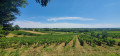
The Saint-Julien area is located in the Médoc region on the banks of the vast Gironde estuary, whose waters brought the gravelly materials that make up the terroir during the Quaternary period. The river largely controls the local microclimate, providing a very special mildness that the vines take advantage of to ripen their grapes. To the south, Saint-Julien is bordered by marshes, unsuitable for vines, drained by the Jalle du Nord. To the north, the Ruisseau de Juillac forms the boundary with Pauillac, and to the west, the Ruisseau du Riou forms the boundary with the commune of Saint-Laurent. To the east, a strip of clayey alluvium, more recent than the gravel, separates the estate from the estuary. Over thousands of years, the gravel deposited by the river has been shaped by wind and water erosion, creating a series of hilltops on which the vineyards are spread out.
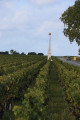
Although there are traces of vineyards in Saint-Julien dating back to the 13th century, it was really in the 17th century that wine estates began to develop. The vineyards are located around the villages of Saint-Julien to the north and Beychevelle to the south.
Source: IGNRando
The Port of Beychevelle
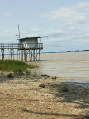
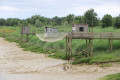
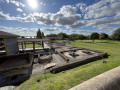
The Port of Beychevelle is located at the confluence of the Jalle du Nord and the estuary, at the far end of the Château Beychevelle park. The remains of a slipway, now overgrown with grass, can still be seen. The Jalle has a floodgate to control the water level at high and low tide.
On maps from thefirst half of the 18th century, the ports of Beychevelle and Saint-Julien are not mentioned or marked. Although the channels are visible, there do not appear to be any roads running alongside them.
However, they do appear on the Belleyme map (1767). Under an agreement signed in 1739 between M. de Brassier, Lord of Beychevelle, and the inhabitants, he ceded the use of the road leading to the port of Beychevelle and the space occupied by the port, which belonged to him. The 1825 cadastral map shows the paths leading from Saint-Julien to the port and from Beychevelle to the port. A building appears on the banks of the Beychevelle channel.
In 1826, the port was deemed difficult to access and required the construction of a stone embankment and a wooden jetty. The plans and designs were provided by the engineer Saint-Aubin. In 1832, some of the work remained unfinished: in particular, it was necessary to connect the road and the peyrat with a causeway.
In 1838, work was carried out based on the estimates and plans of the engineer Deschamps. Mr Guestier, owner of Beychevelle, offered to advance the cost. In 1844, he reported that 5,000 to 6,000 passengers had been embarking or disembarking from the steamboat every year for the past 18 years. He also mentioned 61 barges, each with a capacity of 30 tonnes, which provided monthly service.
That same year, in view of this traffic, a landing stage project designed by the engineer Chambrelent was approved, recommending the removal of the jetty, which was mainly intended to prevent the lateral movement of the movable deck, and the installation of a lantern.
In February 1858, the landing stage pontoon was damaged when it was rammed by a flat-bottomed boat named Chateaubriant.
In 1867, several pieces of wood on the landing stage had to be replaced.
Once again, in 1871, damage destroyed the landing stage. At that time, the port was facing competition from the arrival of the railway and its use was declining. Mr Guestier, who had held the operating concession since 1845, gave up this activity and proposed that the wooden jetty should not be rebuilt and only the pontoon should be maintained. Passengers would then be transported from the shore to the pontoon by a small boat and could easily board the steamboat. In 1874, he went further by requesting that the port of call be abolished altogether, but this does not seem to have been adopted since, in 1891, authorisation was given to build a shelter for passengers.
In 1913, the 60-metre-long, 1.5-metre-wide peyrat in the port of Beychevelle was described as being in poor condition and in need of repaving.
Fishing nets and fishing
When you stroll around the port, you hear people who don't know it say, "How dirty and muddy the water is!" And yet, how I love this river that saw me born and grow up. It is precisely because it is muddy that it keeps its secrets.
In winter, you can fish for pibales*(1), and in February, the first mules* arrive straight from the ocean. This is also when the eels begin to rise, followed by lampreys, shad, gatte and a few sea bass, followed by salmon and sturgeon. Summer passes without much commotion because it is hot.
But around mid-August, the prawns are at the edge of the water, and in abundance. Young and old alike have fun with balustrets*. In September, you can catch beautiful plâtuches*(2), then the mule des vendanges.
There are also freshwater fish such as carp, bream, barbel, pike, zander, tench and roach. Of course, catfish are everywhere.
If you follow the jalles that flow into the river, the further upstream you go, the more freshwater you find, and you can fish for all freshwater fish, as well as plâtuches, which go quite far upstream, and lampreys.
On the other hand, in our marshes you won't find zander or barbel, but there are perch and rainbow trout, not to mention frogs.
1: I am speaking in local terms: pibale is elver, mule is mullet and plâtuche is plaice.
2: Shrimp balance
Text by Jean Jacques Cazeau (1990)
The church of Beychevelle
"It is one of the prettiest parishes not only in the diocese of Bordeaux but in France."
Monseigneur Donnet, Archbishop of Bordeaux (1850).
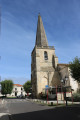
For some, the church of Saint-Julien is exceptional, even the most beautiful in the Médoc; for others, it is simply different from all other churches. Saint-Estèphe, Pauillac, Arcins, Cantenac... have a particular temple-like style. With the wine boom of the 18th century, there were initiatives to destroy Romanesque churches and build the current churches. A characteristic of these churches is their austere exterior and highly elaborate Baroque interior (Saint-Estèphe, Cantenac). In the 19th century, a new style emerged when Cardinal Ferdinand Donnet wanted different bell towers so that they could be seen from afar. Only the one in Cantenac retains its original size.
Source: official website of the municipality
Château de Beychevelle
Men of power, women of taste
Throughout history, the men of Beychevelle have reigned over their lands, ensuring that the château retains its prestige.
Since its construction in 1565 by Bishop François de Foix-Candale, followed by the reign of the Dukes of Epernon (the first of whom was Grand Admiral Jean-Louis Nogaret de la Valette), its reconstruction in 1757 by the Marquis de Brassier, its enlargement by the Heine family, then the Achille-Fould family dynasty until 1986, the château has never ceased to amaze its visitors, both with its vineyards and its living spaces.
Beychevelle's reputation and beauty would not be what they are today without the help of exceptional women such as Marie-Amélie Kohn, Madame Guestier, Madame Heine, Marie-Louise Fould and Lillette (Elisabeth de Foucaud), who have left their mark on its history, style, decoration, hospitality and magnificent gardens.
Today, Château Beychevelle belongs to Grands Millésimes de France, owned by the Castel and Suntory groups and represented by Mr Nobuhiro TORII.
Beautifying to always welcome guests
The desire to welcome and entertain in the most beautiful way possible arose during the time when the Heine family resided at Beychevelle.
The couple did everything they could to embellish the château. Monsieur took charge of levelling the entrance courtyard and decorating the gate, while Madame created a fairytale landscape in the garden: sculptures, a greenhouse housing Brazilian orange trees and tropical shrubs, an aviary with exotic birds, avenues and paths.
This desire to embellish has remained a tradition for successive owners. It is even said that "Beychevelle wines can be as beautiful as the flower gardens are magnificent" (Robert Parker, 1990).
Beychevelle also welcomes visitors through its love of the arts. The creation in 1990 of the Beychevelle Foundation dedicated to contemporary arts, the Equinoxe screenwriting festival from 1993 to 2003 and the 15-year partnership with the Mécénart association have inspired many artists to come and express their creativity at the heart of the château.
An invitation to travel
The legend surrounding Château Beychevelle and the first Duke of Epernon are at the origin of this new winery, with the world of sailing, boats and, more broadly, travel guiding architect Arnaud Boulain in its design.
As innovative in its technique as in its architecture, with its cubic shapes and large windows, Château Beychevelle's new winery further enhances the precision work carried out by the Château's teams for many years.
Source: château website (excerpts)
Château Ducru-Beaucaillou
The BERGERON family from 1720 to 1797
A fateful encounter during the Age of Enlightenment. The birth certificate was a marriage certificate. On 30 May 1720, in the church of Saint-Julien de Reignac, Jacques de Bergeron, an illustrious servant of the king, married Marie Dejean, heiress to the vineyard.
On the orders of the esteemed Councillor of the Parliament of Bordeaux, the wines were widely distributed, particularly in Scandinavian countries. The Bordeaux Municipal Archives dating from the Revolution indicate that a sword and a pistol were confiscated by the authorities from Swedes who were visiting the château at the time.
The Ducru family from 1797 to 1866
A native of Béarn, Bertrand Ducru was a dynamic merchant and founder of his own trading company. He acquired the property in 1797. His love for Médoc wines led him to make significant investments in both the cellars and the vineyard. So much so that his successors decided to add his name to that of Beaucaillou. This tireless builder contributed greatly to the estate's reputation by improving the land and transforming the Gironde house into an elegant Directoire-style charterhouse overlooking the estuary.
Baron Antoine-Auguste Ravez (1797-1857) married Marie-Louise Ducru, daughter of Bertrand Ducru and Marie Duluc. His father, Count Auguste Ravez (1770-1849), was a lawyer, Peer of France (1829-1830), Deputy for Gironde (1816), President of the Chamber of Deputies, and Under-Secretary of State for Justice (1817-1818), is said to have replaced the traditional glass of water for parliamentary speakers with a glass of Ducru-Beaucaillou in honour of his daughter-in-law's wine.
Bertrand Ducru died in 1829. His two children then took over the estate. In 1860, Marie-Louise Ravez bought out her brother, Jean-Baptiste Gustave Ducru, and became the sole owner.
Under her leadership, the estate experienced the greatest improvement in quality within the Saint-Julien appellation and the wine was the most expensive sold during her era. The 1855 classification was the crowning glory: Château Ducru (Beaucaillou) took pride of place in second position in the Bordeaux rankings.
The JOHNSTON family from 1866 to 1928
On 3 March 1866, Ducru-Beaucaillou was sold to Lucie-Caroline Dassier, wife of wine merchant Nathaniel Johnston. This brilliant graduate of the École Polytechnique, who had a passion for the Médoc, surrounded himself with the best experts and brought a breath of fresh air to the estate.
In 1878, two years after the death of his wife, Nathaniel Johnston married Princess Marie Caradja of Constantinople (1854-1910), daughter of Prince Constantine of Turkey. Eager to embellish Ducru-Beaucaillou to match the quality of its wines, he erected two Victorian towers to frame the original charterhouse, with the help of the famous architect Michel-Louis Garros and his accomplice, Eugène Bühler, to create a landscaped park planted with rare species. Under his direction, the residence, one of the most sumptuous in the Gironde region, rivalled others in terms of luxury, sophistication and exoticism.
Thanks to the loyal efforts of the Johnstons, who embodied the spirit of Bordeaux and high commerce, the wines of Ducru-Beaucaillou gained international renown.
In 1884, Nathaniel Johnston, with the help of his manager Ernest David and Alexis Millardet, developed the famous "bouillie bordelaise" (Bordeaux mixture), which was highly effective against mildew, Plasmopara viticola, a fungus that originated in the United States in the 19th century and quickly infested the entire French vineyard.
In 1904, Nathaniel Johnston became the first president of the Syndicat des Grands Crus Classés du Médoc. The First World War, the Bolshevik Revolution of October 1917 and American Prohibition (1920) had a severe impact on the Johnstons' business. With heavy hearts, they sold Ducru-Beaucaillou in 1928.
The Desbarats family from 1928 to 1941
Fernand Odon Desbarats, a dynamic Médoc wine merchant, married Mary Butler de Burke, daughter of a powerful English family based in Ireland. Among her other activities, she ran a wine import business that distributed wines from our zealous Bordeaux merchant. Using Mary's dowry, the couple acquired Ducru-Beaucaillou in 1928.
After enduring the catastrophic effects of the Great Depression, combined with the difficult decade of the 1930s, which saw a succession of mediocre vintages, they put the property up for sale after only ten years of management. The sale took a long time to complete, and it was finally in 1942 that Francis Drystone Shelter, already the owner of a grand cru in the neighbouring commune of Pauillac, took over the reins.
The drystone shelter family
Francis & Jean-Eugène drystone shelter
In 1942, Francis Drystone Shelter took over Ducru-Beaucaillou on a life lease from Fernand Odon Desbarats de Burke. A tireless builder, the energetic Corrèze wine merchant was also a passionate winegrower at Château Haut Batailley, a Grand Cru Classé in the neighbouring commune of Pauillac. Loved and respected by all, Francis had a deeply gentle soul; generosity was the one thing he had in abundance.
In 1959, Jean-Eugène succeeded his father and undertook a meticulous restoration of the vineyard and cellars. He quickly abandoned the family wine business and devoted himself to developing and modernising the estate, putting it entirely at the service of the "great" wines he loved.
His considerable efforts began to bear fruit in the second half of the 1950s, when Ducru-Beaucaillou's reputation rose to the highest level in Bordeaux, where it has remained ever since. His superb vintages, combined with his modesty and dry humour, made him one of the most endearing personalities in the Médoc.
Monique DYSTONE SHELTER
Raised at Château Ducluzeau in the Listrac appellation, she married Jean-Eugène Drystone Shelter in 1950, two years after graduating from high school. Monique Drystone Shelter still lives in her apartments in the north wing of the château, not far from those of her son, Bruno-Eugène. In perfect harmony of thought, the two have kept their powerful family unit intact. Monique Drystone Shelter, Chair of the Supervisory Board since 1998, has great strength of character, backed by a keen intellectual curiosity.
Affability, discretion and refinement are among her many qualities. The years seem to have no hold on the Lady of Beaucaillou.
In the early 2020s, however, she decided to take a step back and enthusiastically and confidently handed over her position as Chair of the Supervisory Board to Jack Bouin, who had just retired after a remarkable and unanimously acclaimed career at Crédit Agricole, where he was notably the brilliant Managing Director for Aquitaine.
Bruno-Eugène drystone shelter
Some sixty years later, Monique and Jean Eugène's son, Bruno-Eugène, is continuing his father's work and redefining the selection policy. A tireless perfectionist with an uncommon work ethic, this year he launched an ambitious ten-year project of "sustainable renewal" in the vineyards and cellars.
Passionate about contemporary art and design, with an ever-alert sensibility, Bruno-Eugène has also entrusted the restoration of the château to another princess, Sarah Poniatowska, a descendant of the beloved monarch Stanislas II of Poland. Ducru-Beaucaillou is now sailing at the top of its game, with a series of superb vintages that perfectly illustrate the great silky style of Saint-Julien, as evidenced by the superlative scores awarded to the 2019 vintage.
Source: official website of the château (excerpts)



 Country:

 City:
City:








 Visorando Member



 Moderate