Discovering the King’s Oak from Château-Voué

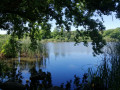
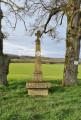
This walk, in the heart of the Saulnois region, will allow us to discover the King’s Oak. Louis XIV is said to have camped near this oak, which is estimated to be four centuries old. It is situated in the woods opposite Château-Voué, a village steeped in history. It is no longer so easy to find today, and I invite you to join me in discovering and admiring it. You will also have the opportunity to visit Château-Voué (the castle ruins and fortified house), as well as to walk along the beautiful Étang de Wuisse.

Details

12506767
Creation:
Last update:
Last review:
  • Walking
    Activity: Walking
  • ↔
    Distance: 5.20 mi
  • ◔
    Average duration: 2h 50 
  • ▲
    Difficulty: Easy

  • ⚐
    Back to start: Yes
  • ↗
    Ascent: + 459 ft
  • ↘
    Descent: - 463 ft

  • ▲
    Highest point: 971 ft
  • ▼
    Lowest point: 712 ft

Photos

Description of the walk

The starting point is the small square, now converted into a car park, located in the centre of the village, just in front of the church.

(S/E) With your back to the church, head straight down the small Rue du Château. At the end of this street, after barely 30 metres, you will see the ruins of the village castle. Turn around and take Rue de la Fontaine on the right to leave the village.

(1) At the end of the street, turn right onto the D 28 and follow it for 200 m, ignoring the first path on the left.

(2) Take the second path on the left. Continue along this path for 1 km after entering the forest.

(3) Take the path on your left, at plot 111 (a sign on a tree bears the number). Follow this path straight down for about 450 m. After crossing a small stream (marked by a large concrete pipe), the path climbs very steeply.

(4) Halfway up the slope, after about a hundred metres, at a stone marker on the ground marked 385, take the path on the right.
After 80 m, at the end of this path (at a Fork in the road, keep to your right), you’ll reach the Chêne du Roi, which you can admire.

(5) Retrace your steps and continue along the very steep path to the right for 150 m.

(6) When you reach a large feeding trough (a device designed to feed wild boars), take the path on the left, which is not shown on IGN maps, and follow it for 400 m (very old and unreliable markings in the form of an orange square, which you may have already seen along the route).

(7) Take the path on the right which leads to the Route Forestière de la Haute Charrière, which you follow to the left.

(8) At a fork in the road, opposite a sign indicating a car park, take the stony path on the left, which leads onto a small tarmac road.
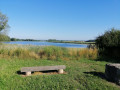
On this stretch, walk alongside the Étang de Wuisse. At the end of the small road, you’ll rejoin the D 28 (elevation 223 m), which you follow to the left for 350 m.

(9) At the next junction, take the Route de Château-Voué on the right. At the entrance to the village, take Rue de l'Église on the left and return to the car park (S/E).

Waypoints

  1. S/E : mi 0 - alt. 820 ft - Car park. Church
  2. 1 : mi 0.38 - alt. 715 ft - D 28. Right
  3. 2 : mi 0.49 - alt. 712 ft - Path. Left
  4. 3 : mi 1.5 - alt. 968 ft - Path to the left (plot 111)
  5. 4 : mi 1.95 - alt. 873 ft - Marker 385. Towards the oak tree
  6. 5 : mi 2.01 - alt. 840 ft - The King’s Oak
  7. 6 : mi 2.31 - alt. 942 ft - Feeding trough. (Left)
  8. 7 : mi 2.52 - alt. 902 ft - Path to the right
  9. 8 : mi 3.23 - alt. 938 ft - To the left (car park)
  10. 9 : mi 4.79 - alt. 741 ft - Turn right towards Château Voué - Étang de Wuisse
  11. S/E : mi 5.2 - alt. 823 ft - Car park. Church

Notes

- Some sections are not shown on IGN maps but are nevertheless genuine paths; indeed, some still bear old markings (Orange Square).
- At checkpoint (4), the number 385 is on the side of the marker facing the forest.

Worth a visit

Fortified house (at the corner of the car park at the start)
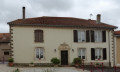
This is a fortified house whose site and remains were listed as historic monuments by decree on 24 December 1991. It is a rare example of a fortified house situated at a high elevation and is privately owned.

Castle ruins (40 m from the car park)
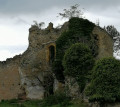
Ruins of the 14th-century fortified castle (1342), ruined during the Thirty Years’ War. Partially destroyed from 1795 onwards.

The church (car park at the start)
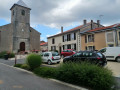
Saint-Martin Church, Baroque, 1721: pulpit 1745, 18th-century altars and confessionals, alabaster holy water fonts by Robert Pincedé (1775), 18th-century reliquary cabinet, 17th-century painting of Saint Martin.

The King’s Oak
This is a pedunculate oak (a species of deciduous tree native to the temperate regions of Europe. Its fruit is borne on a long stalk. It is also known as the white oak, female oak, gravelin, cluster oak or châgne. Its Latin name, Quercus robur, means ‘robust oak’). It stands 36 metres tall and has a circumference of 546 centimetres. It is thought to be around four centuries old. According to the story, Louis XIV, whilst travelling through the salt-producing region, is said to have rested at its foot on a hot summer’s afternoon.

The Étang de Wuisse
The Étang de Wuisse already existed before 1750 and at its outlet, held back by a dam, stood a mill.

Reviews and comments

4.3 / 5
Based on 4 reviews

Reliability of the description
4.5 / 5
Ease of following the route
4.5 / 5
Route interest
4 / 5
Ispa54
Ispa54

Overall rating : 4 / 5

Date of your route : May 18, 2026
Reliability of the description : ★★★★☆ Good
Ease of following the route : ★★★★☆ Good
Route interest : ★★★★☆ Good
Very busy route : No

This is an unmarked walk, which is why it’s important to bring the route description with you – it’s very detailed. There is indeed a very steep slope leading up to and away from the King Oak.
The highlight is undoubtedly the King Oak. It’s a wonderful discovery.
When we went to scout the route before sharing it, we had to give up on taking our group of friends along – two of them had knee problems, and the steep slope might have been impossible for them to manage. We’ll have to do it again once they’ve recovered. Thanks to the person who designed this route, and well done on the description.

Machine-translated

qurin
qurin

Overall rating : 3.7 / 5

Date of your route : Jun 16, 2025
Reliability of the description : ★★★★☆ Good
Ease of following the route : ★★★★☆ Good
Route interest : ★★★☆☆ Average
Very busy route : Yes

no change

Machine-translated

User 26088524

Overall rating : 5 / 5

Date of your route : Jun 08, 2025
Reliability of the description : ★★★★★ Very good
Ease of following the route : ★★★★★ Very good
Route interest : ★★★★★ Very good
Very busy route : No

Personally, I didn't enjoy the hike at this time of year because it was raining and, at the end of the hike before reaching the oak tree, there is a steep descent covered in mud, so if you don't have shoes with studs, you slip quite easily. But apart from that, it was still pretty good! Have a great hike, everyone!

Machine-translated

Charvette
Charvette

Overall rating : 4.7 / 5

Date of your route : Sep 26, 2023
Reliability of the description : ★★★★★ Very good
Ease of following the route : ★★★★★ Very good
Route interest : ★★★★☆ Good
Very busy route : No

A walk taken with the family, with two children aged 4 and 6
Nice route, lovely forest; as the area around the pond is inaccessible because it’s private property, don’t plan on going for a swim
The route is still a bit long for children of this age, so in this situation, make sure you save some energy to carry them!
It was a good day nonetheless
PS: behind the block of flats at the back there’s a chestnut tree which makes for a lovely picnic spot

Thanks for sharing!

Machine-translated

Other walks in the area

For more walks, use our search engine .

The GPS track and description are the property of this route's author. Please do not copy them without permission.