West of Pamproux

A pleasant walk to explore the village of Pamproux and its points of interest, such as the Chabanne wash house and fountain, traditional buildings and Saint-Maixent Church. The route stretches along the Pamproux stream, towards its source (which varies with the seasons), offers beautiful scenery on the western side of the village, and allows you to discover a local curiosity, the Moulin de Pouillet.

Details

3349390
Creation:
Last update:
Last review:
  • Walking
    Activity: Walking
  • ↔
    Distance: 6.79 km
  • ◔
    Average duration: 2h 05 
  • ▲
    Difficulty: Easy

  • ⚐
    Back to start: Yes
  • ↗
    Ascent: + 43 m
  • ↘
    Descent: - 43 m

  • ▲
    Highest point: 108 m
  • ▼
    Lowest point: 81 m
  • ⚐ Country: France
  • ⚐ District: Pamproux (79800)
  • ⚑
    Start/End: N 46.395356° / W 0.055671°
  • ❏
    IGN map(s): Ref. 1628SB
  • Hour-by-hour weather

Photos

Description of the walk

Parking at Place du Président Pierre Mendès France, near Saint-Maixent Church.

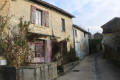
(S/E) Head towards Les Halles and the south-east corner of Place du Président Pierre Mendès France. Follow Rue du Moulin for a few metres, enjoying a fine view of Les Halles and the former priory on the left, before turning left into Grande Rue. At the T-junction, turn right into Rue Saint-Martin, which immediately curves to the left. Cross Rue de Bernon on the left-hand side.

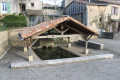
(1) Immediately turn right onto the short path between two properties to see the Chabanne wash house and fountain (information panel on the Pamproux springs). Retrace your steps.

(1) Follow Rue Saint-Martin to the right and cross a street on the right-hand side. At the next junction, turn right into Rue des Tisserands. At the T-junction, turn right onto Rue des Deux Ponts.

At the left-hand bend, just after No. 8, turn right onto a path leading to a viewpoint over the Pamproux. Retrace your steps.

Continue right along Rue des Deux Ponts. Cross the Pamproux and you will immediately come to a junction.

(2) Turn right into Rue du Gué. At the end of the street, turn right onto Chemin du Puits Roy. At the T-junction, turn right onto Rue de la Métairie. At the end, turn left into Rue du Bougon. About twenty metres further on, turn right onto a path heading west at the corner of a building. Just after the hedge on the right, turn right onto a path leading to the banks of the Pamproux.

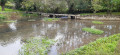
(3) Turn left and follow the Promenade du Moulin, keeping the river on your right. A hedge of various shrubs forms an arboretum. After about 250 m, turn left then right to follow a secondary branch of the river. Cross a path and continue straight ahead, still on the Promenade du Moulin. The old mill, a large two-storey house, can be seen on the right.

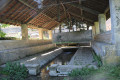
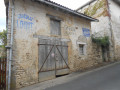
As the path reaches the banks of the Pamproux again, cross a stone bridge to admire the mill on the right, a small landscaped square and a building that once housed an oven for heating the laundry washed at the nearby wash house (information panel). Retrace your steps.

Continue along the Promenade du Moulin and follow the river on your right (washing houses). The path curves to the left and runs alongside the D5, staying slightly below it.

(4) Cross the D5 with care and continue along the path opposite (closed to motor vehicles by a wooden barrier). The path runs alongside the Pamproux and reaches the hamlet of Pouillet. Note the remains of a mill dating from the early 13th century (information panel inside).

Pass the mill and follow the path which replaces the previously tarmac-surfaced road. The path curves sharply to the left, following the course of the Pamproux. Further on, when the path turns right, continue straight ahead. Then turn left to go round a sewage treatment plant. At the corner of the plant, turn right onto a tarmac-surfaced road. Cross a small road and continue straight ahead along a path between two hedges.

(5) At the fork, take the right-hand path, which goes downhill. Cross the Pamproux stream and pass through the hamlet of Pié-Frouin (farm). Then cross a small road and continue straight ahead along the path uphill. Walk alongside a patch of woodland on your left. Then turn 90° to the right and go straight on (east). At the junction (marker 104), continue straight ahead.

(6) You will come out onto a road (Chemin de la Croix Pouillet) and follow it to the right. The small road winds through the Ville area to join the Route de Salles. Then turn left and take the safe verge on the left-hand side. Cross Rue de la Falotte on the left.

(7) Shortly afterwards, turn right onto Impasse de Chamballan (Champ Ballon on the map). Go straight on between the gardens. At the very end, turn left onto a narrow lane. Join Impasse des Vallées and follow it to the left. After about fifty metres, turn right onto a footpath. Emerge onto Route de la Mothe (D5) via a flight of steps. First turn left then right (take care when crossing the D5) and continue along Chemin de la Fontaine.

Walk alongside the Pamproux stream and pass a beautiful wash house. At the junction, turn right onto Rue du Vert Logis, which ends in a cul-de-sac. Continue along a narrow lane that joins Rue du Moulin. Then turn left. At the next junction, turn right onto Rue de l’Église. Walk alongside the church and emerge onto Place du Président Pierre Mendes France (S/E).

Waypoints

  1. S/E : km 0 - alt. 97 m - Place Pierre Mendès France - Église Saint-Maixent (Pamproux)
  2. 1 : km 0.49 - alt. 90 m - Access to the Chabanne wash house and fountain
  3. 2 : km 0.95 - alt. 89 m - Rue des Deux Ponts x Rue du Gué
  4. 3 : km 1.53 - alt. 87 m - The Mill Walk - Pamproux (rivière)
  5. 4 : km 2.32 - alt. 89 m - Crossing the D5
  6. 5 : km 3.85 - alt. 92 m - Fourche
  7. 6 : km 5.63 - alt. 102 m - Chemin de la Croix Pouillet
  8. 7 : km 6.14 - alt. 92 m - Junction of Route de Salles and Impasse de Chambellan
  9. S/E : km 6.79 - alt. 97 m - Place Pierre Mendès France - Église Saint-Maixent (Pamproux)

Notes

There is a car park at Place du Président Mendès France, south of the Town Hall and the Post Office.

This hike across varied terrain requires suitable footwear.

This walk is marked at intervals by a vine leaf on a white background, as it is loosely based on the ‘Feuille de Vigne’ route proposed by the local council. The rest of the route is unmarked. Consequently, it is advisable to follow the directions in the description and on the map, whilst paying close attention to the landscape. The waypoints (with their GPS coordinates and the distance from the starting point) serve as aids for hikers exploring the route for the first time.

Hike completed by the author on 3 January 2021

Worth a visit

Pamproux
The village’s name derives from the distinctive feature of its vines. The leaves of the village’s vines (pampre) are characterised by their reddish colour.
This characteristic gave rise to the village’s name. Originally “Pampre Roux”, it became “Pamproux” over time
Source: Wikipedia (excerpts)

Saint Maixent Church
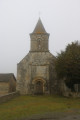
The church in Pamproux consists of a single nave with five bays, 38.50 m long and 12 m wide overall. The first bay, to the west, supports a Romanesque bell-tower porch, whilst the other four bays, with ribbed vaults, form the Gothic-style nave, which was partially restored in the 19th century.
The building has been listed as a historic monument since 1913.
The church of Pamproux, probably built in the early 12th century, replaced the original church about which we know nothing except that it was founded in honour of Saint Maixent and granted to a monk from the Abbey of Saint Maixent by Guillaume Tête d’Etoupe, Count of Poitou, around 950. Thus was established the priory of Pamproux, whose buildings adjoin the church.
From the Romanesque period, the church has retained little more than its bell tower and a few remains of
visible from the outside on the north elevation of the nave… The apparent architectural unity of the nave, in
Gothic style actually masks a turbulent history. Indeed, according to Mr Perlat, the architect who oversaw the 1875 restoration, the Romanesque nave is said to have been extended as early as the 13th century by two Gothic bays ending in a flat chevet, as we know them today.
During the Wars of Religion, probably around 1568, the roof structure was set alight and the Romanesque vault collapsed...
A century later, the two Romanesque bays were still without a vault or roof, whilst a partition wall separated the two Gothic bays that had escaped the disaster. In the early 18th century, to pave the church, gravestones from the former Huguenot cemetery—sold following the Revocation of the Edict of Nantes—were used. Around 1720, a roof structure and a panelled ceiling were built to finally cover the Romanesque nave, and the interior partition was removed. However, the roof across the entire nave was neither the same height nor the same pitch; furthermore, flat tiles covered the Gothic nave and hollow tiles the Romanesque nave. This was the state of the church prior to the 1875 restoration, the aim of which was to construct ribbed vaults and open windows in the Romanesque bays – the first two – in accordance with the style and dimensions of the last two bays.
This restoration work was awarded to Pierre Foisseau, a contractor in Salles, and carried out from 1874 to
1876, whilst the roof was redesigned and rebuilt in 1887. Finally, the current interior appearance, featuring exposed stonework, dates from 1959.
For further information:
Source: the town’s official website

The Pamproux
The River Pamproux has a surprising feature: its source varies depending on the season.
Indeed, in winter it rises at the Roche Ruffin resurgence, then, depending on the level of its numerous springs, its source shifts to Boudemont and, by late summer, to the Chabanne wash house fountain.
Poupot: the spring flows through the garden of the birthplace of Pierre Poupot, who was the first pastor of Poitiers in the 19th century.
Source: information panel on the cul-de-sac leading to Pamproux at 8 Rue des Deux Ponts.

Chabanne wash house and fountain
Its name may derive from the Seigneurie de Chabanne, whose owner held a dairy farm in Saint-Martin de Pamproux during the second half of the 17th century.
In 1874, Mr Richard, owner of the Moulin Premier in Pamproux, complained that the mayor had had the public washhouse at the Chabanne Fountain enclosed by walls to retain its water when the level in the leat fell below that of the washhouse.
Source: Les Lavoirs des Deux-Sèvres website

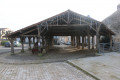
The Market Halls of Pamproux
The construction of the market hall can be dated to the year 1700. Indeed, the ‘plans of the village of Pamproux’ drawn up in 1725 refer to it as the ‘new market hall’, whilst the old market hall was still in use in 1699.
Furthermore, a register, opened in 1700 and accompanied by a plan, reveals the allocation of stalls
allocated to traders who attended fairs and markets; it was likely drawn up when this market hall first opened.
In 1828, the wooden pillars were realigned, a stone pillar was built and the roof was repaired.
In 1923, the roof structure and roofing were repaired. We know nothing of the old market hall, except
that it was built on the site of the current Place de la Liberté.
Description
A building housing a rectangular space 26 metres long and 14.80 metres wide, situated on the southern edge
of Place de la Mairie, at the north-east corner of the former priory buildings and at the junction of Rue de l’Eglise and Rue du Moulin, on a site sloping gently towards the south-east.
"For further information and source: ''

La Côte Belet
An exceptional natural site!
The Côte-Belet site is situated halfway between Niort and Poitiers in the commune of Pamproux, south of the village centre.
Rising to an altitude of 117 metres, the Côte-Belet hill resembles an island situated in the heart of a vast depression formed by the collapse of part of the Jurassic plateau. A ‘poor’ marl soil that dries out in summer, south-facing slopes, a climate characterised by low rainfall and plenty of sunshine… all contribute to the establishment, on plots formerly cultivated with vines, of a rare and endangered pioneer vegetation known as ‘dry grassland’.
Home to plants with a southern affinity, the dry grasslands of the Côte-Belet are renowned for their orchids: 24 species with astonishing colours and shapes have been recorded... some of which serve as lures for pollinating insects, as suggested by evocative names such as bee, fly or bumblebee Ophrys.
Source: the municipality’s official website.

Reviews and comments

4.8 / 5
Based on 4 reviews

Reliability of the description
5 / 5
Ease of following the route
4.8 / 5
Route interest
4.8 / 5
Roro86
Roro86

Overall rating : 5 / 5

Date of your route : Feb 17, 2025
Reliability of the description : ★★★★★ Very good
Ease of following the route : ★★★★★ Very good
Route interest : ★★★★★ Very good
Very busy route : No

A lovely short walk exploring Pamproux and its well-preserved heritage.
Pamproux is a very beautiful village. At the end of our walk, we were able to visit the church (which is becoming increasingly rare as churches are seldom open). It’s a shame the temple was closed.
Highly recommended

Machine-translated

Hortial
Hortial

Overall rating : 5 / 5

Date of your route : Jan 08, 2024
Reliability of the description : ★★★★★ Very good
Ease of following the route : ★★★★★ Very good
Route interest : ★★★★★ Very good
Very busy route : No

A pleasant short walk that largely avoids roads used by cars.
The section along the banks of the River Pamproux is truly delightful and offers interesting views of the village and its old houses, then, after crossing the road to La Mothe, on to the Moulin de Pouillet.
A lovely walk despite the freezing cold.

Machine-translated

lecrechois
lecrechois

Overall rating : 4.7 / 5

Date of your route : Jul 25, 2023
Reliability of the description : ★★★★★ Very good
Ease of following the route : ★★★★★ Very good
Route interest : ★★★★☆ Good
Very busy route : No

Pamproux is a charming little town with well-maintained historic buildings.

Machine-translated

BETIN
BETIN

Overall rating : 4.7 / 5

Date of your route : Jan 22, 2021
Reliability of the description : ★★★★★ Very good
Ease of following the route : ★★★★☆ Good
Route interest : ★★★★★ Very good
Very busy route : No

A lovely route to enjoy at any time of year. Easy and well-maintained.
Make sure you don’t miss the last alley just before the bridge!

Machine-translated

Other walks in the area

For more walks, use our search engine .

The GPS track and description are the property of this route's author. Please do not copy them without permission.