A tour of the new cemetery in Boulogne-Billancourt (known as Pierre Grenier)

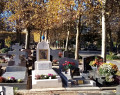
An urban walk to visit the newer of the two active cemeteries in Boulogne-Billancourt. Several notable figures are buried here, including a number of former mayors of the town. The cemetery also features several memorials honouring those who died and were deported during the two world wars.

This walk is part of a multi-day hike: A stroll through Paris’s cemeteries

Details

n°109617383
Creation:
Last update:
Last review:
–
  • Walking
    Activity: Walking
  • ↔
    Distance: 2.40 mi
  • ◔
    Average duration: 1h 05 
  • ▲
    Difficulty: Easy

  • ⚐
    Back to start: Yes
  • ↗
    Ascent: + 10 ft
  • ↘
    Descent: - 10 ft

  • ▲
    Highest point: 115 ft
  • ▼
    Lowest point: 102 ft

Photos

Description of the walk

Start from Marcel Sembat underground station (line 9). Take exit 2 to Place Marcel Sembat.
Access is also possible by bus (lines 126 and 289). Get off at the Rue du Point du Jour stop, near the junction of Boulevard de la République and Avenue Pierre Grenier, close to the cemetery entrance (1).

(S/E) Upon exiting the metro station, cross Boulevard de la République at the traffic lights and follow it to the left. Continue straight on until the next set of traffic lights. Then turn right onto Rue Thiers. At the end of the street, cross Rue du Point du Jour and then Avenue Pierre Grenier using the pedestrian crossings to reach the cemetery entrance.

The route within the cemetery is a guide only and can be adapted in various ways. In the description below, the names appearing on the graves may be highlighted for three different reasons:
1) Graves of notable figures, in which case one or two lower-case letters in brackets refer to a short entry in the ‘Places to see’ section, where the names are listed in the order in which they appear on the route.
2) Particularly original monuments.
3) Useful landmarks on the ground.

(1) Turn right immediately to follow the northern edge. Note straight away, along the wall, the graves of Jules Henripré (a), Victor Bizet (b) with his bust, Jules Lagriffoul (c), Alphonse Le Gallo (d), Jean Vincent (e) and Alfred Costes (f). Opposite the latter, note the medallion on the Delpuech-Giguelle grave. Continue along the path and, on the left, just after the entrance to the Meditation Garden, note the grave of Albert Agogué (g).

Then enter the Meditation Garden by passing under a pergola. Walk anti-clockwise around this small garden, which contains funeral urns. Ignore the first pergola on the right and pass under the second one. Pass under another pergola and leave the garden.

Proceed past two rows of graves and turn left at the corner by the Constantin grave. At the end of the path, opposite the Chiche grave, turn right. Then turn right into row 10, at the corner of the Ladeveze grave. Turn left just before a tarmac path and leave the Bénichou grave on your right. Head slightly left towards a rotunda.

(2) Then follow a tarmac path to the left towards the cemetery entrance. Just before you reach it, on the left-hand side, you will find the grave of Henri Pélisser (h), surrounded by a wire fence.

(1) Turn right and enter Section 2, passing between the Micirane and Boulat graves. Turn left immediately. Then turn right, leaving the bust of Étienne Meusy on your left. Note, on the right-hand side, the medallion adorning the grave of Ferdinand Delcros. At the end of the path, turn left at the corner by Pierre Fillette’s grave (i).

Follow a tarmac path and note, on the right-hand side, a modern-style Pietà, followed by the Landowski family vault, which includes Marcel (j). Then turn left between the Duval and Hsiao graves. Note, on the left, three rows back, the gravesof Hakob Gyurjian (k) and Hagop Arakelian (l). At the T-junction, turn right, leaving the Deleuzy grave on your left. At the end of the path, follow a tarmac path to the left. At the junction that appears shortly afterwards (opposite a monument with sculpted figures), turn left into a perpendicular path. Take the next tarmac path on the left.

N.B. Albert Kahn’s grave (m) is supposed to be in Section 2, which you are about to leave, but I was unable to locate it. The electronic register at the cemetery reception did not recognise this name (!).

Turn right at the corner by the Eranziol grave (medallion). Note, on the left, a First World War soldier’s helmet perched on Paul Delperrier’s headstone. Then turn left, weaving your way between two graves. You’ll come out onto a path; follow it to the right and note, on the left-hand side, the bas-relief depicting an angel on the gravestone of André Michel Harlaut, who died aged 3. At the T-junction, turn right until you reach the next junction.

(3) Turn right onto a tarmac path. On the left-hand side, pass the first chapel and, just before the second, you’ll find the grave of Octave Houdas (n) and his son-in-law Maurice Delafosse (o). Retrace your steps.

(3) Then turn right. Next, turn right onto row 11. Note, on the right, behind the Fiers grave, a bas-relief depicting a wading bird. After about ten graves, note on the left-hand side an earthen grave without a headstone, with just a frame and a small cement plaque on which the initials “JL” are engraved: this is most likely the grave of Jules Ladoumègue (p). At the end of the path, turn left onto a tarmac path.

(4) Continue straight ahead and, at the far end, you will find a memorial honouring the people of Boulogne who died in deportation,“Ni haine ni oubli” (“Neither hatred nor oblivion”), and a memorial honouring the civilian victims of the 1942–1943 bombings (which targeted the Renault factories used by the occupying forces). Retrace your steps.

(4) Turn left onto row 27/26. At the end of the path, turn right at the corner by the Vanneville grave. At the junction, turn left onto a wide grassy path between the Jalucha graves on the left and the Zazima graves on the right. At the next junction, follow a tarmac path to the right.

At the next junction, go straight on between sections 7 and 4. On the left-hand side, in row 8, in the third row, the grave of Léonidas Inglesis (q) is adorned with an icon he painted himself and a bulb.

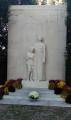
At a roundabout, turn left and proceed to another roundabout lined with memorials: war memorials for the 1914–1918 war, designed by Paul Landowski (see below); a memorial to the laundresses (this profession having been very common in Boulogne right up until the interwar period); a memorial to the fire brigade; and a small obelisk in honour of those who died in the 1870–1871 war.

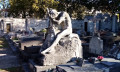
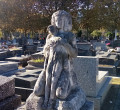
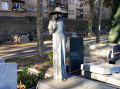
(5) Facing the 14-18 monument, turn right and walk along the left-hand side of the graves of soldiers who died in action during the First World War. Just before the tarmac path turns right, turn right between the Durand and Picot graves. Note, on the left-hand side, the Kapperer grave adorned with a statue of a woman wearing a hat.

Continue along the path and, at the junction, turn right between the Lecalier and Janssens graves. Shortly afterwards, turn left onto path 25/24. You’ll come out onto a tarmac path; first turn right then left to take path 28/27. At the junction, turn right between the Beschizza and Arakelian graves.

Shortly afterwards, turn left, leaving the Escola grave on your right. Walk until you reach two Chinese-style graves on the right-hand side. Retrace your steps and, at the previous junction, turn left, leaving the Garnier grave on your right. Cross a tarmac path and continue straight ahead along a grassy path.

At a junction, turn right, leaving the Batut tomb on your left. You will immediately come to the tomb of Paul Landowski (r), adorned with a statue of his own design, which also houses the remains of his daughter, Françoise (s), and his son-in-law, Gérard Caillet (t).

Retrace your steps and, at the previous junction, go straight on. At the end, turn left and walk behind the Landowski vault, then past the Pietà seen at the start of the route. At the end, turn right to return to the rotunda.

(2) Take the second tarmac path on the left, leaving Section 5 on your left. Go straight on and, at the end, turn right. Then veer right along the path, pass the entrance to the Meditation Garden and follow the northern boundary to the cemetery entrance.

(1) On leaving the cemetery, cross Avenue Pierre Grenier, then Rue du Point du Jour, and walk up Rue Thiers. At the traffic lights, turn left onto Boulevard de la République and follow it to the end, Place Marcel Sembat (S/E).

Waypoints

  1. S/E : mi 0 - alt. 112 ft - Place Marcel Sembat
  2. 1 : mi 0.49 - alt. 105 ft - Entrance to the Pierre Grenier Cemetery
  3. 2 : mi 0.67 - alt. 105 ft - Rotunda
  4. 3 : mi 1.01 - alt. 105 ft - Junction
  5. 4 : mi 1.18 - alt. 108 ft - Junction
  6. 5 : mi 1.42 - alt. 105 ft - War memorial
  7. S/E : mi 2.4 - alt. 112 ft - Place Marcel Sembat

Notes

A good pair of trainers is sufficient for this short urban walk.

Inside the cemetery, there are drinking fountains marked on the map and toilets on the left just past the entrance. There are bars and restaurants in the surrounding neighbourhood.

Allow around two hours for a visit to the cemetery.

Opening times for Pierre Grenier Cemetery:
- Opening: weekdays, 8.00 am; Saturdays, 8.30 am; Sundays and public holidays, 9.00 am.
- Closing: from 6 November to 15 March, 5.30 pm; from 16 March to 5 November, 6.00 pm.

Please note that a cemetery is a place of contemplation and that discreet and respectful behaviour is required.

Walk undertaken by the author on 1 November 2026.

Worth a visit

Some facts about the history of the Pierre Grenier Cemetery:
The cemetery was established in 1889 due to the Western Cemetery—founded in 1858 and therefore older—reaching capacity.
N.B. The municipality was known as Boulogne-sur-Seine from 1790 to 1926, which explains why this name appears in the entries for mayors who held office during that period. The Billancourt district was incorporated into the municipality in 1860, but it took 66 years for its name to be officially incorporated into that of the municipality.

Graves of notable figures (non-exhaustive list):
a – Jules Henripré (1853–1934) A mechanic and fitter by trade, a socialist or communist activist depending on the era, a municipal councillor for Boulogne-sur-Seine from 1904, and acting mayor between 1922 and 1923.
b – Victor Bizet (1867–1933) A potter and ceramic turner at the Sèvres Porcelain Manufactory, a socialist activist, deputy mayor of Boulogne-sur-Seine, and a member of the Seine General Council from 1929 until his death.
c – Eugène Lagriffoul (1878–1941) An artistic ceramist at the Sèvres Porcelain Manufactory, decorator and painter. A socialist or communist activist depending on the era, he served as deputy mayor of Boulogne-sur-Seine and president of the Seine General Council.
d – Alphonse Le Gallo (1902–1965) A trained electrician, he was a socialist and later an SFIO activist. He served as mayor of Boulogne-Billancourt from 1944 to 1965 and as a Member of Parliament for the Seine from 1962 to 1965. A quay on the Seine and the stadium in Boulogne-Billancourt are named after him.
e – Jean Vincent (1906–1937) An aviator who died in an accident during an air show.
f - Alfred Costes (1888–1959) A fitter at the Renault factories, who was called up during the First World War (1914–1918). A senior official in the CGT metalworkers’ union, a communist activist, and a Member of Parliament for the Seine from 1936 to 1940 and from 1946 to 1955.
g - Albert Agogué (1915–1995) Mayor of Boulogne-Billancourt from 1965 to 1971. He was the town’s last left-wing mayor.
h - Henri Pélisser (1889–1935) Cyclist. His list of achievements includes the following victories (among others): Tour de France (1924); Tour of Lombardy (1911, 1913); Paris–Roubaix (1921); Paris–Tours (1922).
i - Pierre Fillette (1926–2003) Painter.
j – Marcel Landowski (1915–1999) Composer, best known for his career in public administration, notably at the Ministry of Cultural Affairs headed by André Malraux, and for establishing regional music conservatoires throughout France.
k – Hakob Gyurjian (1881–1948) Armenian sculptor.
l - Hagop Arakelian (1894–1977) Film make-up artist, responsible in particular for the spectacular transformation of Jean Marais in *La Belle et la Bête* (1946).
m - Albert Kahn (1860–1940) A banker – a sector in which he made his fortune – and a philanthropist. Keen to foster dialogue between peoples and cultures, in 1898 he awarded round-the-world travel grants to young men and women who had passed the agrégation. From 1908 until 1931, he set about collecting photographs and films from all corners of the globe. Numerous photographers were sent on assignments, funded entirely from his own pocket. Ultimately, 72,000 Autochromes and around a hundred hours of film were compiled into the Archives of the Planet. He funded research laboratories and worked for peace in the aftermath of the First World War. Ruined by the economic crisis of the 1930s, he ceased his philanthropic activities. Today, the Archives de la Planète are preserved and promoted in his former home in Boulogne-Billancourt, which has become a departmental museum.
n – Octave Houdas (1840–1916) Ethnographer and linguist specialising in the Arabic language.
o - Maurice Delafosse (1870–1926) Ethnologist and linguist, colonial administrator, specialist in African affairs.
p - Jules Ladoumègue (1906–1973) Athlete, middle-distance runner. In 1930 and 1931, he held several world records over distances ranging from 1,000 to 2,000 metres. He was expelled from the French Athletics Federation in 1932 for accepting payments at certain meets, thereby breaching the conventions of amateurism. He ended his career as a sports journalist. A very popular athlete in his day, many stadiums in France now bear his name.
q – Léonidas Inglesis (1882–1972) Painter and mosaic artist of Ukrainian origin.
r – Paul Landowski (1875–1961) Sculptor and winner of the Prix de Rome in 1900. He was called up in 1914 and, in 1916, was assigned to a camouflage unit, like many other artists. He received numerous public commissions, both in France and internationally. He was renowned worldwide; his best-known work is the Christ the Redeemer (1931), which stands atop Corcovado in Rio de Janeiro. Among his other works are: *David the Warrior* (1900); *The Boxer* (1912), for which he won the gold medal in the sculpture category at the artistic competitions of the 1928 Summer Olympics in Amsterdam; the International Reformation Monument (1909–1917) in Geneva; the statue of Saint Geneviève (1928) on the Pont de la Tournelle in Paris; *The Sources of the Seine* (1936), the fountains at the Porte de Saint-Cloud in Paris; … Deeply affected by his experiences of the Great War, he also created numerous war memorials, mainly in the 1920s: Barcelonnette, Boulogne-Billancourt (this cemetery, see above), Buenos Aires (French hospital), Chézy-sur-Marne, Combs-la-Ville, Le Neubourg, Saint-Paul-sur-Ubaye, Oulchy-le-Château (Butte de Chalmont), Paris (Place du Trocadéro, Hôtel Dieu, École Normale Supérieure), Varrangeville-sur-Mer,...
s – Françoise Landowski-Caillet (1917–2007) Pianist, teacher at the Saint-Denis Conservatoire, and painter.
t - Gérard Caillet (1920–1999) Writer.

Sources: Boulogne-Billancourt Town Hall, Wikipedia and Cemeteries of France and Elsewhere.

Other walks in the area

For more walks, use our search engine .

The GPS track and description are the property of this route's author. Please do not copy them without permission.