Soum de la Génie Braque via the Tres-Croutz forest

A lovely mid-mountain hike through the lush forest of Saint-Pé-de-Bigorre (or Tres-Croutz or Crouts = Three Crosses in Bigourdan). The first quarter of the hike is a bit challenging, as it is steep. You then pass through the Aülhet and Artigue mountain pastures, before following the ridge westwards to the summit of Soum de la Génie Braque. Well known to locals, this route offers a guaranteed change of scenery!

Details

124062
Creation:
Last update:
Last review:
  • Walking
    Activity: Walking
  • ↔
    Distance: 6.27 mi
  • ◔
    Average duration: 6h 05 
  • ▲
    Difficulty: Difficult

  • ⚐
    Back to start: Yes
  • ↗
    Ascent: + 3,698 ft
  • ↘
    Descent: - 3,698 ft

  • ▲
    Highest point: 5,003 ft
  • ▼
    Lowest point: 1,345 ft

Photos

Description of the walk

Park in the small car park (maximum 4 or 5 cars) below the entrance to the Monastery of the Sisters of Bethlehem, in Peyras.

(S/E) The path, which is fairly wide, starts to the right of the entrance gate. Bordered by rough stone walls, it runs horizontally for a few dozen metres. At the first Fork in the road, turn left towards “Refuge de l’Aülhet 3h” (straight on, the path leads to the Castets cave).

Very quickly, the path becomes very steep. It follows a very old transhumance route that is still in use. The path is clearly marked in yellow (the route partly follows trail no. 3 of the Pibeste-Aülhet Reserve). Numerous stone markers or rocks painted red dot the massif, marking the boundary of the state-owned forest. The ground is very stony.

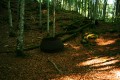
(1) At the 824m mark, just before Pla de Bers, keep slightly to the right rather than the left; the markings are a little unclear here. Gradually, the dense forest and boxwood undergrowth thin out and the path winds through tall beech forests. After a walk of between 1 and 1½ hours, depending on your pace, you reach a semi-circular beech forest known as the amphitheatre.

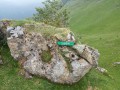
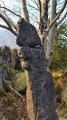
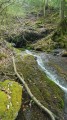
The path resumes its ascent through this forest, passing a remarkable, moss-covered rocky outcrop on the left. At the edge of the forest, you’ll find a wooden signpost for the nature reserve – very handy for the return journey, especially if there’s a bit of mist.

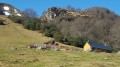
You arrive in the mountain pastures. After a short climb, you reach the Aülhet refuge, once a simple shepherd’s hut clad in green sheet metal, now a beautiful timber-clad refuge, with a few recent cattle fences nearby.
It takes between 1 hour (at a brisk pace or running) and 2½ hours to reach this spot. The 3 hours indicated at the start are rarely needed...

The hut is open all year round and freely accessible. No shepherd lives here permanently any more, a local farmer assured me, whose herds graze in these pastures during the summer. But during an ascent or if caught in the fog, the hut can serve as a refuge for a farmer before their descent into the valley.

(2) We resume the route by climbing across the grassy slope behind the hut and heading towards the Col d’Espadres (signpost), also marked as Espades (Visorando app – IGN map). Pass the rock on the right, with its commemorative plaque marking a weapons airdrop in 1944.
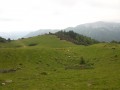
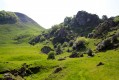
Head towards the nearest peak, the Soum d'Artigue, and reach the small pass of Aülhet at 1,215 m. A vast pasture opens up before you (“Artigue” means “pasture acquired by clearing” in Occitan). Take the narrow path that winds to your right up the slope, towards and then beneath the rocky massif.

Pass by the Fontaine de la Digitale (note as you pass that a pipe channels this spring to a drinking trough slightly below and on to the Aülhet hut). The route is still marked in yellow but the markings are more widely spaced. Take care not to miss a mark!

(3) Reach the Col de Larbastan (1,350 m, below the nearby Pic de Larbastan at 1,368 m). Continue the ascent to the left, passing beneath the Pics de Miquéu (1,542 m) and de Hourbilagous (1,465 m) (which look pointed from the valley; they are misnamed “pics” as, once there, they are simply small hills). Continue along the slope, on a path that looks more like cattle tracks. Pass beneath a low tree, which is striking in this setting, marking the edge of the woodland below.

Once on the ridge, you pass the Bosc deth Troncar small pass (1,455 m), where a signpost indicates the direction of “Plateau de l’Isarce” and “Col d’Espadres”.
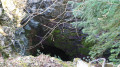
A few sinkholes, of varying depths (marked on the map by a circular contour line with an inward-pointing arrow and dots inside), dot the left-hand side of the path during this final part of the ascent. Be careful not to climb down into them, as they may collapse!
Head towards Col d'Espadres for about 500 m, to go round the Soum and reach it from the south.
After leaving the copses of trees on your right, make your way northwards between the tops of the striking sinkholes (the “Cuts d’Ausets” = “birds’ nests” in Bigourdan). The landscape here is absolutely exceptional, almost lunar...

(5) Following a safe route through the sinkholes, you finally reach the summit of Soum de la Génie Braque, at an altitude of 1,529 m (allow between 2½ and 3 hours to reach the summit).
NB: this is an interesting alternative to the direct, signposted route via the Serrat.

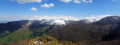
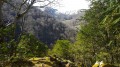
The Génie Braque is the torrent that rises on these slopes and joins the Gave de Pau after gathering countless streams in the cirque of the national forest. From up there, the view is breathtaking, offering a 360° panorama of the plains of Tarbes and Pau, the main range of the Pyrenees and, closer by, the Cirque de Saint-Pé, the Soum de Moulle (1,544 m), the Pic de Hourbilagous (1,465 m), the Soum du Montné (1,387 m, with its electricity pylons), ...

The return journey follows the well-marked ridge, then retraces the outward route to Bosc deth Troncar (S/E).


Waypoints

  1. S/E : mi 0 - alt. 1,345 ft - Parking Sep-Peyras (395m)
  2. 1 : mi 0.91 - alt. 2,733 ft - Crossroads at elevation 824
  3. 2 : mi 1.73 - alt. 3,825 ft - Cabane de l'Aoulhet
  4. 3 : mi 2.24 - alt. 4,409 ft - Turn left as you climb - Col du Larbastan (1350 m)
  5. 4 : mi 2.8 - alt. 4,770 ft - Bosc deth Troncar (1455m)
  6. 5 : mi 3.15 - alt. 5,003 ft - Soum de la Génie Braque
  7. S/E : mi 6.27 - alt. 1,345 ft - Sep-Peyras car park. Near the - Rivière de la Génie Longue

Notes

All the springs mentioned are potential sources of drinking water. There are no real shelters along the route in the event of heavy rain or storms: the Aoulhet hut (if open) and a few small rock shelters in the mountain pastures.

Bring standard mid-mountain hiking kit (hiking boots, suitable clothing, rainwear, water, food, survival blanket, etc.).

See here:
Reserve signposting
the account of the new signposting in the reserve in autumn 2014.

The route is not very busy in early spring. But from the June transhumance onwards, at weekends, you will probably come across several hikers, either alone or in groups, and quite often a farmer, heading up to the summer pastures to check on his flock or to repair a pipe or a drinking trough tap.

The vegetation of this massif reflects the severity of soil drought caused by the terrain and the nature of the substrates
, which is highly permeable, though this is offset by very high rainfall and cloud cover: boxwood, beech, lime and hazel are ubiquitous… (source: Saint-Pé Tourist Office).
This is why the wooded slopes are very damp and sometimes very slippery.

Worth a visit

With a bit of luck, you’ll come across a wealth of wildlife. In particular, Egyptian vultures, a few fine specimens of which inhabit these peaks.

You can enhance this route with:
- a short detour via the Soum de l'Artigue: a beautiful view of the mountain pastures and the herds,
- a walk along the edges of the sinkholes south of the Soum de la Génie Braque: there are an impressive number of them,
- a visit to several caves, chasms and karstic caves, most of which are not marked on the IGN map (1,600 cavities are recorded in the massif),
- a detour to discover the origin of the name "Tres Crouts", which means "Three Crosses" in Bigourdan.
The Three Crosses bear witness to ancient pastoral conflicts between Asson, Salles and Saint-Pé de Bigorre.
In 1569, the Bearnese Protestants of the Asson Valley decided to attack the Bigourdans of the Estrèms de Salles, with whom they were disputing the Azun and Maumula mountains. The 1,500 men intended to lay waste to the village of Salles and carry off all the livestock from Vergoun. But the battle was won by the Bigourdans. These conflicts became so serious that the King’s army had to be called in. It was impossible for the Bishop of Tarbes to restore harmony.
At a place known as "Tres Crouts", the bishoprics of Tarbes, Lescar and Oloron converged on this mountain.
Today, all that remains are three crosses carved into a rock and the inscription 1716. They can be found on the IGN map between the "u" and the "e" of "La Toue".
- a detour via the junction of the three dotted lines: this is the easternmost point of the Pyrénées-Atlantiques department and the boundary between the communes of St Pé, crossed by the Arrialhs stream. But there is nothing to mark this spot, save for a small sinkhole, which retains a patch of snow even late into the season...
- a detour via the Col d’Espadres, another magnificent spot.

Possible alternative route on the return journey:
- At the Col de Larbastan, off the path shown on the IGN map, turn left, leaving the Larbastan spring below on the right. Continue down slightly from the 1300m contour line to 1250m, leaving the 1208m rocky outcrop on the right, until you reach a solitary tree. From the pass, there is no signposted or marked trail, but there are numerous cattle tracks. Take the yellow-marked trail on the right, passing beneath the Soum des Brioles and reaching the Aoulhet hut. However, you’ll miss the beautiful view of the Artigue summer pasture from the Col de Larbastan… You have to make choices…

Nearby:
- the famous Bétharam caves,
- the village of Saint-Pé-de-Bigorre,
- Lourdes.

Reviews and comments

4.4 / 5
Based on 4 reviews

Reliability of the description
4.5 / 5
Ease of following the route
4.8 / 5
Route interest
4 / 5
MCTOUL
MCTOUL

Dear User 13834929,

Thank you for your feedback.
I would dare to say, "The goal is the journey"...
It's a shame about the scabs... But you'll be back, I'm sure!

Machine-translated

User 13834929

Hello, I went hiking with six friends last weekend. There were no problems with the description, and the trail was well marked throughout. However, we couldn't find the "très croutz" between the "u" and the "e" in "la toue"... We wandered around the area indicated in your guidebook for quite a while, which was a shame for us!
As a result, the weather allowed us to do the circular route via the Isarce plateau, which made for a good hike for the last one of the year.
Thank you for your explanations about the local heritage and the history of these three crosses. We hope to see them one day...

Machine-translated

loulou65
loulou65

Thank you very much

Machine-translated

MCTOUL
MCTOUL
• Edited:

Hello loulou65,
The path is called the “orange trail” because it has been marked in orange by hunters.
Shortly after setting off on the Pla dé Bers plateau, it leads to an old fountain hidden amongst the vegetation. Below the plateau, you reach a junction leading north-north-west onto the “Riri path”, which is very pretty, wide but unmarked, and runs roughly parallel to the path leading uphill. It joins the main path almost at the exit of the reserve.
At this same junction, the orange trail continues north-east until it reaches the bed of the Génie Longue.
This path is very overgrown, as is the first section you saw before the junction...
This orange trail therefore leads from Pla dé Bers to the Génie Longue! Best left to the “adventurers”!
Best regards

Machine-translated

loulou65
loulou65

Overall rating : 5 / 5

Date of your route : Mar 30, 2021
Reliability of the description : ★★★★★ Very good
Ease of following the route : ★★★★★ Very good
Route interest : ★★★★★ Very good
Very busy route : Yes

Hello, on the descent from AÜLHET via the charcoal burners’ path (Moreau charcoal kilns), there is a spring marked with orange dots near the hut at Pla de Bers. I followed the markings for about a hundred metres before having to turn back due to numerous fallen trees. Could you please tell me where these markings lead?
Thank you and see you soon.
Thanks again for all these routes.

Machine-translated

Nana47
Nana47

Overall rating : 4.7 / 5

Date of your route : Jun 17, 2019
Reliability of the description : ★★★★★ Very good
Ease of following the route : ★★★★★ Very good
Route interest : ★★★★☆ Good

As for the other walks, everything’s great. I also love the little sections on local heritage.
Keep up the good work in making our hikes such a pleasure. Nadine

Machine-translated

MCTOUL
MCTOUL

Well done and thank you, OLIVDESBOIS!
See you soon on other courses!
Kind regards
Marc

Machine-translated

OLIVDESBOIS
OLIVDESBOIS

Overall rating : 4.3 / 5

Date of your route : Jul 17, 2017
Reliability of the description : ★★★★☆ Good
Ease of following the route : ★★★★★ Very good
Route interest : ★★★★☆ Good

SOUM DE LA GENIE BRAQUE

A lovely walk, 50% forest, 50% meadow... 5km uphill, 5km downhill... well-marked paths... we recommend setting off around 10.30am to arrive at the refuge around 12.30pm for a picnic, then continuing the climb whilst refreshing yourself at the spring. To round off the day, if you’ve had the good sense to do this hike on a Sunday, you can enjoy the singing of the Sisters of Bethlehem at 6 pm in the chapel (free entry, access 50m to the right of the hiking path). Worth doing again as a trail run with poles, given the 1,600m elevation gain.
Oliv

Machine-translated

MCTOUL
MCTOUL
• Edited:

Hello,
The website says this hike takes over 5 hours. I did it myself in 3 hours, following the exact route described. I got caught in fog on the peaks, which forced me to speed up the final part of the climb from the hut and run back down. I must admit I have a fairly brisk walking pace! In fact, the description states quite clearly: “It took me less than 2 hours to reach this modest summit; allow around 2½ to 3 hours for keen walkers.” So it was all there!
Furthermore, on Visorando, as with all guidebooks or signposts in the field, the times given are only approximate.

Also, you’re right, the ground can be slippery. We’re on the north face of the massif, which rarely sees the sun.
I’ve added a recommendation to take your point into account, thank you!
As with any mountain hike, you must always remain cautious, taking full account of the environment, the weather conditions before and during the hike, and your own physical fitness.
I hope you’ll have the chance to come back and finish the hike, as the view from the summit of Soum de la Génie Braque is the most beautiful in the massif and is definitely worth it!
Happy hiking in our beautiful Pyrenees!
Marc

Machine-translated

al4951
al4951

Overall rating : 3.7 / 5

Date of your route : Aug 10, 2015
Reliability of the description : ★★★★☆ Good
Ease of following the route : ★★★★☆ Good
Route interest : ★★★☆☆ Average

We may not be very good walkers, but it took us an hour and a half to reach the 950-metre mark. Once there, given how late it was, we gave up and headed back down. The descent is particularly slippery, as some regulars we met along the way confirmed. It should also be noted that the time given only covers the ascent.

Machine-translated

Other walks in the area

For more walks, use our search engine .

The GPS track and description are the property of this route's author. Please do not copy them without permission.