Country:

 City:
City:


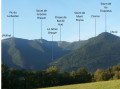
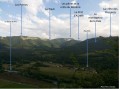
The departure point is just before the Soulas Farm, on a bend in the road. Park on the dirt track, where several trails begin, at the foot of a large signpost with a map (Saint-Pé-de-Bigorre Tourist Office).
From Ferme Soulas to Pladi
(S/E) Take the route marked in yellow. Follow the road uphill towards Ferme de Soulas.
(1) At an altitude of 650 metres, leave the road, turn right and head into the forest.
(2) At the fork, take the path on the right. The climb becomes steeper, with hairpin bends, until you reach Pré de Sauguet.
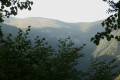
(3). Head south, then south-east, and walk along the magnificent Picoulets ridge, overlooking the steep-sided Génie Longue valley. Climb moderately to the Col de Haü.
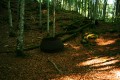
(4) Continue south-east, then east, through a magnificent beech forest, and climb up a coume (a ravine). Through a gap in a rocky ridge, you will finally reach the Pladi summer pasture at an altitude of 1,221 metres (spring and ruined hut).
From Pladi to Col d'Andorre
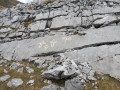
(5) Leave the Pladi clearing, following the signpost for "Prat d'Aoureilh" towards the east. Turn south, then south-west. A pretty path, still marked in yellow, crosses the Bois de la Sirote, then the sharp limestone pavement, and leads to the Prat d'Aürelh hut (Prat du Rey, 1,215m), which you only discover at the last moment.
(6) Then head for the Col du Prat d'Aürelh (Prat du Rey on the map), which is very close by, to the south-west.
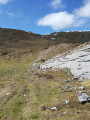
(7) The markings (red and white) become scarce. There are numerous traces of paths, but they are not very clear. All the ingredients are there to lead you more or less away from the path marked on the map. Keep heading west-southwest, almost horizontally.
(8) At an altitude of around 1,230 metres, the trail leaves a large, clearly visible chasm on the right (dangerous approach). Turn south-southwest and climb up the trail, which winds around a few bends.
(9) Shortly before reaching the Escala du Prat d'Aürelh (Prat du Rey) pass, leave theGR®® which turns left towards it, and continue straight ahead (west-southwest) through fairly sparse forest. Follow the old orange markings (broad and rough but relatively numerous). Head north to the surprising Soum de Leiz pass and reach the summit (1,518 m, monument in memory of the victims of the April 2015 earthquake in Nepal).
(10) Below the summit, to the west, a sort of corridor between the rocks leads to one of Andorra's springs: it is best to descend via one of the many passages to the south to reach the Cot d'Ailhès lawns (Frenchised as Col de Lheis then Leiz, phonetically Yeiss, then strangely marked on 20th-century maps as "Col d'Andorre"), then the refuge hut (the landscape becoming arid).
From Col d'Andorre to the 3 Croix des évêchés (Très Croutz)
(11) Head north-west from the hut in the summer pasture towards the fountain. Then take a very old mule track through the forest at the foot of Soum d'Andorre, heading north-north-west then west-north-west. Reach the vast grassy valley of the Sources d'Arials (resurgences). On the left, you can clearly see the wall of the Col d'Espadres (or Espades).
(12) Head west and climb the Col d'Espades (magnificent view). N.B. The passage is more or less easy depending on the season; the last ten metres of the ascent are tricky, with a steep slope. Be careful if there is snow: pass as high as possible.
(13) The following section is much less well marked. Look for a gap in the rock strata forming large, elongated barriers, indicated by a large white arrow, drawn by shepherds to help them find their way in the fog. After that, the yellow markings are easier to find. The path (not shown on the map), which is clearly marked on the ground and well signposted, passes through a sharp limestone pavement in the undergrowth. Leave a huge sinkhole and a modest summit marked 1508m on the IGN map on your right. You then need to leave the marked trail and head towards a ruined hut and a cattle pasture with recent metal fences. This is where the amazing limestone plateau of La Toue begins. There is no longer a trail or markings. Be careful of the numerous holes and cavities, most of which are surrounded by barbed wire. After reaching the most substantial rock strata, continue eastwards and descend from 1,500 metres to 1,380 metres to reach the Très Croutz (crosses engraved in the rock).
From Très Croutz to Bat dé Haü
(14) Continue west-northwest, still off the trail and without markings, in a rocky valley where the grass is more abundant. You will often find herds of sheep, cows and patous (shepherd dogs) here. Keep well away from the herds! After a short, steep climb, you will reach the summit of Soum de Moulle (360° view).
(15) Leave the summit and descend the north slope through the sharp limestone pavement. This section requires a good sense of direction and extra caution to avoid falling into the countless sinkholes. Leave a hut (elevation 1393) in the distance on your left and reach the ridge overlooking the Très Croutz forest at Soum de Marti-Peyras (1464m).
(16) Continue north along the ridge (yellow markings). Pass Soum du Gangues de Courraü (1447m, not named on the IGN map).
(17) At an altitude of 1378m, take a large gap on the right that allows you to descend. First, walk down a gentle slope on a beautiful lawn, then enter the steeply sloping beech forest.
(18) At an altitude of approximately 1250m, follow the yellow Isarce-Bat dé Haü trail on the right. Continue downhill towards the Bat dé Haü spring.
From Bat dé Haü to Caubole
(19) At the fork, turn left to reach the source of Bat dé Haü. N.B. The purple line on the IGN map seems slightly off and the hut mentioned on the map is in ruins. Leave the spring on your right and head towards "Sep - Parking". The trail then begins a poorly maintained section on the right bank of the Génie Braque, as indicated on the ground and marked from time to time in yellow. 100 metres lower down, join a trail in better condition, clearly marked by signs and yellow markings. Head north-east, descending into the valley along the left bank of the Génie Braque, through the thick, lush forest. You will reach the Sep pumping station without any difficulty, and continue along a small road.
We are not yet at the end of the route, but the rest is much easier. We will now return to the starting point at almost the same latitude, but several minutes of longitude further east.
To do this, there is no straight path, but a long detour around the northern end of the massif and also the northern edge of the Très Croutz national forest. Take the small tarmac road to reach the path just below the Caubole farm.
From Caubole to Soulas
(20) Before the road that branches off to the left towards Caubole, descend into the bed of the Génie Longue, cross it via a footbridge and join the start of an uphill path that skirts the northern flank of Mountagnou de la Pale. This section is covered on a path that is clearly marked in yellow and has a slight incline.
(21) Heading east-northeast then east, follow the edge of the Saint-Pé Forest, between altitudes of 420m and 430m, with its easily recognisable stone markers and red numbers. N.B. The path further south, shown as a dotted line on the IGN map, no longer seems to exist.
(22) Leave the road on your left and turn right towards the karstic trail, marked in green and yellow (towards Le Pladi). After about 200 metres, turn south. After a right-hand bend, take a hairpin bend to the left (south-east).
(23) Pass the entrances to the Bouhadère Caves and the gouffre de la borne 109 before reaching the end of the hike, still on the yellow trail, at the car park just before the Soulas farm (S/E).


 Tourist office
 Difficult
 Visorando Member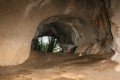
 Easy
Easy 
 Average