Country:

 City:
City:


__ALERTS 2025!__
- no more vegetation blocking the path between (2) and (3)
- no more closure of the path between (4) and (5)!
- a tree is lying across the path shortly before (8). There is no way around it, but it is possible to pass underneath with a little agility!
The walk starts at Place des Arcades in Saint-Pé-de-Bigorre. Plenty of parking spaces available.
However, if the car park is full, there is another car park towards Pau, in front of the pharmacy.
(S/E) Along the old seminary and former Institution Saint-Pierre, take Rue Monseigneur Laurence northwards. At thefirst fork, turn right and continue along the bank of the River Batmale, passing by the beautiful covered wash house in the Labadie district.
Retrace your steps and turn left onto Rue de Labadie.
Continue straight along Rue des Serres and leave the Labadie neighbourhood via the rear exit, until you reach the junction with Rue Darrets Barrats.
Turn left and continue along Rue des Serres (known as Rue du Castéra by the locals).
Pass several houses on the right in the Devant Laurensot neighbourhood. Continue along the road until you reach the Batmale stream, a small reservoir and a public bench on the left. Pass the old Castéra quarry on the right and the last two houses.
The small tarmac road now winds through small woods and meadows. Continue along this small road until you reach the fork at the Manaoutet farm. Then turn right onto the road of the same name, running alongside the Batmale, which flows through woods and fields, until you reach a junction on the right that is difficult to spot.
(1) Leave the road and enter the woods on a path, the rural path known as Louzour, which widens as it climbs quite steeply. First, you will reach a field fence that blocks the rural path. Cross the fence and continue through the field, heading roughly south-west, on a track that is clearly visible in all seasons. You will reach another fence at the south-western end of the plot; cross this fence too and head south, climbing the hill to reach the rural service track known as Chemin Communal des Crouzettes. Turn left and walk about 50 metres to reach a fork in the track at elevation 424.
(2) At the fork, turn right onto a descending path, then very quickly right again onto another smaller wooded path. Reach and pass a zigzag cattle grid.
You will come out into a meadow. Follow the hedge on the right and enter another wooded copse.
Watch out for electric fences and barbed wire, which often block the path!
This will take you to the Fontaine de la Lit, below the path.
Stay on the path, pass a second zigzag cattle grid and continue uphill through the woods.
Don't miss the old lime kiln on the left, clearly marked by a sign from the Tourist Office.
Continue until you reach an isolated barn on the edge of a huge sinkhole.
At the entrance to the meadow, continue southwards on a small plateau on the contour line, along a path that is not very visible.
Gradually turning west, you will reach the wooded copse overlooking the road from Lourdes to Saint-Pé-de-Bigorre.
(3) Join the small uphill tarmac road leading to the Poueyté farm. Descend to the left to the main Lourdes-Saint-Pé-de-Bigorre road.
Cross it and, just opposite the entrance gate to Transports Barracou, take the path that descends towards the Gave.
Cross the Gave river via the Rieuhlès bridge.
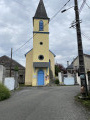
Then cross the hamlet of Rieuhlès, passing close to the small church.
(4) After the church on the left and the fountain on the right, turn right onto the tarmac path that descends towards the Rieulhès stream. Leave the charming wash house on your left and start climbing the hillside on the left bank of the Gave river, on an excellent forest path without straying from the main path, ignoring the paths that branch off to the left to reach the hamlet of Crampet.
(5) As soon as possible, at the end of this path, turn left onto the tarmac Chemin de l'Engous leading to the Cacha farm.
Leave all the houses on the right and left of the road.
(6) At the big bend, after the Jaime Martinez roofing company and just before the gate to an enclosed area used for storing cut wood, turn right to enter the meadow.
Walk along the hedge, leaving it on your left.
After 200 m, find a small gap in the hedge to cross it and enter the field next to it.
Continue to the right across this field.
Exit the field through a fence and reach the paved Chemin de Marrouat; follow it to the left uphill.
(7) At the Marrouat property (a large farmhouse and a dwelling + a large electrical substation), the road makes a right angle to the left. Leave the road and take a small path opposite (renovated in 2018) that runs alongside the property.
Continue straight ahead, passing an old small electrical substation on your left. You will often have to cross at least two electric fences across the path.
This path goes around two fields to the south. Pass two successive paths on your left and continue on this path, which becomes increasingly narrow. When the path turns north-northwest (to the right), you will hear the Génies Réunies torrent flowing below, which you will soon reach.
The very "rustic" path then descends abruptly to the river, where it joins a footbridge that crosses it.
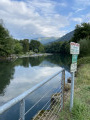
(8) Cross the Cantilerie meadow on the right, heading due north. Go through the gate by passing under the fence on the left. You will reach the "Plage de Saint-Pé" at La Cantilerie. On the banks of this small reservoir, locals come to take a dip on hot summer days.
Continue along the track (Rue du Lapin qui tricote) until you reach the road.
Turn right onto the paved Chemin du Picharrot, pass the old foundry, then the old mill until you reach a fork with a house and garage at the end.
(9) Take a short detour to the right over the bridge on the Génies Réunies, known as the Pont du Diable, and continue towards the hamlet.
At the second fork, on the hamlet square, mischievously named Place de l'Apéro by its residents, turn right, reach the beautiful wash house, restored by its inhabitants, leave the road and take a narrow lane and a very slippery staircase opposite, which leads to the banks of the Gave de Pau canal.
Walk along the left bank, which was beautifully restored a few years ago after a major flood.
At the (barred) entrance to the courtyard of the old carding mill and the current hydroelectric power station, you can admire the dam forming the spillway. Do not cross the power station courtyard.
Turn left into another alleyway between the houses (public passage) and head to the other entrance of the power station.
You can see the water flowing out of the plant by leaning over the railing.
Reach the Saint-Pé-de-Bigorre bridge, cross the Gave river and the railway line.
At the level crossing, cross the Allée des Terrasses, take the stairs opposite and you will reach the aptly named Place Bellevue. Stop here to admire the beautiful view of the Très-Crouts Forest and the Bat dé Haü cirque in the Saint-Pé Massif.
Then cross the Route de Pau D937, stay on the pavement on this side, walk along the orange wall of the property on the left and pass an old barn used as a shed by the roadside.
(10) Immediately turn left onto Rue Darrets Cazaous, then continue straight ahead on Chemin des Elfes, going up all the bends. It's a steep climb, so be prepared! You will reach the water service reservoirs.
Continue right on the dirt track for a few dozen metres.
(11) Leave the main path on the right and go down a small steep path that leads to the centre of the village.
At the bottom of the path, turn left onto the tarmac Chemin de Bazi, walk past a beautiful Pyrenean farmhouse with blue shutters on your right, then at the end, after the small bridge over the Arriou, turn left onto Rue Procope Lassale.
Pass the Bazi watering hole (where the animals used to enter completely) and at the end of the street, turn right onto the tarmac road called Chemin des Pidgeon Hunting Huts. This will take you around the entire enclave of the former Benedictine abbey of Saint-Pé-de-Bigorre, which later became a minor seminary.
Return to Place des Arcades, taking a detour past the church, a former 11th-century abbey. Pass the chevet, the entrance gate and the bell tower, leaving the old chevet, of which only ruins remain (opposite the pharmacy), walk along the nave of the chapel of the former seminary and reach the gate of this establishment. You can see the remains of the buildings erected in the 18th and 19th centuries. The buildings, which have been abandoned since 1999, have been undergoing restoration since 2022.
Return to the car park (S/E).





 Visorando Member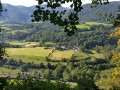

 Easy
Easy 
 Tourist office