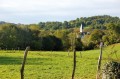
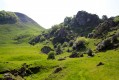
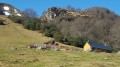
Meadows of Garrapit and Bénac on the slopes of the Araü

On the forgotten trails of Saint-Pé-de-Bigorre No. 6
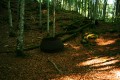
The Araü is the mountainous ridge jutting out from the Massif de Saint-Pé down to the Gave de Pau at the foot of the village. Its imposing, entirely wooded silhouette conceals pretty clearings, once meadows, some well-known paths and others forgotten, used only by hunters and hiking enthusiasts beneath the tall trees of the forest.
Its summit, towering arrogantly over the village, is the Soum de las Toupiettas (1,357m).

Details

542378
Creation:
Last update:
Last review:
  • Walking
    Activity: Walking
  • ↔
    Distance: 8.43 km
  • ◔
    Average duration: 4h 05 
  • ▲
    Difficulty: Moderate

  • ⚐
    Back to start: Yes
  • ↗
    Ascent: + 580 m
  • ↘
    Descent: - 580 m

  • ▲
    Highest point: 783 m
  • ▼
    Lowest point: 325 m

Photos

Description of the walk

As is often the case, I’m taking you along one of the lesser-known trails, partly unmarked, overgrown and therefore, at first glance, unwelcoming to hikers: the Bois de Bénac beneath the summit of Las Toupiettas (Les Toupiettes).
The Bois de Bénac is this vast expanse of forest, stretching from the Grottes de Bétharram, covering the area above the Versailles farm and reaching as far as the cliffs of La Malesse (below the Isarce plateau and the unmarked Col du Taboup).
This route extends the usual Charbonniers route, offers a lovely circular route to the foot of the high-voltage power lines and provides some panoramic views accessible only to the brave!

By car, cross the Gave de Pau at the place known as "Le Bout-du-Pont" and head straight towards the valley floor, following signs for "Monastère de Bethléem".
Park on a small plateau at the hamlet known as Le Haut-fourneau or Carrès (not marked on the map), just before the Mourichi farm, in an open-air exhibition of natural works adorning a rather charming public garden, a remarkable achievement by the residents of the aforementioned hamlet.

(S/E) Start the walk at the large sign from the Saint-Pé-de-Bigorre Tourist Office, which indicates several more conventional walking routes than the one described here.
Follow the path marked "Sentier des Charbonniers" uphill; it is well signposted in yellow.

(1) When you reach a large sinkhole on your right, the path splits into two, with a cairn marking the junction. Turn right and follow the markings.
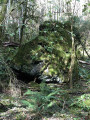
Continue the ascent. The path then skirts around Garapit (or Garrapit) to the north, passing its sharp limestone pavement escarpments.

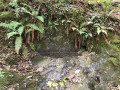
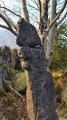
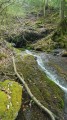
(2) When the path levels out somewhat, on the right-hand side of the path, a remarkable tree marked with ONF inscriptions (unfortunately felled during the winter of 2018) helps you spot a nearby junction. Then take a small, fairly well-defined but unmarked path on the left, which forms a hairpin bend as it turns sharply and heads into the undergrowth, climbing due east towards the Garrapit meadow. Don’t miss a beautiful fountain on the right, carved into the black limestone rock.

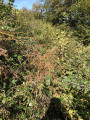
Continue until you reach the edge of the Garrapit meadow (private). As this is now abandoned, a carpet of tree ferns over 10 metres thick sometimes completely blocks access to the rest of the grassy area.

From the west, follow the edge of the meadow to enter it. Head south through its centre.
NB: Alternatively, head north along a low wall of old stones and rocks, skirting it whilst staying in the undergrowth.
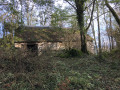
Look out for and reach an old two-storey sheepfold, well hidden beneath the vegetation but very well preserved.
Once you have explored the area and the nearby meadow, which is more accessible from this side, head east across the meadow and find a sunken path that drops steeply (-60m) until you reach the crossroads with the cairn.

(1) Then take the right-hand branch of this junction, heading south-west.
NB: This section of the path is still marked on the paper IGN map, but no longer appears on the new digital map.
Right from the start, on two successive occasions, pass Yellow Cross marks on trees on your left (indicating the path not to follow when taking the Sentier des Béarnais (marked as the Charbonniers on the map) but to follow when heading deep into the Bois de Bénac). Pass under the high-voltage power lines at an altitude of around 610m, along a section of the path that is quite difficult to navigate in spring due to the rampant vegetation.
NB: directly beneath the power lines, tree surgeons regularly carry out their clearing work; low, dense vegetation, full of brambles, has taken over the area. But you’ll notice that in the middle of the double high-voltage line (double row of pylons), a wooded area has retained all its splendour!

(3) Reach a barely visible Y-junction, where the path winds off to the right. A small cairn high up on the right and a rusty sign reading “Caution: Pidgeon Hunting Hut 80m” may help. The climb is steeper and the path narrows in places. It is much less well-trodden here, but remains clearly visible as it is sheltered from the light and protected from encroachment by brambles and other shrubs.

(4) You reach another Y-junction, even less visible than the previous one. It is marked on the left by two pieces of warning tape tied to the branches of two trees and a new rusty sign reading “Attention Pidgeon Hunting Hut” 100m ahead (set slightly higher up).
Continue straight on along the main path, which heads west towards the Bénac meadow.
Walk southwards alongside the high-voltage power lines.

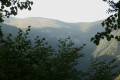
(5) Reach a promontory at the foot of the high-voltage power lines, offering a lovely view over the Saint-Pé-de-Bigorre valley towards Peyrouse and Lourdes.
From here, there is no longer a proper path, only more or less marked tracks.
Continue north-west, crossing the high-voltage power lines once more.
The woodland then becomes much more open and you can make out a few rocky outcrops below.
When the slope becomes less steep, take the opportunity to join the Sentier des Béarnais, which is well marked in yellow.
Then head easily to the left, past the two Bénac meadows, once vast grassy areas of a hectare or so each, but now overgrown with vegetation and barely distinguishable from the rest of the surrounding forest.
Look out for the few ruins that bear witness to a pastoral activity now long abandoned.
At the edge of the rocky outcrop, there is a fine view of the north-facing beech forest which you will be descending into shortly.
Return to the main signposted path and follow it westwards to the right.

(6) Reach a crossroads and follow a small path on the right that winds down the slope, bordered by old stones.

(7) After 250m and a 60m descent, you’ll reach an old pidgeon hunting hut still perched high on its wooden trunks (but for how much longer?).
Continue the descent through a splendid, open beech forest dotted with rocks, along a very comfortable path, although it is unmarked (however, some unconventional signposting using strips of fabric decorates part of the path and certainly helps us find our way...).

(8) Reach the departmental road leading from Saint-Pé-de-Bigorre to the Bétharram caves.
The rest of the route is less picturesque, as a 2 km stretch along the road is required to complete the circular route. However, it is quiet and, as it runs alongside the Gave, you remain in the countryside.
Head for the old quarter of Bout-du-Pont.

(9) Take one of the two streets on the right and follow the Chemin du Picharrot (tarmac road), passing near the Pont du Diable (a short detour to the left at the fork), the old mill on the Génies, the Fonderie and near the “beach” of Saint-Pé (la Cantilerie).
Return to the car park (S/E).


Waypoints

  1. S/E : km 0 - alt. 372 m - Mourichi Farm car park. towards the - Pont du Diable
  2. 1 : km 0.79 - alt. 521 m - Garapit cairn junction – Turn left
  3. 2 : km 1.36 - alt. 574 m - ONF tree junction – Turn left
  4. 3 : km 2.69 - alt. 622 m - Lacet-carrefour of the pidgeon hunting hut at 80m
  5. 4 : km 2.98 - alt. 661 m - Pidgeon hunting hut crossroads 100m away
  6. 5 : km 3.33 - alt. 732 m - Viewpoint
  7. 6 : km 4.42 - alt. 746 m - Crossroads – Turn right as you go downhill
  8. 7 : km 4.67 - alt. 682 m - Pidgeon hunting hut under Prairie de Bénac
  9. 8 : km 6.05 - alt. 337 m - Road junction – Turn right towards the - Gave de Pau
  10. 9 : km 7.3 - alt. 333 m - Le Bout du Pont - Turn right
  11. S/E : km 8.43 - alt. 372 m - Mourichi Farm car park. Near the - Rivière de la Génie Longue

Notes

Caution

This hike takes place in the heart of the countryside in a somewhat rugged environment: steep slopes, rocky outcrops, escarpments, thorny vegetation, partial lack of signposting, and at times a complete absence of a proper path... This is why it is reserved for experienced hikers with a good sense of direction. I recommend using a GPS (or at the very least an IGN map at 1:25,000 scale and a compass).
The paper IGN map shows a path up to (2), then from (1) to (3), (4) and (5). But the new digital version no longer mentions it. The IGN applies its standard policy for a damaged path: if it is heavily used, it remains continuous and is doubled with a purple line; but if it is less so, it first appears as a dotted line, then is completely removed. This does not mean, however, that it no longer exists at all...
Let’s use these paths so that they reappear as a dotted line, then as a solid line!

Furthermore, the Visorando track for this hike remains somewhat approximate between (5) and (6) due to:
1) poor satellite reception in this area,
2) numerous deviations from the path due to damage caused by fallen trees, scree and overgrown vegetation.
I have classified this hike as "Moderate" due to the difficulties described above, particularly the few sections off the trail and without markings.

Estimated time
The two of us completed this route in just under 3 hours, including breaks and photo stops. This is a fairly short time, given the route’s difficulties. Allow at least 4 hours to be comfortable if hiking solo or in a pair, and 4½ hours in a group.

Water sources
All the fountains, springs and rivers mentioned are potential sources of drinking water, as they are outside occupied pastoral areas. But be careful: drinking water in the mountains is not guaranteed to be risk-free...
There is a wash house with guaranteed drinking water near the point (9).

Places to stop and shelters
The two meadows, the promontory (5), the Bénat pidgeon hunting hut (7) and the Place du Bout-du-Pont shortly afterwards (9) are recommended places to take a break.
In the event of heavy rain or storms, the only proper shelters along the route are: the Garrapit shepherd’s hut, the area beneath the Bénat pidgeon hunting hut, and the houses along the route. There are also a few small rock shelters on the descent from Bénat to the Gave de Pau, as well as makeshift shelters provided by low walls or rock faces scattered here and there.

Equipment
Bring standard equipment for a mid-mountain hike (hiking boots or good trainers, suitable clothing, rainwear, water, snacks, knife, compass, map, whistle, GPS, etc.).

Traffic
In summer, up to (2), you may come across a few occasional hikers. But after that, the route is completely solitary until (6), where you may again come across a few occasional hikers.
Unfortunately, there are no longer any resident shepherds or livestock in the meadows.

Spelling of place names (toponymy)
Several place names have different spellings: in Bigourdan, in Gascon, in Frenchified Gascon, in French, in distorted IGN...

Worth a visit

Toponymy
The “Sentier des Charbonniers” (IGN map name), also known as the “Chemin des Béarnais” or “Chemin de Bénac” (Napoleonic land register of 1824 and OpenStreetMap).

Fauna and flora
The vegetation of this massif reflects the severity of soil drought due to the terrain and the highly permeable nature of the substrates
, but this is offset by very high rainfall and cloud cover: boxwood, beech, lime and hazel are ubiquitous… This is why the wooded slopes are very damp and sometimes very slippery. (source: Saint-Pé Tourist Office).

With a bit of luck, you may also come across a wealth of wildlife. In particular, wild boar, roe deer, countless birds and various insects, and occasionally amphibians (frogs, toads, newts).

Pidgeon hunting hut (7)
This is a tree-top hide. “The aim is to get the birds to land around the pidgeon hunting hut, as the lookout and shooting post is at the top of a tree and the birds are not captured alive with nets (as in ground-level pidgeon hunting huts), but shot with a rifle. Hunters are stationed at the top of a tree, and the level of comfort is not the same as in ground-level palombières, as the space available is limited.
The pidgeon hunting hut is generally set up at the top of a small hill or in a valley, always overlooking the surrounding area so that the wood pigeons can be seen arriving from a fair distance away. Furthermore, wood pigeons prefer to land on a site from which they too can survey the surroundings to protect themselves from potential predators. Source: Wikipedia

Variations
From the centre of the village of Saint-Pé, you can walk to the starting point of the hike rather than driving, and then head back to the village centre via the (9). Allow an extra half an hour.
Alternatively, you can also enhance this route by:
- a visit to several caves, chasms and karstic caves, particularly in the valley between the Versailles farm and the Sentier des Béarnais (shortly after (2)), though most of these are not marked on the IGN map (1,600 cavities are recorded in the massif), provided you have the necessary skills and equipment!
- a detour to the technical and building infrastructure at the exit of the Bétharram Caves, west of (8).
NB: continuing along the Sentier des Charbonniers after the waypoint (6) by following a circular route via the Brasserie de Montplaisir, the entrance to the Bétharram Caves, then the exit to reach the waypoint (8) is not particularly interesting (it simply extends the journey along tarmac roads)

A bit of local history
The forest of Saint-Pé is also known as the forest of Très-Croutz (or Très-Crouts or Tres Croutz or Tres Crouts or Tres Crots).
The origin of the name Très-Croutz is thought to derive from the Three Crosses (très croutz in Bigourdan/Gascon) carved into the stone at a place called La Toue, right in the heart of the massif, at an altitude of around 1,400 metres.
"The Three Crosses bear witness to ancestral pastoral conflicts between Asson, Salles and Saint-Pé-de-Bigorre.
In 1569, the Bearnese Protestants of the Asson valley decided to attack the Bigourdans of the Estrèms de Salles, with whom they were disputing the Azun and Maumula mountains. The 1,500 men intended to lay waste to the village of Salles and seize all the livestock from Vergoun. But the battle was won by the Bigourdans. These conflicts became so serious that the King’s army had to be called in. It was impossible for the Bishop of Tarbes to restore harmony.” Source: Abbé B. Abadie, *Le Sanglier du Picharrot*, published by Marrimpoey Jeune.
At a place called Très-Croutz, the bishoprics of Tarbes, Lescar and Oloron converged on this mountain.
Today, all that remains are three crosses carved into a rock and the inscription 1716. They can be found on the IGN map between the "u" and the "e" of "La Toue".

Nearby attractions
- The town of Lourdes, the Marian Sanctuary;
- The Batsurguère valley;
- The village of Saint-Pé-de-Bigorre, the village itself, its cultural heritage, its events, the Très-Croutz forest and the Pibeste-Aoulhet regional nature reserve, water sports;
- The story behind the reserve’s new signposting in autumn 2014;
- The Gaves Valley

Find out more...
- It is well worth consulting the website and publications of the Pibeste-Aoulhet Regional Nature Reserve. The most notable is the "reserve guidebook", packed with information, routes and anecdotes!
- The Saint-Pé Tourist Office also publishes numerous brochures and detailed hiking suggestions. One of the brochures may be of interest for discovering the massif’s flora and fauna: the Karst Trail Brochure, even though it does not cover this particular hike.
- The former Peyras farm, now the Monastery of Bethlehem.
- You can immerse yourself in some excellent local books:
Abbé B. Abadie, *Le Sanglier du Picharrot* (Marrimpoey Jeune),
Jacques-Emile Mengelle, Bigorre de mon enfance,
Jean-Claude Mengelle, Le solitaire de la Gargante.

Reviews and comments

3.9 / 5
Based on 6 reviews

Reliability of the description
3.8 / 5
Ease of following the route
4.3 / 5
Route interest
3.5 / 5
MCTOUL
MCTOUL

Hello Yves F,
I’m sorry that this hike didn’t meet your expectations.
I’m not sure how to explain this any better than what’s already stated in the ‘Practical Information’ section
“This hike takes place in the heart of the countryside in a somewhat rugged environment: steep slopes, rocky outcrops, cliffs, thorny vegetation, partial lack of signposting, and at times a complete absence of a proper path... This is why it is reserved for experienced hikers with a good sense of direction. I recommend using a GPS”

So you shouldn’t expect anything other than what you’ve found.

I hope I haven’t discouraged you from continuing your explorations in this remarkable mountain range.

Kind regards

Machine-translated

Yves F
Yves F

Overall rating : 2.7 / 5

Date of your route : Nov 04, 2024
Reliability of the description : ★★☆☆☆ Disappointing
Ease of following the route : ★★★☆☆ Average
Route interest : ★★★☆☆ Average
Very busy route : No

Garrapit Meadow Walk.
The route is poorly signposted,
The second section under the high-voltage power line is impassable (brambles, fallen trees, no signposting)

Machine-translated

landozarzi
landozarzi

Overall rating : 4 / 5

Date of your route : Oct 08, 2020
Reliability of the description : ★★★★★ Very good
Ease of following the route : ★★★★★ Very good
Route interest : ★★☆☆☆ Disappointing
Very busy route : No

(2) A pretty drinking trough. It’s best to walk along the edge of Garapit meadow rather than go into it. The barn is still standing.
On the return to (1), we took the left-hand branch, then followed some very faint tracks. It is essential to find the passage (630m on my watch) to cross under the power lines. Brambles have taken over this rarely used and very overgrown spot. Once past this, the path is fairly clear up to
(3) and you can follow it without any problems until you reach a gully overgrown with uprooted trees; you must climb up along the edge of the trees to find the clear path again up to
(4) – no more tape, but a cairn and a rusty signpost. The path is fairly clear if you stay at the edge of the trees along the edge of the power line trench
(5). I’d brought a pair of secateurs, and they proved very useful for getting through this new, excessively overgrown area.
(7) The path is clear, marked with cairns and numerous strips of red fabric. From around 550m, there is nothing; fallen trees block the way; head straight down into the valley to find the path, which is no longer marked but presents no difficulty.
Rather than following the tarmac road all the way, you can take a shortcut by turning right at the junction leading to the Versailles farm and, before reaching it, following the field along a path marked on the map which leads to the Pont du Diable crossroads.
A route entirely through woodland with virtually no views. A GPS is essential if you’re doing the circular route. Lots of uprooted trees. Brambles where the high-voltage power lines cross; make sure you have the right kit and wear thick trousers. There are far better things to do in this large area of Saint-Pé.

Machine-translated

Cassandra J.
Cassandra J.

Overall rating : 4.3 / 5

Date of your route : Feb 22, 2020
Reliability of the description : ★★★★☆ Good
Ease of following the route : ★★★★★ Very good
Route interest : ★★★★☆ Good

We got off to a fairly good start, but we found ourselves blocked by brambles; it was impossible to get through under the power lines. Perhaps we’d taken this route too early in the season, and it hadn’t cleared yet. We did try to find an alternative route, but to no avail.

We still managed to walk the distance we’d planned, so no problem there. The area is lovely, not far from Pau, and it’s great not to have to drive too far to enjoy such beautiful scenery.

Machine-translated

stefaix
stefaix

Overall rating : 3.7 / 5

Date of your route : Apr 16, 2019
Reliability of the description : ★★★★☆ Good
Ease of following the route : ★★★★☆ Good
Route interest : ★★★☆☆ Average

Avoid damp periods – it’s a shame for all the boxwoods ravaged by caterpillars.

Machine-translated

bermutibri
bermutibri

Overall rating : 4.7 / 5

Date of your route : Sep 10, 2018
Reliability of the description : ★★★★☆ Good
Ease of following the route : ★★★★★ Very good
Route interest : ★★★★★ Very good

A really interesting walk! If it weren’t for the numerous caterpillars hanging down along much of the path! Otherwise, after turning at the stone wall to head back down and rejoin the road, the ‘unconventional’ signposting, as mentioned in the description, is relatively easy to follow; however, the path, which disappears quite often to make way for mud, is not ‘comfortable’ (as stated in the description) at all! With children, this section is very average; it’s a real adventure!! But thank you very much for offering us these walks, which are nonetheless very picturesque.

Machine-translated

prolava
prolava
• Edited:

Overall rating : 4 / 5

Date of your route : May 27, 2018
Reliability of the description : ★★★★☆ Good
Ease of following the route : ★★★★☆ Good
Route interest : ★★★★☆ Good

It's great, but you need to know your way around and avoid wet weather. Thanks for this lovely walk through the woods. We also had trouble finding the path at point 2.

Machine-translated

Other walks in the area

For more walks, use our search engine .

The GPS track and description are the property of this route's author. Please do not copy them without permission.