La Crèque Noèle in Rieulhès

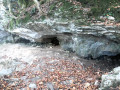
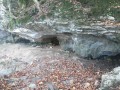
This short family walk takes you to a cute little cave that is very accessible. Over the millennia, it has been home to all kinds of animals, as well as humans. All have left traces, few of which are visible to the naked eye, except for the bear dens and the paleontological excavation sites.
What remains is the beautiful volume of this cave, surprising and rare in the region, and its location in the ever-mysterious forest of Très-Croutz.

Details

425134
Creation:
Last update:
Last review:
  • Walking
    Activity: Walking
  • ↔
    Distance: 1.15 km
  • ◔
    Average duration: 0h 30 
  • ▲
    Difficulty: Easy

  • ⚐
    Back to start: Yes
  • ↗
    Ascent: + 49 m
  • ↘
    Descent: - 51 m

  • ▲
    Highest point: 652 m
  • ▼
    Lowest point: 611 m

Photos

Description of the walk

Access: By car, go to Rieulhès, a small hamlet in the commune of Saint-Pé-de-Bigorre. Drive through the village. After leaving the village, turn right at the Vierge crossroads and follow the square heritage signs. Drive up a narrow road on the mountainside, passing the Cassadou, Bazy and Couret farms. Before the Soulas farm, you will find a small dirt car park on the right-hand side of a bend, at the entrance to a trail, at the foot of a large sign for the Pibeste-Aoulhet Regional Nature Reserve.

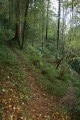
(S/E) Take the path that leads into the forest. There are a few yellow markings.
Cross the Coumat and you will soon come to a red and white stone marker numbered 109 (a standing, sealed stone), marking the boundary of the undivided forest of Saint-Pé. Continue on, passing a signpost numbered 1169 (on the left overlooking the trail, this is the entrance to the Gouffre de la Borne 109), then marker 110 engraved on a rock on the ground.

(1) At the first Bouhadère crossroads, turn right, following the yellow and green markings. At the second crossroads, leave the two markings and continue straight ahead. On a tree on the right, a yellow cross indicates the end of the yellow-marked trail. Continue straight ahead on this trail leading to the Gouffre du Hayau. Continue for about 100 metres.

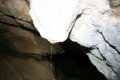
(2) Turn right and descend a well-marked trail with red and white warning tape. In about 5 minutes, following the contour line, you will reach the entrance to the cave known as "Crèque Noèle". You can enter this cave safely with no equipment other than a torch and possibly a helmet.

To return, retrace your steps to the starting point (S/E).

Waypoints

  1. S/E : km 0 - alt. 613 m - Soulas Farm Car Park
  2. 1 : km 0.22 - alt. 647 m - 1st crossroads
  3. 2 : km 0.38 - alt. 652 m - Fork - Turn right going downhill
  4. S/E : km 1.15 - alt. 613 m - Soulas Farm Car Park

Notes

Estimated time
Allow half an hour to reach the cave, to be on the safe side.

Water
There is no drinking water along the route, so bring what you need.

Places to stop and shelters
In the event of heavy rain or storms, the only real shelter along the route is at the end of the hike, in Crèque Noèle.

Equipment
Bring the usual equipment for a short walk in the mountains (hiking boots or sturdy trainers, suitable clothing, rainwear, water, food, map, etc.).
The entire route is through forest.

Traffic
Throughout the year, you may encounter a few hikers and/or cavers on the trail near markers 109 and 110 (this is a "karst" discovery trail).

Worth a visit

The cave in the 20th century
It was during his incessant explorations of the massif that Abbé Abadie, accompanied by a young girl and her father, rediscovered this cave in 1946. The girl, Noèle (not Noëlle), was the first to enter the cave, which would henceforth bear her name. Source: Abbé B. Abadie, Le Sanglier du Picharrot, Ed. Marrimpoey Jeune.

The cave in prehistoric times
La Crèque Noèle is what can be described as a prehistoric cave.
During several survey campaigns, significant deposits of fauna and tools were found there.
With the exception of a few recent bones and traces of medieval occupation, most of them date from the Lower or Middle Palaeolithic period, the latter being between 30 and 80,000 years ago. It was indeed Neanderthal man who lived in this cave! It was also a den for cave bears.
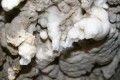
See photo of the interior of the cave and prehistoric details.
Sources http://www.patrimoines-lourdes-gavarnie.fr/, and Sentier karstique de Saint-Pé-de-Bigorre

A bit of local history
The forest of Saint Pé is also called the forest of Très-Croutz (or Très-Crouts or Tres Croutz or Tres Crouts or Tres Crots).
The origin of the name "Très-Croutz" comes from the "Three Crosses" (très croutz in Bigourdan/Gascon) carved into the stone at a place called "la Toue", in the heart of the massif, at an altitude of around 1,400 metres.
The Three Crosses bear witness to ancestral pastoral conflicts between Asson, Salles and Saint-Pé-de-Bigorre.
In 1569, the Béarnais Protestants of the Asson valley decided to attack the Bigourdans of Estrèms de Salles, with whom they were disputing the mountains of Azun and Maumula. The 1,500 men planned to lay waste to the village of Salles and steal all the livestock from Vergoun. But the battle was won by the Bigourdans. These conflicts became so serious that the King's army had to intervene. It was impossible for the Bishop of Tarbes to restore harmony. Source: Abbé B. Abadie, Le Sanglier du Picharrot, Ed. Marrimpoey Jeune.
At a place called "Très-Croutz", the bishoprics of Tarbes, Lescar and Oloron converged on this mountain.
Today, three crosses engraved on a rock and the inscription 1716 remain. They can be found on the IGN map between the "u" and the "e" of "La Toue".

Fauna and flora
The vegetation of this massif reflects the dryness of the soil due to the relief and the highly permeable nature of the substrates
which are highly permeable, but this is compensated for by the high rainfall and cloud cover: boxwood, beech, lime and hazel trees are omnipresent... This is why the wooded slopes are very damp and sometimes very slippery . Source: Saint-Pé Tourist Office.

With a little luck, you may also encounter abundant wildlife. In particular, wild boar, roe deer, chamois, countless birds and insects, and sometimes amphibians (frogs, toads, salamanders).

Nearby attractions
- The town of Lourdes, the Marian Shrine;
- The village of Saint-Pé-de-Bigorre, its cultural heritage, its events, the Très-Croutz forest and the Pibeste-Aoulhet regional reserve, water sports;

Find out more...
- It is useful to consult the website and publications of the Pibeste-Aoulhet Regional Nature Reserve. The most remarkable is the "topo-guide to the reserve", which is full of information, routes and anecdotes!
- The Saint-Pé Tourist Office also publishes numerous brochures and detailed hiking suggestions. One of the brochures may be of interest for discovering the flora and fauna of the massif: the Karst Trail Brochure, which covers part of this hike.
- You can immerse yourself in reading local books:
* Abbé B. Abadie, Le Sanglier du Picharrot (The Picharrot Boar), published by Marrimpoey Jeune,
* Jacques-Emile Mengelle, Bigorre de mon enfance,
* Jean-Claude Mengelle, Le solitaire de la Gargante.

Reviews and comments

4.4 / 5
Based on 6 reviews

Reliability of the description
4.5 / 5
Ease of following the route
4.2 / 5
Route interest
4.7 / 5
Enguerrand260
Enguerrand260

Overall rating : 3 / 5

Date of your route : Aug 16, 2023
Reliability of the description : ★★★☆☆ Average
Ease of following the route : ★★☆☆☆ Disappointing
Route interest : ★★★★☆ Good
Very busy route : No

Trails in all directions. Signposting for Crèque Noèle is often absent.
Paths made slippery by heavy foot traffic.
Finally, a beautiful and unique cave. Don't forget your torch.

Machine-translated

MCTOUL
MCTOUL

Thank you, Caliaga!

Machine-translated

caliaga
caliaga

Overall rating : 5 / 5

Date of your route : Apr 28, 2018
Reliability of the description : ★★★★★ Very good
Ease of following the route : ★★★★★ Very good
Route interest : ★★★★★ Very good

Immersing yourself in human history is a truly exotic experience, starting from the moment you step inside the cave!

Machine-translated

rando64800
rando64800

Overall rating : 3.7 / 5

Date of your route : Mar 09, 2018
Reliability of the description : ★★★★☆ Good
Ease of following the route : ★★★☆☆ Average
Route interest : ★★★★☆ Good

Not to be done in rainy weather, extremely slippery.

Machine-translated

MCTOUL
MCTOUL
• Edited:

Overall rating : 5 / 5

Date of your route : Feb 25, 2017
Reliability of the description : ★★★★★ Very good
Ease of following the route : ★★★★★ Very good
Route interest : ★★★★★ Very good

I took out a subscription for this authentic cave!
It hasn't changed a bit, everything is intact.
But I won't be crawling through the final passage today... I have my 16-month-old baby on my back... She could soon be crawling through it herself!

Machine-translated

MCTOUL
MCTOUL

Overall rating : 5 / 5

Date of your route : Dec 25, 2016
Reliability of the description : ★★★★★ Very good
Ease of following the route : ★★★★★ Very good
Route interest : ★★★★★ Very good

Coming back here on Christmas Day... it's a challenge!
Today we're with the extended family, including nephews and nieces, brother and sister-in-law! The cave is barely big enough to accommodate us all. We decide to cut our stay short, because without headlamps, we only have the light from our mobile phones... And even inside, it's freezing!

Machine-translated

MCTOUL
MCTOUL

Overall rating : 5 / 5

Date of your route : Dec 10, 2016
Reliability of the description : ★★★★★ Very good
Ease of following the route : ★★★★★ Very good
Route interest : ★★★★★ Very good

It's always a pleasure to return to this little cave!
Today it was almost a solo trip, with the youngest underground explorer in the department, AZ, aged 14 months!

Machine-translated

Other walks in the area

For more walks, use our search engine .

The GPS track and description are the property of this route's author. Please do not copy them without permission.