Country:

 City:
City:


Park your car in the small car park (maximum 4 or 5 cars) below the entrance to the Monastery of the Sisters of Bethlehem in Peyras.
(S/E) The fairly wide path starts to the right of the entrance gate. Bordered by rough stone walls, it runs horizontally for a few dozen metres. At the first fork, turn left towards "Cabane de l'Aoulhet" (straight ahead, the path leads to the Castets cave).
The path quickly becomes very steep. It follows a very old transhumance route that is still in use. The path is clearly marked in yellow (part of the route follows trail no. 3 in the Pibeste-Aülhet Reserve). Numerous stone or rock markers painted red dot the massif, marking the boundaries of the national forest. The ground is very stony.
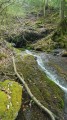
With no distinctive signs or markings, you can hear a stream flowing on the left side of the trail. A few metres away from the trail, you will find a small fountain, still flowing, piercing through the limestone rock.
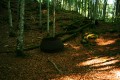
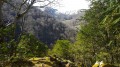
(1) At elevation 824, shortly before Pla de Bers, at a T-junction, continue to the right and not to the left, as there is a lack of markings here. Gradually, the dense forest and boxwood undergrowth thin out and the trail runs through tall beech trees. After walking for between 1 and 1½ hours, depending on your pace, you will reach a semi-circular beech forest called the amphitheatre.
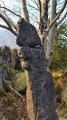
The trail continues its ascent through this forest, leaving a remarkable, moss-covered rocky promontory on the left. At the edge of the forest, there is a wooden signpost for the reserve, which is very useful for the return journey, especially if there is a little fog.
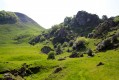
You arrive at the summer pastures.
(2) After a short climb, with yellow markings only on the ground, you reach the Aoulhet refuge hut, formerly a simple shepherd's hut made of green sheet metal, now a beautiful refuge with wooden cladding, with a few recent cattle barriers nearby.
It takes between 1½ and 2½ hours to reach this spot.
The hut is open all year round and free to access. No shepherds live here permanently, but the flocks graze in these pastures in summer. During an ascent or if caught in fog, the hut can serve as a daytime or night-time refuge for one or more herders before their descent into the valley.
The return journey follows the same route as the outward journey to return to the starting point (S/E).


 but thick).
 Visorando Member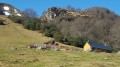
 Difficult
 Tourist office