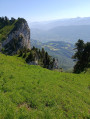
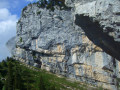
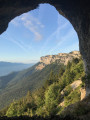
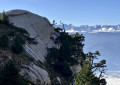
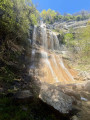
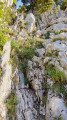
Sangle des Belles Ombres and Porte de l'Alpette

A wild and off-the-beaten-track hike linking the high-altitude ridge of Les Belles Ombres, where chamois frolic all year round, with the bucolic meadows of L’Alpette, where marmots abound.

This route is mainly off-trail and requires sure-footedness and a good sense of direction. It is unlikely that you will encounter other walkers, except at the Croix de l’Alpe and on the section of path leading there.

Details

1127948
Creation:
Last update:
Last review:
  • Walking
    Activity: Walking
  • ↔
    Distance: 11.97 km
  • ◔
    Average duration: 6h 25 
  • ▲
    Difficulty: Difficult

  • ⚐
    Back to start: Yes
  • ↗
    Ascent: + 1,046 m
  • ↘
    Descent: - 1,042 m

  • ▲
    Highest point: 1,821 m
  • ▼
    Lowest point: 1,411 m

Photos

Description of the walk

Park at the Pré Orcel car park.

(S/E) From the car park, take the yellow-marked trail which climbs northwards (signpost indicating the trail and the Croix de l'Alpe). This trail quickly emerges from the pine trees and, after three hairpin bends, joins a wide path at the Cabane de l'Allier, which will serve as a landmark on the return journey.

(1) Turn left onto this path and head south-south-west along a gentle slope for about 600m.

(2) In a small valley, a small cairn marks the start of the Col des Belles Ombres path (the main path heads under a rocky overhang at the exit of this valley; turn back if you have gone that far). Climb this steep path, which starts with a few hairpin bends and heads generally west-north-west. After passing through a small gap in the rocks, cross a flat area beneath the forest to reach a viewpoint overlooking the Col des Belles Ombres. Do not continue to the pass (see instructions in the practical information).

(3) Look out for a small scree slope branching off to the right (north), which marks the start of the traverse. Take the traverse which, after a wide circular loop, heads north, following the undulations at the foot of the cliff.

(4) The Giffres cliff face (see details in the ‘Practical information’ section) marks the middle of the path. Continue through several deeper cirques, sometimes passing under fairly low rock overhangs. When the path enters a more wooded area of pine trees, look to your left for the rock bearing the yellow mark and blue arrow indicating the path’s exit (see ‘Practical Information’ section).

(5) Turn left to follow the blue arrow and climb straight west up a steep, grassy and slippery slope to reach the base of the short exit couloir; climb this using your hands on the rock.

⚠️ The route described here between (6) and (8) is very tricky, as the forest is truly wild and the terrain is dotted with sharp limestone pavements that are treacherous. If you are not confident or are tired, it is best to use the quick return route.

(6) Reach the ridge (see the ‘Practical Information’ section for a quick return route) and turn left (south) onto a path. Follow this for about twenty metres until you can see the Alpette mountain pasture below on the right through the trees. Then head into the forest (no marked path), heading towards this mountain pasture, but veering slightly to the right (north-west) at each obstacle and taking care of the sharp limestone pavement. You will arrive at the bottom of a small valley blocked to the west by rocky outcrops.

(7) Stay at the bottom of this valley where the forest is less dense, and veer sharply north-north-west to follow the valley floor. This leads out onto the upper part of the Alpette meadows. Head up these meadows in the same direction, then climb the steeper slope opposite, criss-crossed by several paths all leading to the Porte de l’Alpette.

(8) From the Porte de l'Alpette, head south in the opposite direction, skirting the edge of the forest and keeping it on your left at a distance of about 50–100m. When the forest becomes denser again, take a gently descending path to the south-west which joins the wideGR®9trail after 200m. Turn left onto this path and follow it for about 300m. Leave this path on your right as soon as it reaches the edge of the forest, and head up through the mountain pastures towards the south, keeping the forest less than 50m away on your left. When the slope becomes steeper, the rounded dome of the Croix de l'Alpe is the summit in sight (the cross itself is not visible). Head up towards it in an east-southeasterly direction to reach the highest point.

(9) From the Croix de l'Alpe, take the well-marked path heading due east towards the Col de l'Alpe, behind which the snow-capped peaks of Belledonne loom. Depending on the remaining snow cover, follow this winding path or take a steep slope on the left if it still allows for a controlled descent. In either case, you will end up on the almost level path that passes back through the junction towards the Col des Belles Ombres.

(2) Continue the descent and, after two hairpin bends, you will reach the Cabane de l'Allier.

(1) From the hut, turn right onto the path taken on the way up, which quickly returns to the Pré Orcel car park (S/E).


Waypoints

  1. S/E : km 0 - alt. 1,411 m - Pré Orcel car park
  2. 1 : km 0.51 - alt. 1,529 m - Allier Hut
  3. 2 : km 1.22 - alt. 1,617 m - Start of the Col de Belles Ombres trail
  4. 3 : km 1.61 - alt. 1,737 m - Start of the Sangle des Belles Ombres
  5. 4 : km 2.73 - alt. 1,784 m - Vertical drop at the Griffes de l'Ours
  6. 5 : km 4.11 - alt. 1,713 m - Exit marker: Yellow Circle and blue arrow
  7. 6 : km 4.16 - alt. 1,733 m - Trip to the Rochers de l'Alpe
  8. 7 : km 4.52 - alt. 1,617 m - Valley with sparser forest
  9. 8 : km 5.5 - alt. 1,549 m - Porte de l'Alpette
  10. 9 : km 9.84 - alt. 1,821 m - Croix de l'Alpe
  11. S/E : km 11.97 - alt. 1,411 m - Pré Orcel car park

Notes

(4) The Griffes de l'Ours route
Visual landmarks:
The start of the traverse can be identified using two photographs: the pass and the start of the traverse.
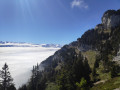
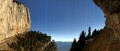
The pass is clearly visible in the photograph on the right, and the ridge starts at the patch of grass in the sunlight above the shadow line in the middle of this image. The same patch of light can be seen in the photo on the left, as well as the scree leading directly to the path from the edge of the forest where these photos were taken. Click on the photos to enlarge them.

To exit the path, look for the markings on the rock near the path.

This yellow circle and the half-faded blue arrow indicate the direction to follow to exit the path. These markings are difficult to spot as they are above the path and obscured by trees until the very last moment.

As you climb towards the exit of the ridge, you can see the end of the natural ridge. It disappears behind a cliff; it is not possible to go any further.

The exit from the gully and the return to the ridge is via a steep grassy couloir followed by a few steps of easy climbing (grade 2). A yellow mark on the rock indicates the location (click on the photo to view it in full size).

Difficulty:
The main difficulty lies in finding the route through the forest and the steepness of the slopes below the ridge; the grade is at the upper limit of Difficult and crosses into Very Difficult if you opt for the Pas de la Rousse variant.

Please note: snowfields persist for a long time on the ridge, often until the end of June, making the ridge crossing difficult without an ice axe. They can also cover the sharp limestone pavement on the west face of the Rochers de l’Alpes, creating hazards where it is easy to injure yourself if you move too quickly.

Equipment:
Use of the Visorando app is highly recommended to compensate for any lack of a sense of direction.

For this route, the only essential equipment is walking poles and an ice axe, which allows you to cross the frequent snowfields until the end of June and climb the steep clay slopes below the Sangle pass.
As always, a helmet is a wise precaution: chamois or other hikers often dislodge rocks.

Trousers will prevent you from getting scratched by the dense forest beneath the Rochers de l’Alpe.

Water:
The Fontaine du Bénitier is a short walk from the off-trail route (see IGN map). A short detour via the Cabane de l’Alpette also allows you to top up your water supplies, though this involves crossing the very busyGR®9.

Dogs:
Dogs, even on a lead, are prohibited on the high plateaus and mountain pastures. In any case, the route is not particularly suitable for dogs.

Terminology:
The word ‘sangle’ is synonymous with ‘vire’ in the Dauphiné region. It is always used in the masculine form in this context. The one at Les Belles Ombres (click on the photo to locate the sangle) is typical.

A sharp limestone pavement is jagged with cracks and narrow crevasses with sharp edges.

The ‘ramasse’ is a technique for descending snow slopes that involves sliding down the slope using an ice axe and a leg bent backwards to slow oneself down.

This route passes through a protected area, which may be subject to special regulations:

Worth a visit

Not to be missed:
April and May see crocuses blooming on the mountain pastures.

But whatever the season, it is the sunrise over the rocks of Les Belles Ombres that offers the most beautiful spectacle. This is also the time of day when you are most likely to spot numerous chamois.

The photographs from this hike give a good idea of the scenery just after dawn.

To make the most of this, you must set off from Pré Orcel an hour before sunrise.

Alternatives:
It is possible to shorten the hike by heading directly to the Col de l’Alpe once you’ve left the Sangle (6). To do this, head south along the ridge path overlooking the Rochers de Belles Ombres. This path runs slightly below the ridge at the start, but you should always try to join the ridge to enjoy the view, particularly of the Griffes de l'Ours at around 1,820m.

From the highest point (1,845m), the path improves and leads to the Col de Belles Ombres; simply follow it to the Col de l'Alpe or the Croix de l'Alpe (9). From there, the return to the car park follows the main route of the hike.

This short alternative allows you to complete the route in 2½ hours.

Another variation involves, once you reach the Croix de l'Alpe (9), descending via the Pas de la Rousse to completely avoid the crowds of hikers. Be careful, however, as the Pas de la Rousse is Very Difficult, especially on the descent. This longer variation adds between 1 and 1½ hours to the route.

To reach it, head for the base of the rock formations topped with pine trees to the south-east of the Croix and follow them until you find a path leading up through meadows (IGN elevation 1768m); see the caption for the photograph on the right below and the picture taken when there was no snow.

Continue along this path, which winds through sheep pastures, until you reach the ridge and the cliffs overlooking the Grésivaudan. A wide gap in the cliff, lined with pine trees, marks the way to the Pas de la Rousse. Take this route (worn yellow and blue markings) and follow the track descending due east, keeping the cliff on your left. Pass beneath the Trou de la Rousse, then descend steeply through the scree (tracks) and into the forest to reach a level path at around 1,400m. Turn left onto this path to head north-east and reach the car park (S/E) at Pré Orcel.

Finally, as suggested by mimizen38, a more challenging alternative is to continue to point (5) on the Sangle trail to complete the full route as described in the ‘Sangle des Belles Ombres’ guide. This allows you to reach point (8) by climbing up to the ridge at the last moment. This alternative is more difficult, as the route is poorly marked and the exit onto the ridge is hard to find. However, it avoids a passage through sharp limestone pavement and awkward undergrowth between points (6) and (8) on the route described above.

Finally, the hike combining the Fouda Blanc and Belles Ombres trails indicates the locations of several beautiful arches along the route.

Pascal Sombardier isthe inspiration behind this circular loop, as he is for many others; see the excellent *Vercors secret* or his other works (which are unfortunately often out of print).

Always be cautious and plan ahead when you're outdoors. Visorando and the author of this route cannot be held responsible for any accidents occurring on this route.

The GR® and PR® markings are the intellectual property of the Fédération Française de Randonnée Pédestre.

Reviews and comments

4.3 / 5
Based on 6 reviews

Reliability of the description
4.3 / 5
Ease of following the route
4.2 / 5
Route interest
4.5 / 5
bader
bader

Overall rating : 3.7 / 5

Date of your route : Jul 30, 2025
Reliability of the description : ★★★★☆ Good
Ease of following the route : ★★★☆☆ Average
Route interest : ★★★★☆ Good
Very busy route : No

Carried out today, the descent into the forest was difficult and exhausting from point 6 to point 8, but feasible.

Machine-translated

PASCALOU27
PASCALOU27

Overall rating : 3.7 / 5

Date of your route : Aug 08, 2023
Reliability of the description : ★★★★☆ Good
Ease of following the route : ★★★☆☆ Average
Route interest : ★★★★☆ Good
Very busy route : No

A very beautiful hike. Unfortunately, some of the directions are difficult to follow. At point 2, you must not climb over the fence, but instead head back down a few metres to find the marked rock on the right (this isn’t visible when you’re going up). The view from the straps is magnificent, and the section between points 5 and 6 isn’t as difficult to navigate as it seems. On the other hand, the walk through the forest is very tedious and adds nothing of interest to this hike. After crossing the mountain pasture, we decided to top up our water supplies at the water point near the refuge, then rejoin the hiking trail via the GR. The climb across the mountain pastures between points 8 and 9, with no visibility of the cross to guide us, makes this section more difficult.
The description of ‘difficult’ is not inaccurate.

Machine-translated

ChristianNant70
ChristianNant70

Overall rating : 4.7 / 5

Date of your route : Jun 06, 2023
Reliability of the description : ★★★★★ Very good
Ease of following the route : ★★★★☆ Good
Route interest : ★★★★★ Very good
Very busy route : No

We only did the round trip along the path so as not to make the day too challenging, and in keeping with our fitness levels...
A 3.3 km climb up a stony track to reach Pré Orcel. From there, a climb of about 350 m to reach the start of the path at the foot of the cliffs. If you don’t suffer from vertigo, there’s no difficulty in walking this path.
Magnificent setting and views. The Isère Valley, the Alps... Jagged, colourful cliffs. Lots of paragliders flying overhead.
Brilliant!!

Machine-translated

bouvierjr
bouvierjr ★

Good evening,

thanks for the feedback!
The route through the forest is indeed really only for those who enjoy adventurous terrain.

Unfortunately, the return route along the ridge (6) that you suggest requires going back almost as far as (3), which considerably lengthens the hike. A more direct option that avoids the forest is to follow the entire Sangle route as described in this hike, but the difficulty increases slightly.
As for the various arches of Les Belles Ombres, I have indicated their location and how to reach them in this very long hike linking the Fouda Blanc and Les Belles Ombres trails at the stages (8) and (14).

Happy hiking – jr

Machine-translated

Opetigny
Opetigny

Overall rating : 4.7 / 5

Date of your route : Jul 15, 2020
Reliability of the description : ★★★★☆ Good
Ease of following the route : ★★★★★ Very good
Route interest : ★★★★★ Very good
Very busy route : No

Hello,
Route completed this weekend.
Thanks for the description and the route map, which were very helpful.
Like others, I think the section through the woods after point 6 is really unpleasant, even borderline dangerous (it’s easy to twist or even break an ankle in the woods with its sharp limestone pavements and holes often hidden beneath the vegetation).
It took us (the two of us) ages to get through it, and we’re actually keen walkers.

Having looked at the slopes on the way back, I think we wouldn’t waste any time returning (in six) via the well-marked track towards the Col des Belles Ombres and then heading right (west) down the alpine slopes as soon as we really leave the forest and see the plateau, before heading north back to the Porte de l’Alpette. It adds a bit to the distance but probably not much to the time for a route along the ridge, and it’s much safer.

Otherwise, a very beautiful hike; no one on the upper ridge apart from an eagle and two young ibex...

The next day, heading back up to the Croix de l’Alpe, I set off again towards the summit at 1,843m along the ridge trail to find the Arche des Belles Ombres. It wasn’t easy to find the entrance to the chamois track leading there, involving a few rather exposed steps. Fortunately, I bumped into Pierre, who had marked the route with red dots some twenty years ago and who was kind enough to accompany me there... thanks to him, without whom I surely wouldn’t have found it!
A lovely encounter with this local resident who knows the area like the back of his hand.

Machine-translated

Mimizen38
Mimizen38

Thank you for the information, and good luck to your business and your staff: it’s a difficult time, but not an insurmountable one

It’s true that, thinking about it, even 12 hours is a bit short if you want to take the time to enjoy the scenery. I’ve tried to think of ways to shorten the route, but there are so many points of interest that it would be a shame to miss out on any of them. For the ‘Foudra Blanc’ section, we could head in the opposite direction to what’s described, but it’s still a shame to miss out on the ladder. However, be careful on this hike: the GPS track is incorrect in the circular section before point 6; if you follow it strictly, you risk falling onto 3–4-metre ledges as there are scree slopes (I’ve noted this in the comments).

Machine-translated

bouvierjr
bouvierjr ★
• Edited:

You’re lucky to be able to get out this weekend (I’m stuck trying to keep my business and its staff afloat following the Covid restrictions)!

For the Crête des Crocs this weekend, I reckon you’ll have little or no snow on the east face; as the western slopes are less steep, an ice axe will probably suffice – no need for crampons. Be careful between the point (3) and (4) – the path is barely visible. The descent from the point (13) is essentially on sight; just head west then north and stay in open terrain until you reach the rocky ridge that descends towards the Fontaine du Berger. If this presents any difficulty, go round it from below.

As for your suggestion to combine the Fouda Blanc with the Rochers de l’Alpe and the Belles Ombres, I think it’s a brilliant idea; I’ll try to do it, but it’s likely to be more than 12 hours’ walking at a steady pace. Along the way, there are limestone mushrooms, several karstic caves, etc. I’ve never combined these routes, but it’s undoubtedly spectacular. In principle, I’d aim for the IGN contour line 1799 after the point (4) on the Fouda Blanc hike, then the 1679 line (incidentally, there’s a very beautiful sheepfold nestled in the rock), then descend the GR to contour line 1638, followed by a climb on sight along the forest edge towards the Col de Belles Ombres (there is a section off the trail and out of the forest described in the Sangle des Belles Ombres hike). Then, you do indeed followthe entire Belles Ombres route between (8) and (12), but after the last point, instead of strictly following the edge of the forest on your left, you head back down to the Cabane de l’Alpette and from there follow the normal signposted route up to Le Pinet.

I’ll make a note of that in my book of future routes – thanks for the idea!

Machine-translated

Mimizen38
Mimizen38
• Edited:

The Alpette meadow really is lovely; it would be a shame to miss it

As for the full route, I’m not sure I’ll ever do it: a 10-hour 45-minute hike plus 3–4 hours’ drive (as I have to cross Grenoble )… that’s going to be too much for me (I’m not a fan of getting up early).
However, I do plan to do the Sangle again next year, but starting from Saint Pierre d’Entremont (that way, I avoid going through Grenoble and save 1½–2 hours on my drive... I’d rather walk than drive).

I was thinking of doing it like this:
1- Follow the hike https://www.visorando.com/randonnee-le-p... up to point 4.
2- Head to the Croix de l'Alpe (which path should I take?)
3- Follow the route https://www.visorando.com/randonnee-pas-..., points: 8-9-10-11-12
4- Cross the Pré de l'Alpette (not necessarily the whole thing... at least the most interesting part)
5- Join point 5 of the hike https://www.visorando.com/randonnee-le-p... (which path?) to finish it normally

That would make a lovely circular pattern (two hikes for the price of one )

And if you’re up for posting the hike online, I’d love to see it
In your opinion, how long should we allow for this circular route at a moderate pace? Less than 9 hours?

Anyway, thanks for your input; tomorrow I’m off to do your hike https://www.visorando.com/randonnee-peti... ... though I’m a bit unsure – will there still be snow (I hope not)? Which website should I check to find out?

Machine-translated

bouvierjr
bouvierjr ★
• Edited:

Hello Mimizen, and thank you for your constructive comments!
Indeed, at this time of year, snow from the western slopes of the Chartreuse ridge overlooking the Grésivaudan is still present and dangerously conceals the sharp limestone pavement.

I can confirm that if you turn north-east too early before point 3, you risk ending up on the route leading to the Griffes de l’Ours (it’s magnificent); it is possible to scramble upwards afterwards to get back onto the ‘Sangle des Belles Ombres’, but it’s rather awkward.

The reason I did not extend the hike between point (6) and (8) along the ridge, as is possible by following the entire ridge (a hike I also authored), is the difference in difficulty: although the terrain described here is chaotic and awkward, it poses no danger other than the infamous sharp limestone pavement.

On the other hand, the route between point (6) and the Porte de l’Alpe, as described in the full route, is extremely difficult, both in terms of finding the route and the exit onto the plateau, and I didn’t want to make it too challenging. However, I will mention this option in the alternatives, noting also that the terrain between (6) and (8) is rather awkward.
If you do this full route, please do leave a comment so I can improve the descriptions!

Another alternative I’d like to mention is to turn back by reaching the ridge at (6) and following it south-south-west to reach the Col des Belles Ombres. It’s also cluttered with low trees, with poor visibility, but it shortens the circular route at the expense of the section through the very beautiful meadows (see your photo) of the Alpette.

Happy hiking!

Machine-translated

Mimizen38
Mimizen38
• Edited:

Overall rating : 4.7 / 5

Date of your route : May 16, 2020
Reliability of the description : ★★★★★ Very good
Ease of following the route : ★★★★★ Very good
Route interest : ★★★★☆ Good

A hike with stunning scenery!!!
The GPS track is accurate: thank goodness, because without it I’d probably have got lost, especially when you reach point 3 – if you follow the visible path, you tend to veer right too early (perhaps it joins up later?). It seems impossible to me to complete the route relying solely on a description (GPS is essential for me).
On the other hand, I didn’t enjoy the section through the forest between points 6 and 8 at all: you’re in the middle of primeval forest where you have to make your way through the undergrowth and moss-covered sharp limestone pavements (so it’s easy to hurt yourself on a section which, for me, isn’t particularly interesting). What’s more, at this time of year (mid-May 2019), there was still snow in places in this forest that couldn’t be avoided. In theory, you can avoid this forest by continuing to follow the path (see this route: https://www.visorando.com/randonnee-pas-...): I therefore recommend taking that route... unless anyone sees a point in going through the forest anyway? What is it?
Otherwise, as for the rest of the route, I didn’t find anything difficult (for an adult, I should point out… and one who isn’t prone to vertigo).

Thank you for this discovery

Machine-translated

bouvierjr
bouvierjr ★

Thank you for this review; the hike is indeed challenging, mainly because of the difficulty in finding the route.

Are there any improvements that could be made to the description to make it more accurate? Or should I change the rating to TD rather than D?

Thanks in advance, - jr

Machine-translated

ourabah
ourabah

Overall rating : 4.7 / 5

Date of your route : Oct 15, 2018
Reliability of the description : ★★★★☆ Good
Ease of following the route : ★★★★★ Very good
Route interest : ★★★★★ Very good

The off-trail section is challenging

Machine-translated

Other walks in the area

For more walks, use our search engine .

The GPS track and description are the property of this route's author. Please do not copy them without permission.