Country:
 City:
City:



Parking is available at the Vita car park, 31 Rue de Richwiller, or just next door at the secondary school car park, at the junction of Rue de Richwiller, Rue des Chevreuils and Rue de la Forêt.
Lutterbach station is 750 m away.
(S/E) With your back to the car park, head towards Rue de Richwiller, which climbs up opposite. To do this, go round the roundabout on the right, carefully crossing Rue de la Forêt, then the pedestrian crossing that crosses Rue de Richwiller. Stay on the left-hand pavement for about a hundred metres, then turn left up a path that runs along the hillside and leads to Rue des Vosges. At the end, this street narrows and leads to the cemetery. See the ‘Places to see’ section.
(1) Walk down Rue du Cimetière towards the basilica. At the junction with Rue Aristide Briand, look out for a beautiful Lebanese cedar on your left. Turn right to cross (at the pedestrian crossing) and reach the basilica’s forecourt. A visit to the basilica is well worth it; see the “Places to see” section.
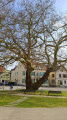
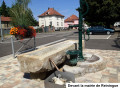
(2) From the forecourt, walk round the west side of the basilica, cross the car park, walk down a path lined with old boundary stones and ancient ruins (remains of the old church), and go down the steps towards Rue Ackermann. Turn right, then right again, walking alongside the school. When you reach Rue Aristide Briand, turn left and then, in front of the town hall gardens § “Places to see”, cross the road (pedestrian crossing). Continue left along the other pavement until you reach the junction just after a chemist’s. Cross Rue du Houblon to admire the majestic plane tree (notable tree), § “Places to see”.
(3) Cross Rue du Houblon again to visit, behind the chemist’s, the mural depicting iconic figures from Lutterbach, § “Must-see”. Walk up Rue du Houblon towards the new brewery and its museum commemorating the history of this famous pre-war industry, § “Must-see”.
(4) Continue by going to the right of the roundabout, towards “École La Forêt”. At the next junction, cross the road and walk between the two buildings. With the school on your left, take the path that turns left; then, at the junction of the paths, turn right, cross the road in front of the park and turn left towards a footbridge over the Dollerbachlein, § “Places to see”.
(5) Head right, along the edge of the stream, following the Blue Saltire signposts. The path leads to a junction between a footbridge and a bench.
(6) Walk a few metres, then, with the bank of the Dollerbaechlein opposite you (this is the return route), turn left, passing under a high-voltage power line. Immediately afterwards, turn left. The path runs alongside the high-voltage power line for about 150 m before veering away to the right. Shortly afterwards, a sign indicates that you are on the fitness trail. Pass a piece of fitness equipment, then walk through a plantation dotted with educational panels. Shortly after the last panel, you’ll reach a junction with a path branching off at 90° to the left (be careful, it isn’t signposted).
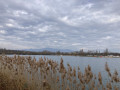
(7) Leave the fitness trail and follow this path westwards. After a few dozen metres, at the junction, turn left towards a Red Ring marker, then continue to the right. You’ll find yourself heading west again, with the Red Ring markings appearing more regularly. A sign on a tree reads “Route du Muguet”; the path gradually turns northwards until it reaches a junction at the far end of a long, narrow pond, the Baggerloch § “Must-see”.
(8) Pass the chicane on the left to take the path along the western bank. You are on private land; passage is tolerated but please keep a low profile so as not to disturb the anglers. A shelter and a few tables and benches are situated along the 600 metres of this unusual stretch of water.
At the end, carry on straight ahead along the path marked with the Red Ring, heading due north. Take care at a junction: ignore an arrow sign indicating you should turn left; carry on straight ahead and maintain your bearing to rejoin the ‘Red Ring’ markings. Further on, after crossing a stream, you’ll reach the junction marked with a sign reading ‘Lieu dit croisement des Chênes’ on a tree on your left.
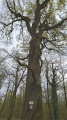
(9) Turn right onto the wide ‘Chemin du Gros Chêne de Pfastatt’, heading east. You’ll need to walk about 800 metres to admire this remarkable 250-year-old tree with a circumference of 5 metres. Continue straight on for a few hundred metres until you reach a bridge over the stream on your right and the start of a signposted path.
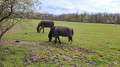
(10) Cross the stream and take the path, following the Red Ring markings (accompanied by the Yellow Ring) which quickly lead to the road; cross the road towards a small car park on the left. Cross the car park and continue along a small road running alongside a horse pasture. Carry on to the next junction.
(11) Turn right between two fences; a sign reminds you that, for the animals’ sake, it is forbidden to feed them. At the end, the track becomes a path and leads to a junction with several paths.
Take the second path branching off to the right, the southernmost one. Cross a stream, which can sometimes be muddy, then pass under the high-voltage power line. Continue straight on until you reach a cross-path. Turn left and walk for a few dozen metres until you find a path marked ‘Blue Saltire’ just before a footbridge.
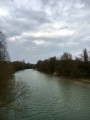
(12) This is the “Chemin de la Dollerbaechlein”; it follows the stream more or less southwards, then, as the buildings of Lutterbach come into view, gradually turns to the right before hugging the riverbank as closely as possible.
(13) Walk along the bank westwards until you pass under the high-voltage power line and then cross the road. Turn left immediately, still following the stream, to reach the footbridge near the junction you passed on the way there.
(6) Turn left, cross the Dollerbaechlein and, keeping to the right, follow the path to the car park (S/E).

 Visorando Member
 Local authority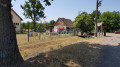

 Moderate