(S) Work by Fernand Kayser: "Bienvenue à Mulhouse" ( Welcome to Mulhouse ) directly at the Tourist Office. This Mulhouse artist describes himself as a superimposer obsessed with punk imagery and the industrial riches of his hometown. Several elements are stacked on top of each other, but not just any elements. Here we find many buildings and objects symbolic of Mulhouse.
(1) " Le M.U.R. Mulhouse". This section of wall is an exhibition space occupied by a different artist each month. Le M.U.R. (Modulable Urbain Réactif) is a tool for promoting street art initiated by the Mulhouse association Épistrophe with the support of the city. You can see previous works and the latest news from Le M.U.R. on the Facebook page "Le M.U.R. de Mulhouse". Next to this wall is the "Vinyle de KESA". Kesa was a graffiti artist for many years before turning to urban collage. A vinyl enthusiast, one evening he decided to heat one up with a hairdryer. Seeing that the disc became soft (and therefore malleable), he came up with several ideas and created new works (today, he no longer uses the hairdryer). Inspired by music, he created his own world surrounded by birds and other street animals (birds, cats, mice, rats, etc.).
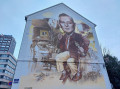
In Rue de la Justice: "Jana & JS": A couple in life and on stage, Jana and Jsest are a Franco-Austrian duo of photographers and stencil artists working in Salzburg. Their works are exhibited on the walls of cities around the world and in numerous European and American galleries. Inspired by the city, its ever-changing architecture and the people who live there, JANA & JS produce intimate, delicate and sensual works. Created in four days on a 15-metre-high gable, the artists used stencils and spray paint. The graphic elements that accompany the work represent the façade of the neighbouring building in order to integrate it into its surroundings. In the bubble at the top left corner, the artist paid tribute to a couple from Guebwiller and Soultz, the famous volcanologists Katia and Maurice Krafft.
(2) Man painting: An angel, a sumo wrestler, a sculptor, a bird, a guitarist... you see these characters on geometric shapes and you know it's the work of Clet Abraham. This artist enjoys subverting road signs with a touch of humour. However, there is a real message behind it: the artist seeks to criticise the signs because, from his point of view, they are the first signs of rules and order. In Mulhouse, there are more than 200 of them! So, look up to find them, but watch out for the road!
In Rue des Cordiers: The "Benne colorée" (Colourful Dumpster), created by Swiss artist Burstart, lights up Place des Cordiers, while the "Femme couchée" (Reclining Woman) is a new sign reinterpreted by CLET Abraham.
"Dr Latscha": portrait of Jacques Latscha, a doctor born in Mulhouse. It was created by graffiti artist Shaka in 2014 as part of the Bozar Festival Jam Session. Shaka, a friend of the doctor's son, created it as a tribute to the doctor, who had recently passed away.
(3) "The Sculptor", a panel repurposed by CLET Abraham!
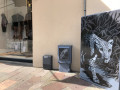
The "Portrait". In his exhibition entitled "2013: the end of prehistory", Bernard Latuner, a committed artist from Mulhouse, contrasts nature with human progress. He shows the powerlessness of nature, particularly in the face of machines. Among his paintings, there are also a small number of black and white portraits of animals, with a "prehistoric feel". The aim of these portraits is to convey a message through the animal's gaze, leaving the viewer with a sense of unease and inviting them to reflect on their life choices.
Les Amazones is a sculpture depicting three women and two men (recognisable because they have a glottis). The characters are created from metal, the speciality of Mulhouse-based visual artist and sculptor Sébastien Haller. This work was created as part of the Fil Rouge and Mulhouse Grand Centre redevelopment project.
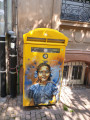
Rue de la Sinne: the work "Jeune indienne" (Young Indian Woman) by C215 , a major artist on the international street art scene. He has created around twenty works in collaboration with the Orlinda Lavergne gallery and La Poste in Mulhouse itself.
In front of Saint-Étienne Church, there is another work by CLET called "Homme au pilori" (Man in the Pillory).
(4) Vinie created this female figure, whose hairstyle and clothing change depending on her environment. Now found all over the world, her Mulhouse appearance, with her leafy hair and coloured beads, has made her one of his greatest successes. The work has been ranked among the 100 most beautiful works of street art in the world.
Fraenkel's work was commissioned by SOMCO during the renovation of the Flammarion building (2016, façade refurbishment, thermal insulation). The constraints imposed by Bâtiments de France had to be respected, hence the subtle colour. It reads: "Living together – the good as one – we have so little time together – what would I be without you – you are us".
Between Avenue du Président Kennedy and Rue de Lorraine: William Wyler: The work was completed in 12 days at the request of the city of Mulhouse to mark the 120th anniversary of the birth of William Wyler, the man with 40 Oscars, who was born in Mulhouse, and the 100th anniversary of his career. An international artist, Niko Loveletters is particularly known for his style and attention to detail. It took 60 hours of work, 112 kilos of paint and 10 litres of varnish to create this work.
Rue des Trois-Rois: the work "Jaune". Behind the pseudonym Jaune is Jonathan Pauwels, a Belgian street artist who works mainly in Brussels. As he himself explains, his work is based on the paradox between the visible and the invisible. He likes to depict municipal employees and technical agents in often comical situations. Why this type of character? Because, despite the fluorescent vests these employees often wear, they seem to be invisible to passers-by. Drawing on his professional experience as a sanitation worker, Jaune began bringing his characters to life on walls in 2011. "Those who were supposed to keep the world clean are now the harbingers of chaos." Jaune created around fifteen boxes in July 2019 in Mulhouse, as part of a partnership between GRDF and the Orlinda Lavergne Gallery.
(5) A work by Fernand Kayser. The superimposition of shapes, curved or felted and coloured, is the work of Fernand Kayser, a member of the Schlager Club. Unfortunately, the letters of the sign (on the red band) have been removed.
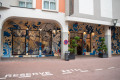
Galerie Orlinda Lavergne. This is an important venue, as it is thanks to its owner of the same name that urban art has flourished in Mulhouse. She has set up collaborations for CLET, C215, Jana & JS, OakOak, and others. She set herself three objectives: "to support artists in their creations, to surprise the public and to inspire and enable people to collect works of art".
Rue des Boulangers: A native of Mulhouse, David Zeller created "Flexo" in 2010. This funny little man, simple and protean, is available in plexiglass and metal. Today, Zed has sold 20,000 copies worldwide, and can be found in galleries in Tokyo, Barcelona, Kuala Lumpur, Beirut and New York. In Mulhouse, he installed six of them ("Love", "Dream", "Dare", "Contemplate", "Persevere", "Have fun") as part of a public commission for Mulhouse en fil rouge. Each one metre high and made of Andrinople red powder-coated steel, they are installed at height.
(E) Williann: In this large fresco, the cartoon-like characters and animals in full motion appear powerful. And yet, if you look closely, they are cracked, as if made of porcelain. The artist Williann likes to use this Delft blue (which we associate with porcelain) but above all wanted to show that despite the cracks in life, we must continue to move forward.



 Country:
 City:
City:


 Tourist office

 Visorando Member

 Average
