Refine your search for walks in Puente la Reina/Gares
Puente la Reina/Gares walks


 Puente la Reina - Estella Lizarra
 Visorando Member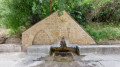
 13.23 mi
 +1,280 ft
 -1,030 ft
 7h 10
7h 10
 Difficult
 Departure from Puente la Reina/Gares (Navarre)
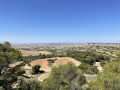
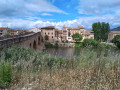
Forty-ninth stage of the Camino de Santiago. This short stage remains very interesting thanks to the towns you pass through, such as Mañerú, Cirauqui and Villatuerta, until you reach your destination for the day, Estella, on the River Ega, a marvel from centuries past, which welcomes you with a very photogenic bridge.
Estella Lizarra - Torres del Rio
 19.24 mi
+1,335 ft
-1,329 ft
10h 00
19.24 mi
+1,335 ft
-1,329 ft
10h 00
 Very difficult
Departure from Estella-Lizarra (Navarre)
Very difficult
Departure from Estella-Lizarra (Navarre)
Fiftieth stage of the Camino de Santiago. This stage takes you to the southernmost reaches of Navarre, to the picturesque village of Torres del Río, with its Church of the Holy Sepulchre, a jewel of Romanesque art. In the blazing sun, this route is long and gruelling. When you arrive in Irache, known for its wine fountain, you will have walked for only half an hour, and you will still have 27 km to go… yet Irache wine is very strong, even if it goes down easily! Remember to fill your water bottle… with water!
Estella the Beautiful
4.29 mi
+381 ft
-384 ft
2h 20
 Easy
Departure from Estella-Lizarra (Navarre)
Easy
Departure from Estella-Lizarra (Navarre)
The medieval old town of Estella, through which the River Ega flows, boasts numerous Romanesque and Gothic buildings that bear witness to its former splendour. ‘Estella la bella’, as the pilgrims of the Middle Ages called it, is situated in Navarre, on the Camino Francés, between Puente la Reina and Logroño. I visited this beautiful town during the forty-ninth stage of my Camino de Santiago.
Esteribar - Puente la Reina
 20.98 mi
+1,657 ft
-1,932 ft
8 hrs
Very difficult
Departure from Esteribar (Navarre)
20.98 mi
+1,657 ft
-1,932 ft
8 hrs
Very difficult
Departure from Esteribar (Navarre)
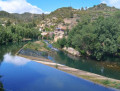
Forty-eighth stage of the Camino de Santiago. A stage like today’s is described in Spanish as: todo derecho – straight ahead all the way. You walk alongside the River Arga with little change in elevation until you reach Pamplona, at the foot of a group of hills covered in beech, oak and wild pine trees. As you approach Pamplona, the landscape becomes more clearly influenced by civilisation, with its conifers, reforestation and farmland.
The rest of the stage is dominated by the Alto del Perdón, which offers a magnificent view. From there, you can see Pamplona and the Pyrenees behind, and opposite, the vast Navarrese plain. You will spend part of the day climbing up and down this mountain range, passing through quiet little towns that resemble islands floating amongst the fields of grain.
Torres del Río – Logroño
 12.89 mi
+909 ft
-1,171 ft
6h 45
Difficult
Departure from Torres del Río (Navarre)
12.89 mi
+909 ft
-1,171 ft
6h 45
Difficult
Departure from Torres del Río (Navarre)
The fifty-first stage of the Camino de Santiago. On this stage, you leave Navarre and enter La Rioja, famous for its vineyards, before reaching Logroño. The twenty kilometres of this section begin with a path winding through ravines, but once you reach Viana, the route becomes much easier to walk. Make the most of your late afternoon and evening to explore Logroño, a city steeped in history and traditions that have been passed down since the Middle Ages. In the evening, the narrow streets of the old town are bustling with life.
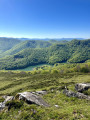
Leurtza peaks and lakes from Urrotz
 7.34 mi
+1,529 ft
-1,552 ft
4h 40
7.34 mi
+1,529 ft
-1,552 ft
4h 40
 Moderate
Departure from Urroz (Navarre)
Moderate
Departure from Urroz (Navarre)
A superb hike with four peaks over 1000 m, two superb lakes and also a dolmen, a menhir, an ancient Roman road, all in a protected natural setting.
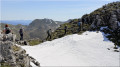
Ganboa Circular Loop
 9.33 mi
+3,556 ft
-3,543 ft
7h 25
Difficult
Departure from Abaltzisketa (Gipuzkoa)
9.33 mi
+3,556 ft
-3,543 ft
7h 25
Difficult
Departure from Abaltzisketa (Gipuzkoa)
A superb circular route in the karst massif of the Sierra de Aralar to reach Ganboa (or Ganbo, 1,413 m), the highest point in the area. A few slightly technical sections; please read the description carefully. GPS or the Visorando app recommended.
Adi ascent
4.92 mi
+1,752 ft
-1,732 ft
3h 45
Moderate
Departure from Erro (Navarre)
The Adi overlooks the Urepel valley and the Quinto Real, which belonged to the kings of Navarre. The inhabitants paid a grazing fee corresponding to one-fifth of the herds, the quint.Currently reduced to 2,000 ha on the French side, but belonging to Spain, only the families of Saint-Étienne de Baïgorry have use of it. Herd owners pay a grazing fee (vacade) for each animal. This is why a fence marks the boundary of the Quinto Real.
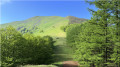
Ichterbegui, Adi and Iturrumburu from the Korrota Pass
 8.22 mi
+3,419 ft
-3,422 ft
6h 45
Difficult
Departure from Urepel (Pyrénées-Atlantiques)
8.22 mi
+3,419 ft
-3,422 ft
6h 45
Difficult
Departure from Urepel (Pyrénées-Atlantiques)
This walk starts at the head of the Baigorri valley on the edge of the Pays Quint (Kintoa). The route forms a semicircle around the Inbelertegiko Erreka valley and takes you up the three peaks (Ichterbegui, Adi – the highest – and Iturrumburu) that frame this watershed.
Eznaazu Circuit
 Tourist office1.11 mi
+194 ft
-177 ft
0h 40
Easy
Departure from Aldudes (Pyrénées-Atlantiques)
Tourist office1.11 mi
+194 ft
-177 ft
0h 40
Easy
Departure from Aldudes (Pyrénées-Atlantiques)
A picturesque walk along this headland, where the cool mountain breeze blows, making for a pleasant post-meal stroll.
The Harriondoko ridges, Lindus and Xaxperro in a loop from Urepel
14.13 mi
+3,294 ft
-3,264 ft
9h 20
Very difficult
Departure from Urepel (Pyrénées-Atlantiques)
This loop is a superb hike in Lower Navarre, taking you in turn to the peaks of Lindus, Xaxperro and Sorotepo. This ridge route between France and Spain offers total immersion in the open, wild landscapes of the Basque Country. Throughout the route, panoramic views of the Baigorri valley, the surrounding Basque peaks and, on a clear day, the High Pyrenees follow one after another. A complete itinerary, between high-altitude pastures, airy ridges and a pastoral atmosphere, ideal for hikers in search of tranquillity and wide open spaces.
 Association / Club / Walk leader