Country:

 City:
City:


The hike described here largely follows the route known in Navarre as PR®-NA 102: PR® for Pequeño Recorrido and NA for Navarre, with white and yellow markings. It has been adapted for use with Visorando.
The starting point for this hike is at the Leurtza Lakes dam car par, opposite a small house with explanatory panels and a sculpture of a frog: the "rana bermeja" or red-legged frog, a protected species and emblematic of the region.
For directions by car to this starting point, see "Practical information" below.
(S/E) From the frog statue, drive in the opposite direction to your car, then immediately take the path which climbs to the right (PR®-NA 102). Shortly afterwards, pass a fountain and reach a pass, having followed the sign for "Bonozorrotz".
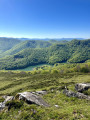
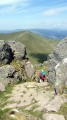
(1) From the pass, turn right to reach the summit of Bonozorrotz at 1018 m: at the top there's a metal letterbox. There's a magnificent 360° view.
(2) Turn around and retrace your steps.
(1) Following the ridge line, pass Mugakosoro (1035 m), Soratxipi (1069 m), the highest peak of this hike (at the summit there's a geodesic marker, i.e. a large cylinder on a cube, as well as a letterbox) and finally Erronealekua (1053 m).
(3) Continue NorthWest, then South-West to the Col d'Ello.
(4) Then head in the opposite direction, towards the forest, and continue until you reach a fork in the road.
(5) Turn left/right to follow PR®-NA 102 to Col de Zumardenako.
(6) Continue straight ahead and you soon come to an enchanting spot of green moss-covered rocks, reminiscent of a fairy-tale setting.
(7) In this place is located the Cross of Erlaingo Harria or Cross of Erlain. The cross was erected here in memory of Francisco Juancorena Urroz, a resident of Beintza-Labaien. He was stranded and died here in 1781, following heavy snowfalls, when he went to collect some money he had earned working in the valley near Ultzama, money he needed for the carnival festivities.
Turn left, continuing to follow PR®-NA 102, and turn left again at the foot of a large dovecote to reach the Pittortzar dolmen.
(8) ''At first, you see a very large stone, but as you bend over, you can clearly make out the other stones that serve as pillars to hold the dolmen. It dates back 4,000 years. The most common interpretation is that dolmens were used as human burial sites.
Turn around to return to the pass.
(7) Turn right, passing a well-preserved Roman road: this road is called Eltzaburuko Galtzada or calzada de Eltzaburu and linked Urrotz to the Ulzama valley. At the end of the road, you'll see a milestone numbered 39, dating from around 1789.
(9) Pass the Leurtza menhir, a large stone lying on the ground, with a milestone marked "Zutarria menhir" beside it, and an old milestone numbered 35. Then turn right. A little further on, closer to the lake, we come across a large boundary marker number 34 with the letters V and L engraved on it. This marker indicates the separation between the communes of Urrotz (V) and Beintza-Labaien (L). In the past, U and V were not differentiated. Cross the river on a small wooden bridge and reach the first dam.
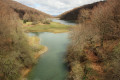
(10) Don't hesitate to step over the dam to contemplate the first lake and its superb blue/green waters. Continue along the second lake to the second dam.
(11) Cross it all the way back to the starting point (S/E).



 Visorando Member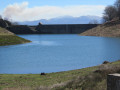
 Difficult
 Association / Club / Walk leader
 Easy
Easy