Country:

 City:
City:


The hike starts from the car park located just past the Larraitz Hermitage (407 m).
(S/E) Continue straight on from the car park. Shortly afterwards, follow the main path on the right.
(1) Then turn left across a field (the junction is not very obvious, just by an open fence), thus avoiding the rarely used shortcut at the bottom, which is overgrown with scrub. Join a track to follow on the left.
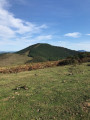
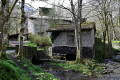
(2) Take the small path on the left at a transmitter (610 m). The route alternates between steep grassy slopes and wooded sections. A few tight hairpin bends allow you to gradually gain altitude. The section of the path overlooking the ravine is slightly exposed, on tricky grassy slopes: this section should be avoided in wet or foggy conditions. Proceed with caution; the path then turns into a pleasant balcony-like walk, passing a memorial cross erected in memory of a young man who died here in the 1980s. Reach the Muitze Waterfall (960 m). The path then enters a gap beneath the rocks. Turn right and climb a ridge leading to the Col d’Egurral (1157 m).
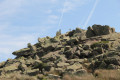
(3) After a short break, pass the Beltzulegi house on your right, nestled in a sinkhole surrounded by standing stones, in the heart of a sharp limestone pavement landscape. From this point, any clear trail disappears. To reach Ganboa, keep heading in the same direction and look for the easiest route through the rocks and vast, bright green pastures. Continue by skirting Auntzizegi along its northern slope. As you make your way across the limestone plateaus characteristic of the massif, you will eventually reach the summit of Arrubi (1,325 m).
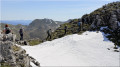
(4) Continue on to reach a wide grassy plateau. In places, you will need to cross large patches of snow. Leave Ganbotxiki on your right, then cross the rocky flank of Zealar (1,401 m). A final outcrop finally leads to the summit of Ganboa (1,413 m), the highest point of the hike and of the Aralar massif. The view is immense. Take advantage of the spot to have a break.
(5) Begin the descent, which is then sometimes a matter of judgement, down to Irazustako lepoa (1266 m).
(6) You then cross a stunning limestone massif: the karst terrain forms a chaotic landscape of sharp limestone pavements, sinkholes, blind valleys and a multitude of small peaks. Although the massif is well-trodden, the silence is absolute. The trail is sometimes broken, but the yellow and white markings remain regular and clearly visible. Continue north-west, then turn right to join the green and white marked path to Igaratza (SL-GI 2008). This leads across the Alotza meadows to the spring of the same name. Beyond this plateau, rejoin the standard ascent route to Txindoki on the right (still marked in yellow and white). Walk once more through grassy areas and sharp limestone pavements before reaching Zirigarte Hill (950m).
(7) A fairly steep descent follows, marked by a fountain. Further on, walk alongside a forest and then across pastures. Continuing straight ahead, the standard route gradually widens and levels out until you reach the end. Arrive at the junction from the outward journey.
(1) Continue straight ahead to the car park (S/E).
 Association / Club / Walk leader
 Moderate
 Visorando Member
 Easy
Easy