


Refine your search for walks in Plouaret
Plouaret walks


 From Plouaret to Lannion along the Léguer
 Visorando Member
 16.39 mi
 +994 ft
 -1,375 ft
 8h 25
8h 25
 Difficult
 Departure from Plouaret (Côtes-d'Armor)
The aim is to follow the course of the Saint-Éturien stream and then the Léguer river from Plouaret-Trégor station to Lannion station. Plan to return by train.
From Vieux-Marché to Sept-Saints
 9.29 mi
+656 ft
-653 ft
4h 50
9.29 mi
+656 ft
-653 ft
4h 50
 Moderate
Departure from Le Vieux-Marché (Côtes-d'Armor)
Moderate
Departure from Le Vieux-Marché (Côtes-d'Armor)
This walk, suitable for walkers of all ages, takes you through wooded, shaded areas along sunken paths as well as fields and meadows. It features three remarkable sites: the centuries-old beech tree, the Chapel of the Seven Saints and the Saint-Éturien stream, where the lucky ones may find amethyst crystals.
To the west of Vieux-Marché
 8.30 mi
+846 ft
-837 ft
4h 35
Moderate
Departure from Le Vieux-Marché (Côtes-d'Armor)
8.30 mi
+846 ft
-837 ft
4h 35
Moderate
Departure from Le Vieux-Marché (Côtes-d'Armor)
The Trégor region boasts a rich religious heritage. This walk allows you to discover several examples, which, whilst not exceptional, are classic in their beauty and aesthetic appeal.
This walk also allows you to enjoy the lush countryside and the Breton bocage.
Moments of tranquillity and exertion are always welcome in this mild climate.
Les Sept-Saints and the Léguer Valley
 7.62 mi
+643 ft
-656 ft
4h 05
Moderate
Departure from Le Vieux-Marché (Côtes-d'Armor)
7.62 mi
+643 ft
-656 ft
4h 05
Moderate
Departure from Le Vieux-Marché (Côtes-d'Armor)
Forest paths and sunken lanes lead walkers along the "Sentier des Améthystes" (Amethyst Trail) alongside the Léguer and then the Saint-Éturien stream, before arriving at a centuries-old beech tree.
The walk starts and ends at the Chapelle des Sept-Saints: a place of great significance for the friendship between Islam and Christianity.
Pluzunet – Le Danot
6.36 mi
+482 ft
-479 ft
3h 20
Moderate
Departure from Pluzunet (Côtes-d'Armor)
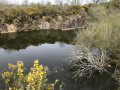
In the green Trégor region, a walk through wooded countryside with a brief visit to the Léguer before discovering the rolling landscape of the foothills of the ancient Montagnes Noires.
The Léguer on the outskirts of Le Danot
 7.12 mi
+682 ft
-699 ft
3h 50
Moderate
Departure from Pluzunet (Côtes-d'Armor)
7.12 mi
+682 ft
-699 ft
3h 50
Moderate
Departure from Pluzunet (Côtes-d'Armor)
A walk through the Trégor forest, where you’ll follow the Léguer coastal river, as well as passing chapels and cave dwellings.
Option to take a shortcut, reducing the distance to 8 km; classified as ‘Easy’.
Tonquédec Forest
3.10 mi
+213 ft
-180 ft
1h 35
Moderate
Departure from Tonquédec (Côtes-d'Armor)
A refreshing walk through the woods and along the Léguer.
Rosanbo Castle
7.46 mi
+449 ft
-423 ft
3h 50
Moderate
Departure from Tréduder (Côtes-d'Armor)
Winding through the Trégor countryside, this route will take you past the most imposing castle in Brittany. Built between the 14th and 18th centuries, it has belonged to the same family for several generations. It is furnished with period pieces and open to the public.
Tonquédec Castle and Kerfons Chapel
 4.90 mi
+643 ft
-633 ft
2h 50
4.90 mi
+643 ft
-633 ft
2h 50
 Easy
Departure from Tonquédec (Côtes-d'Armor)
Easy
Departure from Tonquédec (Côtes-d'Armor)
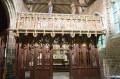
Two historic sites along this walk: Tonquédec Castle with its walls and restoration work, and the magnificent little Chapel of Kerfons. All this is complemented by a relaxing stroll along the Léguer.
Walk around the Moulin Neuf Pond (Vilin Nevez)
 1.88 mi
+10 ft
-7 ft
0h 50
Easy
Departure from Plounérin (Côtes-d'Armor)
1.88 mi
+10 ft
-7 ft
0h 50
Easy
Departure from Plounérin (Côtes-d'Armor)
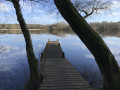
A short walk along the Étang du Moulin Neuf, with opportunities to spot birds and, if you’re lucky, otters.
The Trégor countryside in Pluzunet
 7.40 mi
+197 ft
-200 ft
3h 35
Moderate
Departure from Pluzunet (Côtes-d'Armor)
7.40 mi
+197 ft
-200 ft
3h 35
Moderate
Departure from Pluzunet (Côtes-d'Armor)
The Trégor countryside, always rich in peaceful scenery, is at its best during this walk, which presents no difficulty.
Tréduder and its streams
 6.15 mi
+673 ft
-643 ft
3h 25
Moderate
Departure from Tréduder (Côtes-d'Armor)
6.15 mi
+673 ft
-643 ft
3h 25
Moderate
Departure from Tréduder (Côtes-d'Armor)
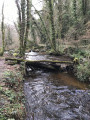
The commune of Tréduder is bounded by three streams: to the west, the Roscoat; to the south, the Dour Plat, which flows into the Yar, marking the commune’s eastern boundary. This walk takes you along these streams, but numerous small streams feed into them, making certain sections very wet in spring.
Tour of the paper mill valley in Plounévez-Moëdec
 4.33 mi
+466 ft
-456 ft
2h 25
Easy
Departure from Plounévez-Moëdec (Côtes-d'Armor)
4.33 mi
+466 ft
-456 ft
2h 25
Easy
Departure from Plounévez-Moëdec (Côtes-d'Armor)
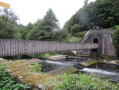
The tour of the paper mill valley is a short hike through the forest that runs alongside the Léguer river and passes by the ruins of an old factory and a dam.
To the east of Tonquédec
 7.15 mi
+236 ft
-236 ft
3h 30
Moderate
Departure from Tonquédec (Côtes-d'Armor)
7.15 mi
+236 ft
-236 ft
3h 30
Moderate
Departure from Tonquédec (Côtes-d'Armor)
We are not inviting you to hike towards Tonquédec Castle, which was dismantled around 1626 on the orders of Richelieu and is situated to the north-west of the village of the same name, but rather to the south-east of this village. There we will find the Guindy, a river dear to the people of Trégor, as well as green sunken paths in lush countryside.
From Tonquédec to the castle ruins via the Léguer
7.26 mi
+371 ft
-381 ft
3h 40
Moderate
Departure from Tonquédec (Côtes-d'Armor)
There is virtually no elevation gain on this walk in the Trégor forest. Just magnificent scenery, starting with paths through chestnut trees, then a walk along the banks of the Léguer, ending with a visit to the imposing ruins of Tonquédec Castle. At the end of the walk, don't forget to visit the village church.
Castles and chapels in the Trégor
7.14 mi
+587 ft
-617 ft
3h 50
Moderate
Departure from Tonquédec (Côtes-d'Armor)
The chapels of Kerrivoalan and Saint-Gildas on the one hand; but also Kergrist Castle (a private residence open to visitors only in summer) and, of course, the ruins of Tonquédec Castle and its oratory on the other; and finally the mills at Traoumorvan, Kergrist and Kergrot bear witness, throughout this route, to a Brittany that was once warlike, devout and agricultural, but has now become a tourist destination.
In the forest of Coat an Noz
 9.21 mi
+745 ft
-738 ft
4h 55
Moderate
Departure from Belle-Isle-en-Terre (Côtes-d'Armor)
9.21 mi
+745 ft
-738 ft
4h 55
Moderate
Departure from Belle-Isle-en-Terre (Côtes-d'Armor)
To the south of Belle-Île-en-Terre, a forest hides many secrets. It comprises two parts separated by the Léguer river: to the east, the Coat an Hay State Forest (Le Bois du Jour) and to the west, the Coat an Noz State Forest (Le Bois de la Nuit). In the latter, with a 19th-century castle undergoing restoration and a former ironworks site (lead mine), the route follows wide paths that are sometimes poorly lit by daylight.
Reach the heights of Saint-Michel-en-Grève to admire the bay.
6.89 mi
+751 ft
-755 ft
3h 50
Moderate
Departure from Saint-Michel-en-Grève (Côtes-d'Armor)
The Bay of Saint-Michel-en-Grève is one of the most beautiful in Trégor, despite the major cleaning problems caused by the presence of green algae. At low tide, the sea recedes so far that it is barely visible. At high tide, the waves break on the coastal road.
Circular route from Saint-Michel-en-Grève to Locquémeau
7.80 mi
+574 ft
-564 ft
4h 05
Moderate
Departure from Trédrez-Locquémeau (Côtes-d'Armor)
This circular route starting from Toul ar Villin will take you to the Port of Locquémeau and Pointe de Séhar via rural paths in the bocage countryside around Trédrez-Locquémeau. Take the time to stroll around the harbour and walk around Pointe de Séhar. If the tide allows, venture onto the sharp rocks and climb up to the place known as "Le Château". The return journey is via the GR® 34 coastal path, passing through Beg an Evned, the cliffs of Trédrez and Beg ar Forn.
There are no particular difficulties on this excursion between land and sea, except for the hilly terrain of the coastline.
La Forêt de Coat an Noz à partir de Loc-Envel
 7.25 mi
+732 ft
-732 ft
4h 00
Moderate
Departure from Loc-Envel (Côtes-d'Armor)
7.25 mi
+732 ft
-732 ft
4h 00
Moderate
Departure from Loc-Envel (Côtes-d'Armor)
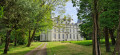
The Breton heritage is rich in monuments and landscapes. This walk in the forest, which, when linked to another circuit, allows you to discover part of this rich heritage, includes old ironworks, manor houses, a castle and chapels.
Countryside and coastal path around Trédrez
 3.21 mi
+351 ft
-351 ft
1h 45
Moderate
Departure from Trédrez-Locquémeau (Côtes-d'Armor)
3.21 mi
+351 ft
-351 ft
1h 45
Moderate
Departure from Trédrez-Locquémeau (Côtes-d'Armor)
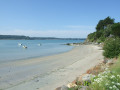
From the small village of Trédrez, where the memory of Saint-Yves still lingers, shaded paths lead to the GR®34 near Saint-Michel-en-Grève. The route then follows a section of the Trédrez Cliffs route before, after a fairly steep climb, joining a small country road and arriving opposite the imposing Church of Notre-Dame-de-Trédrez.
The Cliffs of Trédrez
 6.21 mi
+541 ft
-541 ft
3h 20
Moderate
Departure from Trédrez-Locquémeau (Côtes-d'Armor)
6.21 mi
+541 ft
-541 ft
3h 20
Moderate
Departure from Trédrez-Locquémeau (Côtes-d'Armor)
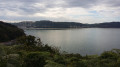
A very beautiful hike along the cliffs of Trédrez-Locquémeau with varied landscapes (moors, cliffs, hedgerows and reed beds) and magnificent views of Grève Saint-Michel.
Around Guerlesquin
 10.74 mi
+781 ft
-774 ft
5h 35
Moderate
Departure from Guerlesquin (Finistère)
10.74 mi
+781 ft
-774 ft
5h 35
Moderate
Departure from Guerlesquin (Finistère)
Guerlesquin, a small town full of character, was known in the 11th century for its fairs. From the 17th century, beautiful buildings remain in the town centre: the Présidial, the Market Halls and the Church. The town is close to the Étang du Guic, where two fine sandy beaches await walkers.After walking around the lake, we explore the nearby forest, moving in turn from Finistère into Côtes-d’Armor before returning to Finistère. Indeed, it is the river ‘Le Guic’ that forms the departmental boundary.