Refine your search for walks in Place du Maréchal Juin
Place du Maréchal Juin walks


 Les Grandes Carrières, Les Épinettes and Les Batignolles
 Visorando Member
 4.64 mi
 +7 ft
+7 ft
 -62 ft
 2h 10
2h 10
 Easy
Easy
 Departure from Paris
A journey through the northern districts of Paris in a new light, with the old Petite Ceinture railway line as a common thread. The many flower-filled passages, squares and gardens allow us to forget the hustle and bustle of the capital for a while.
From Île de la Cité to Porte de Courcelles
 5.46 mi
+43 ft
-39 ft
2h 35
Easy
Departure from Paris
5.46 mi
+43 ft
-39 ft
2h 35
Easy
Departure from Paris
From the heart to the outskirts of the capital, an urban route that starts at the Pont Neuf (the oldest bridge in Paris), the Cour Carrée and the Louvre Pyramid, and the Tuileries Garden. We then reach the luxurious Opéra district. Finally, we cross Haussmannian Paris, with a few twists and turns in Parc Monceau along the way.
The Péreire walk and the Dauphine district
 2.95 mi
+75 ft
-10 ft
1h 25
Easy
Departure from Paris
2.95 mi
+75 ft
-10 ft
1h 25
Easy
Departure from Paris
A short walk in the western districts of Paris. After the flower-filled Promenade Péreire, you walk along or cross a few wide avenues offering a beautiful view of the Arc de Triomphe de l'Étoile.
The Petite Ceinture in Paris
 36.37 mi
+863 ft
-863 ft
10 days
Easy
Departure from Paris
36.37 mi
+863 ft
-863 ft
10 days
Easy
Departure from Paris
A tour of Paris following the route of the former Petite Ceinture railway line! A highly varied itinerary, reflecting the diversity of the arrondissements it passes through, which focuses on the converted sections of the old railway line, squares and gardens, and the narrow streets and passageways away from traffic.
Green spaces in the west of Paris’s 17th arrondissement
 6.52 mi
+49 ft
-36 ft
3h 05
6.52 mi
+49 ft
-36 ft
3h 05
 Moderate
Departure from Paris
Moderate
Departure from Paris
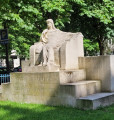
The 17th arrondissement of Paris is distinguished by its great urban and social diversity. The western part of the arrondissement is more residential and middle-class than the east, with the Ternes and Monceau neighbourhoods. It is characterised by varied architecture ranging from Haussmann-style buildings to contemporary blocks. Well-served by public transport, it combines Parisian traditions with modernity. The western part of the arrondissement offers two long walks and around twenty green spaces, including picturesque gardens such as the Square Saint-Odile and the undulating Jardin Claire Motte.
Walks near Place du Maréchal Juin
A cosmopolitan stroll through the Plaine Monceau
 Association / Club / Walk leader
 1.17 mi
+20 ft
-13 ft
0h 35
Easy
Departure from Paris
1.17 mi
+20 ft
-13 ft
0h 35
Easy
Departure from Paris
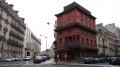
A journey through space and time, taking you past the many 19th-century mansions of the Plaine Monceau. Within a short distance, you will discover: a church, Russian restaurants, a Chinese pagoda, and a late 18th-century park featuring a pyramid, an Italian-style bridge and replicas of Roman antiquities.
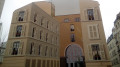
The trompe l'oeil of Levallois-Perret
 3.49 mi
+7 ft
-16 ft
1h 35
Easy
Departure from Levallois-Perret (Hauts-de-Seine)
3.49 mi
+7 ft
-16 ft
1h 35
Easy
Departure from Levallois-Perret (Hauts-de-Seine)
The streets of Levallois-Perret are decorated with a large number of trompe-l'oeil paintings and murals. This urban trail takes you on a tour of around thirty of them, as you stroll through the city's grid-like streets and cross some of its public gardens.
The wildlife of Monceau and Faubourg Saint-Honoré
 4.03 mi
+72 ft
-75 ft
1h 55
Easy
Departure from Paris
4.03 mi
+72 ft
-75 ft
1h 55
Easy
Departure from Paris
An approximate north-south crossing of the 17th and 8th arrondissements of Paris in search of animal representations. The architectural styles evolve throughout the route. The crossing of Parc Monceau offers a slice of greenery.
Paris Walk No. 1
 3.65 mi
+75 ft
-10 ft
1h 45
Easy
Departure from Paris
3.65 mi
+75 ft
-10 ft
1h 45
Easy
Departure from Paris
The start of a grand tour of Paris in several short stages, taking in the narrow streets without missing out on the monuments. Here is route No. 1 from Porte Maillot to Place Clichy.
The route takes you through the capital’s ‘upmarket neighbourhoods’, the 16th arrondissement, the Arc de Triomphe (which you can visit), then the famous Parc de Monceau, an Orthodox church and, finally, Place Clichy.
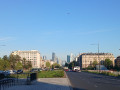
From Porte Maillot to Saint-Nom-la-Bretèche following the GR®1
 18.84 mi
+1,319 ft
-988 ft
8 hrs
18.84 mi
+1,319 ft
-988 ft
8 hrs
 Very difficult
Departure from Paris
Very difficult
Departure from Paris
TheGR®1is a long-distance hiking trail stretching over five hundred kilometres that circles the Île-de-France region. This section is the first part of it. Thirty kilometres long, it passes through numerous parks and forests such as the Parc de Saint-Cloud, the Bois de Boulogne and the Forêt de Marly. It also passes close to some remarkable monuments and several charming spots, such as the village of Marnes-la-Coquette.
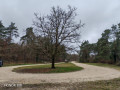
GR®1: Tour of Île-de-France
 363.31 mi
+17,464 ft
-17,103 ft
21 days
Very difficult
Departure from Paris
363.31 mi
+17,464 ft
-17,103 ft
21 days
Very difficult
Departure from Paris
Over 500 km long and with more than 4,000 m of elevation gain, this hike is accessible to everyone if broken down into several stages. Beautiful, rural and fairly close to Paris, it is suitable for anyone who wants to try their hand at hiking. There are many points of interest along this route. History and heritage enthusiasts, as well as nature lovers, will find something to enjoy.
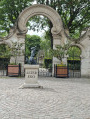
Parks and cemeteries in the Hauts-de-Seine: art, anarchism and feminism
 5.27 mi
+13 ft
-20 ft
2h 25
Easy
Departure from Paris
5.27 mi
+13 ft
-20 ft
2h 25
Easy
Departure from Paris
This walk takes us in the footsteps of famous men and women, through the cemeteries of Clichy, Asnières and Levallois. The route is flat and is covered at a moderate pace to allow time to locate the graves, which can sometimes be difficult to find.
Discovery tour of Haussmann's Paris
 2.15 mi
+13 ft
-46 ft
1h 00
Easy
Departure from Paris
2.15 mi
+13 ft
-46 ft
1h 00
Easy
Departure from Paris
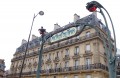
Baron Haussmann transformed Paris between 1852 and 1870. The 9th arrondissement of Paris is at the heart of this transformation: the new thoroughfares, grand boulevards and square-shaped junctions showcase buildings suited to life under the Second Empire: department stores, the Opéra, theatres, music halls, churches, press offices, banks, covered arcades, Morris columns, kiosks, etc. This tour will introduce you to the remnants of that era and how they have adapted to modern-day Paris.
Tours and detours in the Champs-Elysées and Tuileries gardens
 3.27 mi
+26 ft
-16 ft
1h 30
Easy
Departure from Paris
3.27 mi
+26 ft
-16 ft
1h 30
Easy
Departure from Paris
This walk allows you to stroll through the gardens that have been laid out in the heart of Paris and enjoy a relative calm that is hard to imagine so close to busy thoroughfares. Along the way, you will discover views of the Champs-Élysées and the Pont Alexandre III, some of Paris's most famous monuments and museums, and a rich and diverse collection of statues.