


 Country:

 City:
City:


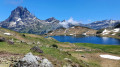
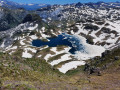
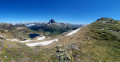
From Laruns, head towards Spain via the Col du Pourtalet. After the hamlet of Gabas (commune of Laruns), at a hairpin bend with a small car park on the left, turn right towards Lac de Bious-Artigues (road closed in winter, which explains the presence of the "No Vehicles" sign, which can be confusing).
There are two car parks available. The first is on the edge of Lac de Bious-Artigues and the other is a little further down before you reach the lake.
Leave early, otherwise you will have to park in the "lower" car park, which means an extra thirty minutes' walk.
(S/E) From the car park (altitude 1304), head to the foot of the dam at the western end of Lac de Bious-Artigues, taking a section ofthe GR®10andGR®108trails, then one of the many footpaths.
Continue for a few dozen metres and follow the traffic on the arch dam itself (not visible from the car park).
Continue along the path that goes around the lake in an anti-clockwise direction.
(1) At the fork, take the path on the right, which climbs rapidly into the forest along the Ruisseau d'Arec d'Aas stream. This is where the Vallon d'Aas de Bielle valley begins.
It is sometimes described as a hidden valley or secret valley, in contrast to the classic, highly frequented Ayous lakes route.
The trail encounters several side forks at an elevation of 1,491 metres; continue straight ahead.
The trail climbs a little over 200 metres before leaving the shaded part of the valley.
The landscape changes completely. The view is wide open as you approach the first hut in the Vallon d'Aas.
On the right are the south-facing slopes of Soum d'Aas (2427 metres), which are quite arid with low vegetation and stony ground. On the left below is the bottom of the valley, with Arrec d'Aas and a metal cuyalas (enclosure) for keeping sheep at night.
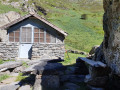
(2) A short stop at the Vallon d'Aas pastoral hut allows for a mini-break (about 1 hour after departure).
Continue straight ahead uphill. The path continues to climb steeply.
At an altitude of 1,825 metres, cross the main stream of the Arrec d'Aas for the first time.
(On the other bank, you can leave the trail and approach the next ravine, which is not recommended to cross here).
Follow the stream to reach the second crossing, here near a secondary tributary of the main stream, at 1930 m.
The ruins of a metal cuyalas show the force of the snow slides in winter.
From there, the path, which generally followed a west-southwest direction, turns southwest, running under the north-south ridge starting from Soum d'Aas and joining Pic d'Ayous.
Reach the Col d'Aas de Bielle (elevation 2098 m).
(3) The pass provides a route forthe GR® 10 from the Chemin de la Mâture and La Baigt de Saint-Cours in the Upper Aspe Valley to Lac de Bious-Artigues in the Upper Ossau Valley.
The ridge leading to Pic d'Ayous is only accessible by climbing.
Descend to the south-west towards Baigt de Saint-Cours, taking a fairly modest but well-marked path with a 50 m drop.
The path then climbs between rocky outcrops in a small valley (still snow-covered at the end of May 2022 but perfectly passable without equipment).
At an altitude of 2,212 metres, you will reach the small pass between Col d'Ayous and Pic d'Ayous (also still covered in persistent snow at the end of May 2022, but perfectly passable without equipment, except for a pair of walking sticks as both sides are exposed).
(4) Take the ridge due east to reach Pic d'Ayous (elevation 2288).
(You can easily walk along the ridge to the north to elevation 2264, overlooking the Col d'Aas de Bielle, which you passed earlier).
After spending the necessary time at the summit (see paragraph "During the hike or nearby" below), turn back to the small pass you have already passed.
(4) Continue straight ahead, descending and staying on the ridge, heading south-west. Reach the Col d'Ayous at an altitude of 2188 metres.
(6) A marker post marks the pass, as well as theGR®10trail markers, which pass through here (to the right towards Chemin de la Mâture, to the left towards the Ayous Lakes).
Continue straight ahead, slightly below and to the left of the ridge, still heading southwest, then quickly turn south.
Follow the gentle ridge line.
400 m after the pass, you will come to a rocky outcrop on the ridge.
(7) Do not cross it, but descend to the right into a small hanging valley, on a narrow, unexposed path.
Once at the bottom of the valley, look for the best route, depending on the presence of late snow, to climb up on the left onto the ridge leading to Pic de Larry at an altitude of 2,337 metres (the destination of the hike).
There are no exposed passages, as the ridge is well rounded.
(8) Turn back for the descent until you reach the Col d'Ayous ridge at the rock mass.
As soon as possible, turn right into the basin below the Col d'Ayous.
Depending on the season, cross a small snowfield or a network of small meltwater streams (at the end of summer, everything is dry).
Join theGR®10, which descends towards Lac Gentau. Further down, you will come to a fork in the path that you must not miss.
(9) TheGR®10continues along the slightly descending contour line. Leave the southbound trail, which descends much more steeply towards the refuge.
After a few hairpin bends, you will reach Lac Gentau at an altitude of 1,947 metres and a very obvious fork in the path.
(10) Turn left onto theGR®10, where the red and white markings resume. Leave Lac du Miey on your right. Descend the Cascade du Miey passage until you reach Lac Roumassot and the pastoral hut at 1,850 metres.
(11) Continue on theGR®10until you reach the Col Long d'Ayous clearing. Instead of continuing on theGR®10, leave the trail on the left and head towards the (main) Cabane du Col Long d'Ayous at 1,698 m.
(12) Continue down the valley towards the forest.
Enter the forest. Pass the spring at 1,650 m on your left.
Continue on a gentle descent through the forest for just over a kilometre and 240 m of elevation loss.
Reach the first crossroads with a track around the lake and continue to the left. Reach a second crossroads with the main track around Lake Bious-Artigues.
(13) Turn left to walk around the lake in a clockwise direction. Return to the crossroads at the lake shore.
(1) Continue straight ahead in the opposite direction to the outward journey, cross the dam and then return to the car park (S/E).


 Visorando Member
 Moderate
 Very difficult
  Tourist office

 Easy
Easy 
