Pic d'Arriel via the north-west route and Petit Pic d'Arriel loop

This loop in the Ossau Valley offers a wide variety of peaks, lakes, rivers, waterfalls, aerial passages and remarkable 360° views. It is a challenging hike due to its significant elevation gain and passages where you will need to use your hands, but it is sure to leave a lasting impression.
You will be following in the footsteps of Henry Russel, who made the ascent in July 1874 and gave a faithful account of it in the Bulletin de la Société Ramond, under the title "Explorations pyrénéennes" in October 1874.
Writing a description of it yourself requires a certain amount of humility, as his style, always generous, often lyrical and sometimes emphatic, commands respect! All this with the limited technical means of the time!

Details

41417628
Creation:
Last update:
Last review:
  • Walking
    Activity: Walking
  • ↔
    Distance: 13.36 km
  • ◔
    Average duration: 7h 55 
  • ▲
    Difficulty: Difficult

  • ⚐
    Back to start: Yes
  • ↗
    Ascent: + 1,449 m
  • ↘
    Descent: - 1,451 m

  • ▲
    Highest point: 2,802 m
  • ▼
    Lowest point: 1,400 m

Photos

Description of the walk

After Laruns, take the D934 leading to the Col du Portalet and, shortly after Lac de Fabrèges, park at Caillou de Soques (1,400 m), next to a hut.

(S/E) Take the HRP (Haute Route Pyrénéenne) to the northeast, which climbs quite steeply through the forest.

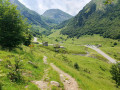
(1) At the edge of the forest, cross the Ruisseau d'Arrious stream on a footbridge (1,560 m) and follow the very wide HRP, which runs alongside the stream, to reach the Cabane d'Arrious.

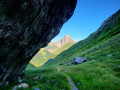
(2) Continue and shortly afterwards pass the Quèbe d'Arrious (1885 m) with its hut. The hut is built against a huge erratic rock, forming a shelter for animals, while the hut itself is a shelter reserved for shepherds.

(3) Stay on the main path, which winds tightly, and arrive at a fork (2068 m).

(4) Continue straight ahead and you will eventually reach the Col d'Arrious (2,252 m).

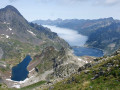
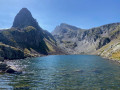
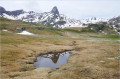
(5) Immediately turn right and reach the shores of Lac d'Arrious (2,283 m), just at its outlet into the Ruisseau d'Arrious. Straight ahead on the left, you can admire this strange isolated mountain overlooking the lake, the Pic du Lac d'Arrious (2,495 m). Further away, the two peaks of Arriel stand out above the scree slope.
Leave the lake on your left and head up the grassy mountain ridge that rises to 2,320 m. Then follow the path that continues to climb away from the lake. On the other side, you can clearly see the path that leads to the vertiginous Passage d'Orteig. Walk through the entire Vallon de Sobe, staying slightly higher up on the right bank, on a well-marked trail. You will reach a fork, which you will also take on the way back.

(6) Continue straight ahead, heading south. You will reach the Col de Sobe (2,449 m), on the border with Spain. South of the pass is the Barranco de Soba valley, which allows the Spanish (who are very numerous) to climb up to Arriel. Head for the Collado de la Soba or Alouste viewpoint at 2,444 m for a photo break and a snack.

(7) Follow the southern ridge of the pass to the Petit Pic d'Arriel. Leave the Petit Pic on your left and head for the Col d'Arriel.
You can leave any unnecessary items for the summit of Arriel in a crevice on the pass viewpoint, near a memorial stone.

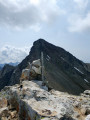
(8) This marks the start of a fairly long and enjoyable climb where you need to find your way while staying as close as possible to the ridge, surrounded by more cairns than you could ever need. Reach the summit of Pic d'Arriel (2,824 m) after crossing a passage known as "les Pas Japonais" (the Japanese Steps), consisting of flat rocks well aligned on the surface, but quite narrow and a little exposed on both sides. It took me 4½ hours from the start.

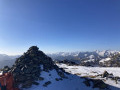
(9) From there, there is a magnificent 360° view (see "Sights to see"). There are two relatively well-made bivouac areas and a large cairn at the summit.
After spending the necessary time up there to rest, eat and take photos, you have to return by the same route to the Col d'Arriel.

(8) Then head north-west, climbing towards the Petit Pic d'Arriel. Stay on the left of the ridge line, on the Spanish side. Reach the Petit Pic d'Arriel (2,683 m) and its cairn at the summit.

(10) There is a beautiful view of the Pic d'Arriel and, with the necessary distance, of the Crête du Palas and its picoulets, passing by the Col d'Arrémoulit, the Col du Palas and the Pic Von Martin (2,785 m).
Leave the summit via the north-west face and enter France, descending a reasonable slope without any clearly marked path. Reach the ridge overlooking the lakes of Artouste and Arrémoulit and continue west, descending towards the Vallon de Sobe, avoiding the rocky outcrops. Reach the fork in the Vallon de Sobe valley.

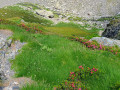
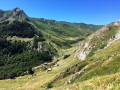
(6) Continue straight ahead to descend into the bottom of the valley and the scree covering the stream. You can sometimes hear the stream flowing between the boulders. Descend all the way to the bottom of the valley. Shortly before reaching the ridge overlooking the Vallon du Ruisseau d'Arrious and the waterfall seen on the way up, the trail turns westward into the rhododendrons. Cross the Ruisseau d'Arrious and reach the bottom of the valley, where you will find the fork in the trail from the way up.

(4) Then take the same path through the Vallon du Ruisseau d'Arrious until you reach the car park at the Cabane du Caillou de Soques (S/E).

Waypoints

  1. S/E : km 0 - alt. 1,417 m - Cabane du Caillou de Soques - Cabane de Caillou de Soques (1400 m)
  2. 1 : km 0.91 - alt. 1,568 m - Arrious Stream footbridge
  3. 2 : km 1.85 - alt. 1,745 m - Arrious hut
  4. 3 : km 2.57 - alt. 1,873 m - Quebe d'Arrious (1,885 m)
  5. 4 : km 3.36 - alt. 2,057 m - Crossroads at the bottom of the Vallon de Sobe
  6. 5 : km 4.53 - alt. 2,260 m - Col d'Arrious (2252m)
  7. 6 : km 5.71 - alt. 2,383 m - Crossroads of the Vallon de Sobe
  8. 7 : km 6.25 - alt. 2,445 m - Col de Sobe (2449m)
  9. 8 : km 7.08 - alt. 2,611 m - Col d'Arriel (2605m)
  10. 9 : km 7.49 - alt. 2,793 m - Pic d'Arriel - Pic d'Arriel (2824m)
  11. 10 : km 8.1 - alt. 2,646 m - Petit Pic d'Arriel (2683m)
  12. S/E : km 13.36 - alt. 1,417 m - Cabane de Caillou de Soques (1400 m)

Notes

The description is for a "summer" hike undertaken by two people at the end of June 2023. There is only one snowfield left on the route, between (7) and (8), but it can be avoided by taking the lower route. However, the summer of 2023 was particularly hot. Depending on the weather conditions during the hike, you may encounter snow before the Col de Sobe, in the northern gully of the Col de Sobe, between (6) and (7), and after the Col de Sobe between (7) and (8).
Even without signposts, or even without any path for more than half of the route, you can do this route with just a map; GPS or the Visorando app on your smartphone are particularly useful for the climb up to the Petit Pic d'Arriel and the descent on the north-west face.

Parking at the start
The starting point is at the Cabane du Caillou de Soques car park (S/E). The departmental road (D934) is in very good condition and, connecting with Spain via the Col du Pourtalet, is clear in both summer and winter.

Time indicated
I completed this route in 8 hours. This is a reasonable time, including photo stops and a snack break at the summit.
Compared to Henry Russel, who did it in 6 hours starting from Gabas (+400D+ and +9k), I am very, very slow!
However, allow between 7.5 and 9.5 hours.

Difficulty
This hike is classified as Very Difficult; most of the route is on marked trails, although they are not signposted. The main landmarks (passes, peaks, lakes) are visible from a distance. However, some sections are off-trail and unmarked, and the last few dozen metres before the summit of Arriel (9) are a little exposed with some fairly steep slopes (between (8) and (9) and between (8) and (6)).
You need to be fit for a 1,460 m elevation gain.
The IBP Index (automatic route difficulty rating system), a partner of the FFRandonnée, is 156 HKG, which corresponds to a Difficult route for a hiker with a high level of physical fitness.

Water
There are no drinking water points on the route.
Springs, lakes, rivers and runoff water are not guaranteed to be drinkable due to grazing livestock.
Bring 2 litres per person or a filter.

Shelter
There are no permanent shelters along the entire route! However, in the event of a heavy storm, you can take shelter under the rock shelter at Quebe d'Arrious (3): be careful not to confuse it with the much lower Cabanes d'Arrious in the valley!

Equipment
Bring the usual equipment for summer hiking in the high mountains, hiking boots, suitable clothing, rainwear, sunglasses, water, food, survival blanket, knife, compass, map, whistle, sunscreen, lip balm and walking stick(s) if necessary. A GPS or the Visorando app on your smartphone can complete your equipment to make the hike really safe.
Crampons may be useful in case of persistent snow between (6) and (8).
Add a helmet to protect yourself from falling rocks on the north-west face of Pic d'Arriel when someone is above you, both on the way up and on the way down, and a headlamp in case you have to return at night.

Frequency
In summer, the route is fairly busy from (S) to (5).
Beyond that and up to (7), you may encounter a few rare hikers.
Between (7) and (9), there may be quite a few Spanish hikers, as this summit is very popular.
Between (8) and (4), you generally won't encounter anyone.
The vast majority of this route is therefore in an area with little or no traffic.
Whatever the season, don't forget to tell your friends and family your exact route and let them know of any changes by text or phone.

Météo-France mountain bulletin
Check the weather forecast.

If you notice any errors in the signposting or place names on your route or on the map you are using, you can become a contributor and report them:
- signposting errors, safety issues, conflicts of use, environment, etc.: click here
- mapping errors, place names, etc.: click here

This route passes through a protected area, which may be subject to special regulations:

Worth a visit

Account by Henry Russel in 1871
Pic d'Arriel (2,823 m), 3 July 1871
This peak, also known as Soum de Seoube, rises to the south of Lake Artouste and to the south-west of Pic Pallas, from which it is separated by the Port d'Arrémoulit (2,455 m). Crossing Gabas, I took Camy, who is still walking quite bravely despite his age, and following the more or less passable road southwards for nine kilometres, which will no doubt one day reach the Spanish border, we left it fifteen minutes downstream from the Broussette hut to climb left (east) towards the Col d'Arrious. We first crossed a beautiful pine forest, turning back often to contemplate the reddish pyramid of the Pic d'Ossau to the west. Soon we emerged from the woods onto immense pastures full of flowers, vipers and excellent springs. Then, at an altitude of 1,900 metres (or thereabouts), we came to a colossal rock (editor's note: (3)) forming a good shelter, an hour downstream from the pass, still too far from Arrius, where we spent a very good night before the shepherds took possession of it: this is often desirable.

The next day, a good hour's climb (east) brought us to the Arrius pass (2,254 metres) (5), a grassy, hummocky ridge with a beautiful view of the Balaïtous, Pallas peak, Lake Artouste, etc. From here, you can also see two peaks to the south-south-east pointing parallel to the east, one behind the other, like the ears of a frightened horse: the southernmost of these two peaks is the true summit of the Pic d'Arriel.

Climb south for a few minutes: here is Lake Arrius, long and very narrow, with floating ice (3 July); a light breeze from the south blows them silently towards us, but they finally break with a crash on the shore. The water and air are a magnificent blue, completely unknown in the plains. There is passable shelter under a rock to the north of the lake, on the right bank of the stream that flows out of it.

Climbing up to the WSW on a rounded, grassy ridge, we descend on its western side into the valley that rises from north to south to the Sobe Pass, open to the west of Ariel Peak.
The slopes are gentle, with lots of snow. An hour from the Col d'Arrius brings us to the Col de Sobe (2,445 m) (7), from where the true summit of Ariel suddenly appears to the east; its western flank is all red, and the whole thing looks threatening, which the climb does not justify, as it is a peak that offers no difficulty from the north and west: the south and east are formidable. The view to the south from the Sobe Pass is very arid: from the top of the Pyrenees, Spain always looks like the Sahara.
We climb steeply eastwards towards a wide pass open to the left of the Pic d'Ariel, between it and the more modest summit to the north. In thirty minutes, we reach this pass (8), from where another half hour of climbing to the south, sometimes very rough but without any danger, brings us to the summit of the Pic d'Ariel (2823m) (9).
Total time from Gabas to the summit (not including stops) = 6 hours. However, you can shorten the trip by an hour by not going to the Col d'Arrius and climbing from north to south through the entire Sobe valley from (4) to (6), which opens up far to the west of the Arrius ridge: very easy.
To the east of Ariel Peak, frightening abysses open up, 800 to 900 metres deep, at the bottom of which sparkle the small Spanish lakes of the same name, and beyond which rise with superb majesty the devilish western ridges of the Balaïtous. In fog, this whole region is very dangerous.
Here are the points I have noted with the utmost care: a large peak to the west, about a dozen kilometres away (the Bisouri); another to the south-south-west (the Castello); the Bondellos group to the south-east; the Vignemale to the east-south-east; Bout de Sallent to the south; the Balaïtous, Pallas and the lakes of Arrémoulit and Artouste (see maps).
In short, Ariel Peak is a beautiful peak, accessible to almost all hikers, but its eastern region should be feared and avoided.

Bulletin of the Ramond Society: Pyrenean explorations
Author of the text: Henry Russel
Publisher: Ramond Society (Bagnères-de-Bigorre)
Date of publication: 1874

Panorama of the Pic d'Arriel
To the north-east, Pic Palas (2,974 m). To the west-north-west, Crête and Pic du Balaïtous (3,144 m). To the north-west, Lurien (2,826 m). To the west-north-west, Pic du Midi d'Ossau (2,884 m), the nearest French peaks.
On the Spanish side, to the south-east, Pico de la Forqueta (2,723 m) and Pico Llena Cantal (2,941 m); to the east-south-east, Pico Frondella Sud-Ouest (2,992 m) and Punda Alta deras Frondielas (3,071 m); to the east, Agula d'Ussel (3,022 m), to the west-southwest, Pico de Soba (2,627 m) and just above the Col de Sobe, Puenta dero Cuello (2,611 m).
Below, on the Spanish side, you can admire several lakes, Ibon de Arriel Alto to the east and, a little further away and smaller, Ibon Chelau. Ibon de Arriel Bajo is nearby to the south-east and even the large Embalse de Respomuso dam a little further away.

All these lakes can be reached by passing the Col d'Arrémoulit (2,448 m) or the Col du Palas (2,517 m), both on the border ridge. On the French side, there are several large lakes: Lac d'Artouste (dam, 1,984 m, which can be reached by the Petit Train d'Artouste), the Arrémoulit lakes (2,265 m; two main lakes, including a dam and numerous smaller lakes) and Lac de Palas (2,359 m). Next to the small Arrémoulit dam is the Arrémoulit refuge (2,305 m).

Shortly before the Col de Sobe (7)
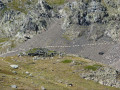
The last 200 m before reaching the pass are dotted with more or less deep sinkholes, which retain snow for a long time in the season, making the landscape quite astonishing.

Variation
On the way back. You can choose (present route) not to return by the same route as on the way there, making a loop without descending to the Col de Sobe and without reaching the Lac d'Arrious.
Or (Variation 1) take the same path as on the way there. Allow an extra 30-45 minutes.

Option 2
On the way up. From the Col d'Arrious (5), you can choose to take the famous and fun Passage d'Orteig, with chains. At around 2,365 m, turn off the trail towards the Pic du Lac d'Arrious (2,495 m) and climb its secondary peak at 2,483 m to the south, then choose to reach the Petit Pic d'Arriel before tackling the Pic d'Arriel, or head to the Vallon de Sobe (6).
This alternative route is described by Morti93 in his hike to the Petit Pic d'Arriel.

Reviews and comments

4.8 / 5
Based on 2 reviews

Reliability of the description
5 / 5
Ease of following the route
5 / 5
Route interest
4.5 / 5
MCTOUL
MCTOUL

Thank you, nathandelHM and User 22998359!
Kind regards

Machine-translated

User 22998359

Overall rating : 4.7 / 5

Date of your route : Nov 12, 2025
Reliability of the description : ★★★★★ Very good
Ease of following the route : ★★★★★ Very good
Route interest : ★★★★☆ Good
Very busy route : No

A two-day hike to enjoy the sunrise at Pic d'Arriel.
On paper, it seems fairly straightforward with no particularly exposed sections, apart from the last few metres before the summit.
The trails seem obvious, and even without a great sense of direction, it's easy to navigate (except for the final section).
The view from the summit is incredible and well worth the effort — unless the fog decides to spoil the party.
A very beautiful hike, ideal as preparation for higher or more technical peaks.
The times and distances indicated on the information sheet are generally accurate, although we were a little faster.
You don't need to be in Olympic shape, but it's best to be in good condition and have a little experience to avoid any unpleasant surprises.

Machine-translated

nathandelHM
nathandelHM

Overall rating : 5 / 5

Date of your route : Oct 13, 2024
Reliability of the description : ★★★★★ Very good
Ease of following the route : ★★★★★ Very good
Route interest : ★★★★★ Very good
Very busy route : No

An exceptionally beautiful route, taken when there was no snow yet.
You pass by Lake Artouste and can let yourself be guided by the magnificent view of Lakes Arremoulit and Arrious.
The trail starts shortly after Lac de Fabrèges in the Col du Pourtalet, which you will cross without any apparent difficulty.
After the lakes, you will face the scree slopes of the Pic d'Arriel and its steep ramps: the main difficulty of the day.
You will need to use your hands and preferably wear a helmet when this route is busy, as rockfalls can occur (I experienced this myself when a large rock passed right by me).
Finally, you will reach the peak, encountering a small exposed passage with a drop on either side, so don't be too afraid of heights.

Machine-translated

madydou
madydou ★

With pleasure!
Thank you for your contributions.

Machine-translated

MCTOUL
MCTOUL

Thank you, Madydou and Jean-Jacques Trouvé!

Machine-translated

Other walks in the area

For more walks, use our search engine .

The GPS track and description are the property of this route's author. Please do not copy them without permission.