Country:

 City:
City:


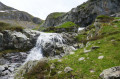
From Laruns, take the road leading to the Col du Pourtalet, which passes successively through Les Eaux Chaudes, Gabas and along Lake Fabrèges, before running alongside the beautiful glacial valley of the Gave du Brousset, dotted with cyclopean boulders deposited there by the glacier.
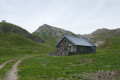
About one kilometre before the Col du Pourtalet, on the upper left side of the road, you will see a stone chalet with green shutters: this is the Cabane de l'Araille. On this side of the road, park in one of the many parking bays.
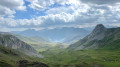
(S/E) Look west towards the vast Cirque d'Anéou depression and find the track that starts at a bend in the road (signs for the nature park and the Refuge de Pombie) and descends towards the river, which it first follows before crossing one of its tributaries. Continue west towards the beautiful buildings of the Pastoral Centre. Walking along the right-hand side of these buildings, you will come to a crossroads with a signpost pointing to the Col de Soum de Pombie on the right.
(1) Continue straight west, keeping some distance from the stream that descends on the left.
After skirting a hill on the right, you will come to a flat area with the Cabane de Lalagüe 300 m to your right.
(2) Leave this flat area on your right and continue straight ahead towards the west, on a gentle slope with the stream still on your left.
(3) When you reach the foot of a rocky area, go around it slightly to the right, leaving the best-defined path on your left, and climb westwards along a very faint path that runs alongside a stream whose bed was carpeted with buttercups when we passed by. Continue climbing until you come to a small lake (note that in summer it may be dry).
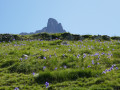
From the lake, you can see, on the right, a network of peat bogs that descend the gently sloping valley to the north, on the left the sugar loaf summit of the Pène de la Glère and far ahead a stream that cascades down from a cirque still covered in snow when we passed through. Continue towards this stream.
(4) Descend overlooking the stream, on a slope towards the north-east where small streams meander, draining a network of peat bogs. As the slope is gentle, these streams form pronounced meanders, known in the Alpes de Haute Provence as "eaux tortes" (such as the famous Eaux Tortes site in the Lavercq valley).
The stream on your left rushes into a gorge, towards which the peat bogs descend in steps. Head right along the southern flank of a rocky ridge and descend towards the point where the peat bogs converge.
(5) The streams draining the peat bogs merge to form a single stream that cascades northwards and disappears into a chasm. The path overlooks this chasm (be careful if you are accompanied by children!) and descends northwards into a wide, flat valley where numerous streams converge, notably the Ruisseau de la Glère.
When you reach the first large stream, turn right and follow it eastwards. You will see numerous peat bogs and a few small chasms and dissolution funnels. Be careful at this time of year (and even more so before), as these depressions are often filled with snow and it would be very unwise to walk on them, not knowing what holes they might be hiding!
Following the path that runs alongside the stream, overlooking it, you can see terraced peat bogs on its banks, and you will soon notice that the stream also disappears into a large sinkhole.
Continue eastwards to reach a rocky area, probably a glacial lock.
(6) Two options:
- Continue eastwards along the rocky path
- As shown on the map, descend to the left to bypass this barrier to the north via an easy path through grassy terrain.
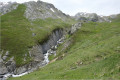
(7) After descending along the barrier through a pretty little valley dotted with peat bogs, you will hear a growing rumbling on the right. This is the stream emerging from its underground course in a beautiful resurgence gushing out of a cave. Climb up on the right to get a closer look and descend along the waterfalls on the left bank of the stream.
Then follow the path that runs more or less alongside the stream, still heading east. Take the opportunity to admire the gorges that it has carved into the subvertical limestone layers.
The trail joins the path coming from the Refuge de Pombie, not far from the Cabane de Houns de Gabès; it crosses the stream on a footbridge and joins an intersection already encountered on the way there.
(1) Turn left to retrace your steps and return to the road and car park (S/E).


 Visorando Member
 Difficult