Country:

 City:
City:


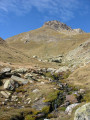
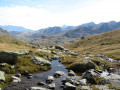
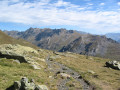
At Laruns, head towards the Col du Pourtalet (or Gabas, or Fabrèges). Pass through Gabas, then Lake Fabrèges, and continue along the Gave valley towards the pass. As you emerge from the gorges, continue for about 300 m until you find the entrance to the track on the right leading to the start of the paths for Pombie.
Park on the left-hand side of the road as you climb (plenty of parking bays).
(S/E) Take the track that descends to the right of the road towards the Cirque d’Anéou basin.
(1) Near the Gave de Brousset, a path on the right allows you to fords the stream. Take this path; a little further on, you’ll find a footbridge where a yellow sign points towards the Col de Soum de Pombie.
''If the water is too high, you can continue a little further along the track and take the path on the right (another yellow sign pointing to the Col de Soum de Pombie) after crossing the river via the next footbridge.
The path climbs to the right, first winding a few times, then fairly straight.
(2) You pass close to the Sénescau hut, around which sheep may be grazing; in this case, be careful not to approach them, or you may be chased away by the Patou dogs.
Continue climbing along the main path or one of its side trails. Soon the slope will become steeper, the ground rockier, and the path will follow more numerous and sharper hairpin bends.
(3) You arrive at the Col de Soum de Pombie, marked by a yellow sign and also because the path stops climbing and crosses a path coming from the left, on the southern flank of the Pic de Peyreget.
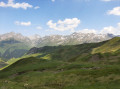
Continue straight on. The path, running along a ledge, tends to descend but is mostly level, offering fine views of the ridges towards Artouste and crossing numerous scree slopes and rocky outcrops.
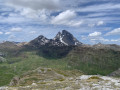
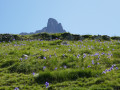
(4) You thus arrive effortlessly at the Refuge de Pombie. Go round it to the right to find the start of the path leading to the Col de Suzon, at the other end of the lake, and we return along the lake, skirting it to the left to take the Haute Randonnée Pyrénéenne trail (marked on a yellow sign ‘Col de Peyreget’), which climbs between the wall of the Pic d’Ossau on the right and the mass of the Pic de Peyreget on the left. The path first runs alongside the lake, then overlooks it as it crosses a rocky scree slope, before climbing towards the vast scree cone of Pic d’Ossau, and finally entering the gully that separates the two peaks.
The path is generally easy to walk on, with a surface ranging from sandy to stony, except on the scree and rocky sections, all the way to the Col de Peyreget.
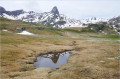
You pass alongside a pretty, elongated lake, then near another which lies on a ledge above the first. Seen from above, you can see that these two lakes are blocked by a rocky barrier.
(5) You reach the Col de Peyreget, marked by the highest point of our trail. The descent begins on a well-marked path, then through rocky terrain (watch your ankles!) before reaching a small lake halfway down.
(6) From this small lake, the path descends gently to Lac de Peyreget. Unlike the two lakes encountered on the ascent, these two lakes seen on the descent are blocked by an alluvial barrier (chaotic rock, scree and a layer of sand and silt).
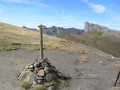
(7) Turning your back on Lac de Peyreget and looking south, you will find the path leading up to the Col de l'Iou; you cannot go wrong, as this path climbs towards the pass, skirting the mass of the Pic de Peyreget to the right. Soon, moreover, you will come across a large cairn perched on a rock.
(8) The Col de l'Iou is marked by a yellow sign. Continue along the path, which winds along a slightly descending ledge heading south-east.
You cross several small streams that spring from resurgences in the scree on your left. You can easily follow one of them to descend, keeping the Anéou basin in sight.
(9) We chose to descend along the stream crossed by the path in a trough (a right-hand bend in the path) just after a large scree slope. This is presumably the Ruisseau de Sénescau. The descent is straightforward, passing through a few small rocky outcrops and some peat bogs.
Caution: depending on the terrain, take care not to trip or slip. This descent offers a change from the trail as it allows you to observe bog vegetation and enjoy the cool air.
The stream becomes more confined in places, adding a pleasant variety to the descent.
(10) The stream crosses a track coming from the left. Take it to the right and you will soon pass the Cabane de Houns de Gabès. The track then turns left and crosses the bed of a mountain stream; a few hundred metres further on, it joins another track near a large farmstead: this is the Centre Pastoral d’Anéou.
(11) Turn left onto this new track.
(12) Cross the stream via a lovely footbridge and rejoin the original track, which takes you back to the road and the car park (S/E).


 Visorando Member
 Moderate